
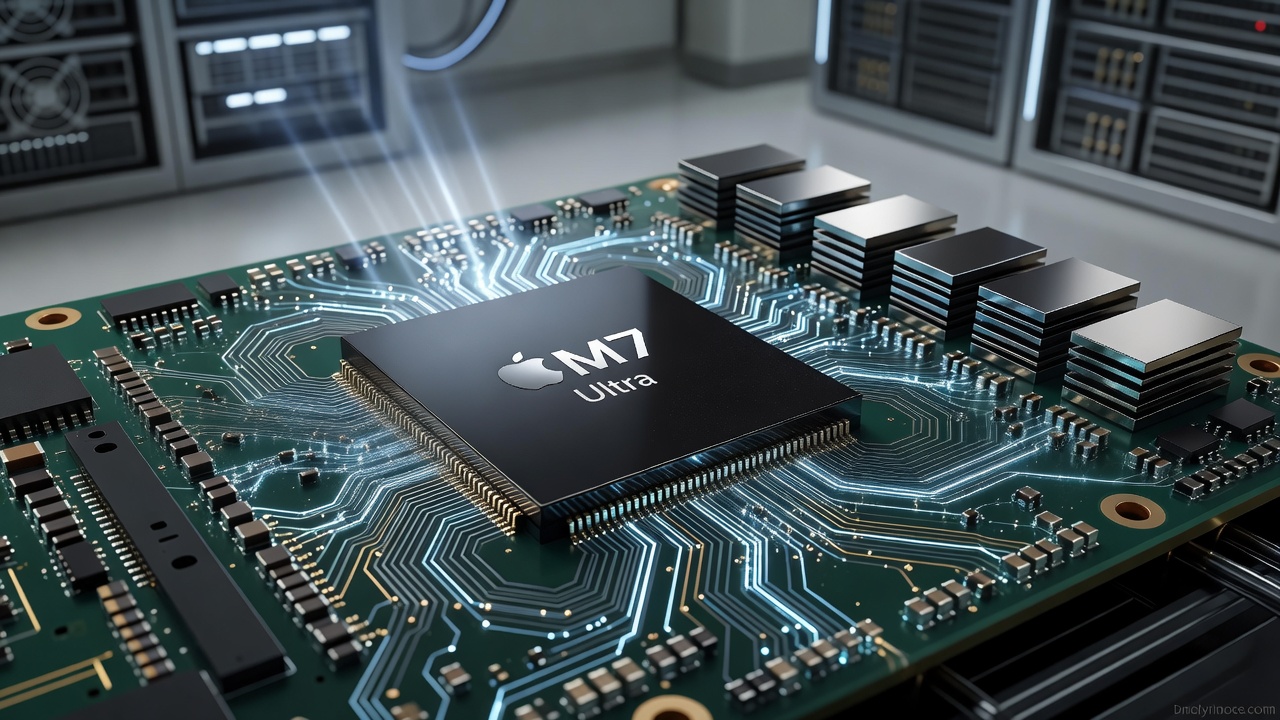
Apple has spent years perfecting its unified memory architecture. Now that approach faces its sternest test yet. According to a report from Bloomberg, the company is engineering an M7 Ultra chip capable of supporting up to 1.5 terabytes of unified memory. The target arrival? 2028. That’s not a modest evolution. It’s a direct play at workloads long dominated by specialized accelerators from Nvidia.
Mark Gurman broke the details in his Power On newsletter. He described how Apple has accelerated its M7 family development while skipping higher-end M6 variants entirely. The reason? Artificial intelligence now shapes every silicon decision. No longer an afterthought. No longer a secondary feature list item.
1.5 terabytes. Consider that figure. Current high-end Macs top out far lower. The upcoming M5 Ultra is expected to reach roughly half that capacity at best. This leap isn’t about running spreadsheets faster. It’s about loading and inferring on models measured in hundreds of billions or even trillions of parameters without constant swapping to storage or offloading to distant cloud clusters.
But raw capacity tells only part of the story. Apple’s chips have long paired high memory volumes with exceptional bandwidth thanks to their on-package design. The M2 Ultra already delivered 800 GB/s. Successors scaled further. If the M7 Ultra maintains or improves that ratio at 1.5TB scale, the system could deliver memory performance that makes discrete GPU setups look fragmented by comparison. Data moves between CPU, GPU and neural engine without PCIe bottlenecks. That’s the longstanding promise. Now it’s being stress-tested against the largest models yet.
Nvidia’s Blackwell architecture looms large here. The latest generation from the graphics giant brings massive tensor core counts, high-bandwidth memory stacks and a focus on trillion-parameter training and inference. Digital Trends noted the M7 Ultra appears engineered to bring Apple’s on-device and server-side AI performance closer to that level than any prior desktop-class processor. Not an exact match perhaps. Yet close enough to matter in specific inference scenarios where power efficiency and unified access provide an edge.
Power matters. Data centers filled with H100 and Blackwell GPUs consume enormous electricity. Apple’s silicon has demonstrated strong performance-per-watt in laptops and desktops. Extending that to servers could reshape costs for Apple Intelligence features. Gurman reported the company plans M5 Ultra-based AI servers first. M7 Ultra variants would follow around 2029. The timeline shows deliberate pacing. First prove the architecture at moderate scale. Then push the memory envelope.
Memory shortages complicate everything. High-density DRAM modules remain expensive and scarce. Apple might not ship every M7 Ultra configuration with the full 1.5TB out of the gate. Supply chains will dictate. Still, the mere capability signals serious intent. Previous Intel-based Mac Pros supported 1.5TB using traditional DIMMs. Apple abandoned that expandable approach for its own unified design years ago. This returns to similar total capacity but through a fundamentally different, tightly integrated method.
Analysts see broader implications. A 9to5Mac article from late June detailed the Mac Studio roadmap. An M5 Ultra refresh arrives later in 2026. The M7 Ultra update targets 2028 with potential thermal redesigns suited to sustained AI workloads. No major chassis changes expected for the M5 version. The later M7 model could bring meaningful cooling improvements to handle the increased power draw from larger memory subsystems and more aggressive neural engines.
Apple’s shift away from the traditional tick-tock cadence stands out. Normally the company releases base, Pro, Max and Ultra variants within each M-series generation. Not this time. MacRumors covered how the firm will launch a standard M6 chip soon but reserve the Pro, Max and Ultra tiers for the M7 family. That compression accelerates AI-focused features. It also creates an unusual market window where certain high-end Mac configurations might skip an entire generation.
Software readiness will decide success. Apple’s MLX framework has gained traction for machine learning on Macs. Core ML and Metal provide foundations. Yet Nvidia’s CUDA ecosystem remains the default for many researchers and enterprises. Apple must expand its developer tools to make the M7 Ultra attractive beyond its own walled garden. Local inference of massive models could appeal to creative professionals wary of cloud costs or data privacy rules. Enterprises might deploy M7-powered racks for specific inference tasks where latency and efficiency trump raw training throughput.
So what does 1.5TB actually enable? A 70-billion-parameter model at aggressive quantization might need only tens of gigabytes. Scale to a trillion-parameter mixture-of-experts architecture and requirements balloon toward hundreds of gigabytes or more. With headroom for activations, context windows and multiple models resident in memory simultaneously, the M7 Ultra could support workflows impossible on today’s consumer or even prosumer hardware. Real-time video generation. Complex scientific simulations. Multimodal reasoning at scale. All without leaving the device or rack.
Challenges remain. Thermal limits. Cost. Yield on such large memory packages. Competition from AMD, Intel and custom AI chips from hyperscalers. Nvidia itself continues rapid iteration. Blackwell successors are already in development. Yet Apple’s vertical integration gives it advantages in optimization. The same team designs the silicon, the operating system, the frameworks and the applications. That coherence proved decisive in the transition from Intel to Apple Silicon. It could prove decisive again in AI.
Recent discussions on X underscore the excitement and skepticism. One user noted that 1.5TB could cover even the largest local inference workloads currently requiring cluster access. Another highlighted potential bandwidth targets exceeding 2TB/s, positioning the chip as a legitimate alternative to single high-end Nvidia accelerators for certain tasks. These conversations reflect industry hunger for options beyond the current GPU shortage dynamics.
Gurman’s reporting also touched on M8 plans and touch-enabled MacBook Pro variants. The M7 Ultra focus, however, captures the strategic pivot most clearly. AI isn’t a feature. It’s the organizing principle. Every transistor allocation, every memory controller decision now bends toward neural network performance. The 1.5TB target represents the most visible manifestation of that philosophy to date.
Whether the M7 Ultra truly matches Blackwell in real-world AI benchmarks won’t be known for years. Early silicon tests, developer previews and eventual shipments will tell. For now the signal is unmistakable. Apple intends to compete at the highest levels of AI infrastructure, not merely participate. The memory specification makes that ambition concrete. And expensive. Very expensive.
Industry watchers will track memory pricing closely. They’ll monitor power consumption numbers once prototypes emerge. Most of all they’ll watch whether Apple’s software momentum can match its hardware boldness. The unified memory bet that powered the M1 revolution now scales to server-class proportions. The stakes have never been higher.


 WebProNews is an iEntry Publication