
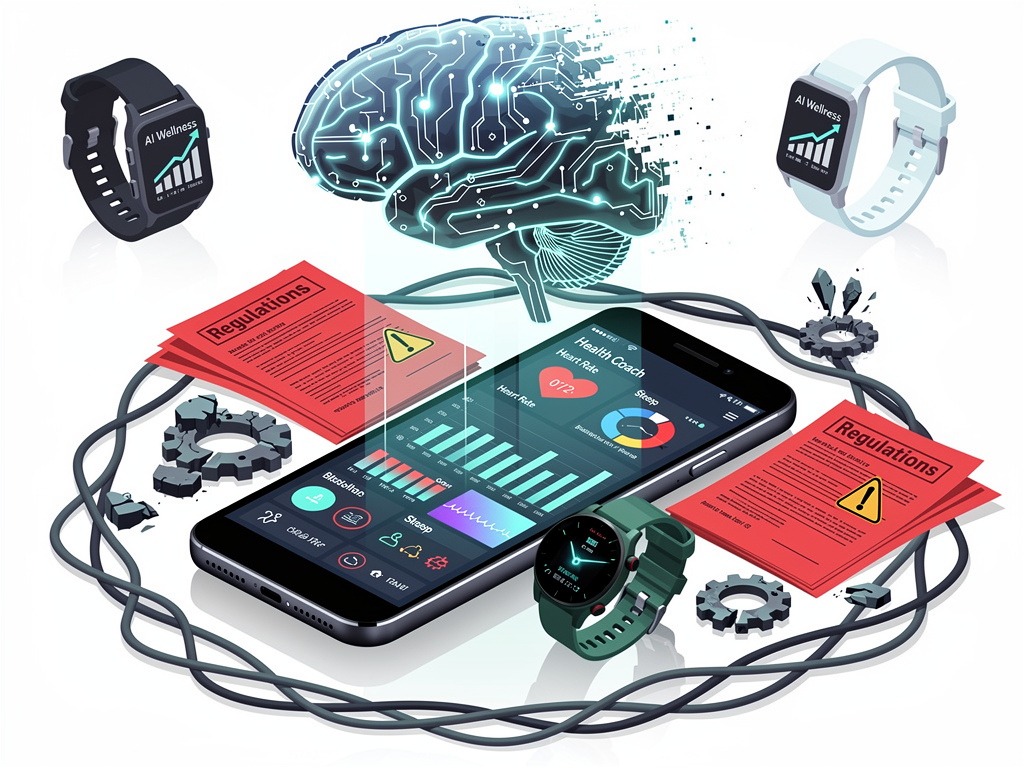
For years, Apple has positioned itself as a company deeply invested in personal health. From the Apple Watch’s heart-rate monitoring and fall detection to its Health app ecosystem, the Cupertino giant has steadily expanded its footprint in digital wellness. But the company’s most ambitious health initiative to date — an AI-powered health coaching service — appears to be struggling before it ever reaches consumers, raising questions about whether even the world’s most valuable company can crack the code on personalized wellness technology.
According to reporting by CNET, Apple’s internal AI health coach project, which has been in development for several years, faces significant hurdles that have cast doubt on its near-term viability. The project, which reportedly aims to leverage artificial intelligence to provide users with personalized health guidance — spanning exercise, nutrition, sleep, and mental wellness — has encountered technical limitations, organizational challenges, and the inherently complex regulatory environment surrounding health-related technology.
Inside the Vision: What Apple’s AI Health Coach Was Supposed to Be
The concept behind Apple’s AI health coach is straightforward in theory but extraordinarily complex in execution. The service would draw on the vast troves of health data already collected by Apple Watch sensors and the iPhone’s Health app to deliver tailored coaching recommendations. Think of it as a virtual wellness advisor that knows your resting heart rate, your sleep patterns, your activity levels, and your medical history — and uses all of that information to nudge you toward healthier behaviors in real time.
Apple has long signaled its interest in this space. CEO Tim Cook has repeatedly said that health will be Apple’s “greatest contribution to mankind.” The company’s acquisition of health-focused startups, its investment in clinical research through the Apple Watch, and its partnerships with major health systems all point toward a future where Apple doesn’t just track your health metrics but actively helps you improve them. The AI health coach was meant to be the centerpiece of that vision — a flagship service that could differentiate Apple from competitors like Google, Samsung, and Fitbit in the wearables market.
Technical and Organizational Roadblocks Plague the Project
Yet as CNET detailed, the project has been beset by internal difficulties. Sources familiar with the initiative suggest that Apple’s AI models have struggled to deliver health coaching that feels genuinely personalized and clinically sound rather than generic. The challenge is not merely technical — it is epistemic. Health coaching requires nuance, contextual understanding, and the ability to account for an enormous range of individual variables, from chronic conditions to psychological states. Current large language models and machine learning systems, while impressive in many domains, often fall short when tasked with providing advice that must be both safe and specific.
Organizational friction has compounded the problem. Apple’s health team has reportedly experienced leadership turnover and shifting strategic priorities, making it difficult to maintain momentum on a project of this scope. The departure of key personnel and internal disagreements about the product’s direction have slowed development. In a company known for its secrecy and its willingness to kill projects that don’t meet its exacting standards, the AI health coach’s troubled trajectory has raised the specter of cancellation — or at least indefinite delay.
The Regulatory Minefield of AI-Driven Health Advice
Beyond internal challenges, Apple faces a daunting regulatory environment. Any AI system that provides health recommendations walks a fine line between wellness guidance and medical advice. The U.S. Food and Drug Administration has been increasingly attentive to AI-powered health tools, and Apple must ensure that its coaching service does not inadvertently cross into territory that would require regulatory clearance as a medical device. This is not a hypothetical concern — the FDA has already taken action against companies whose AI health products made claims that veered into clinical territory without proper authorization.
Apple’s legendary emphasis on user privacy adds another layer of complexity. The company has built its brand on the promise that personal data stays personal. But an effective AI health coach requires access to deeply sensitive information — medical records, biometric data, behavioral patterns — and must process that data in ways that are both useful and secure. Balancing the utility of AI-driven insights with Apple’s privacy commitments is a design challenge that has no easy solution.
Competitive Pressures and the Stakes for Apple’s Health Ambitions
The stakes extend well beyond a single product. Apple’s competitors are not standing still. Google has integrated AI health features into its Pixel Watch and Fitbit ecosystem, while Samsung has expanded its Samsung Health platform with AI-driven insights. Startups in the digital health space are proliferating, offering everything from AI therapy chatbots to personalized nutrition plans. If Apple cannot deliver a compelling AI health coaching experience, it risks ceding ground in a market it has spent a decade cultivating.
For industry insiders, the struggles of Apple’s AI health coach are a cautionary tale about the gap between technological ambition and real-world execution. Health is a domain where the consequences of getting things wrong are not merely commercial but deeply personal. A flawed recommendation, an inaccurate reading, or a poorly timed nudge can erode trust — and in health technology, trust is everything. Apple’s challenge is not just to build an AI that can coach effectively, but to build one that users will trust with their most intimate data and their most consequential decisions.
What Comes Next for Cupertino’s Wellness Gambit
Whether Apple’s AI health coach ultimately sees the light of day remains an open question. The company has a track record of shelving projects that don’t meet its standards — the long-rumored Apple Car being a recent high-profile example — and there is no guarantee that the health coach will survive the gauntlet of internal review. But if Apple can overcome the technical, organizational, and regulatory obstacles, the payoff could be enormous: a deeply integrated, privacy-respecting, AI-powered wellness service embedded in the devices that hundreds of millions of people already wear on their wrists and carry in their pockets.
For now, the project may indeed need a wellness check of its own. But dismissing Apple’s health ambitions entirely would be premature. The company has shown a willingness to play the long game, investing years in technologies that eventually reshape entire industries. The AI health coach may yet prove to be one of those bets — just one that requires more patience, more iteration, and more humility than Apple initially anticipated.


 WebProNews is an iEntry Publication