
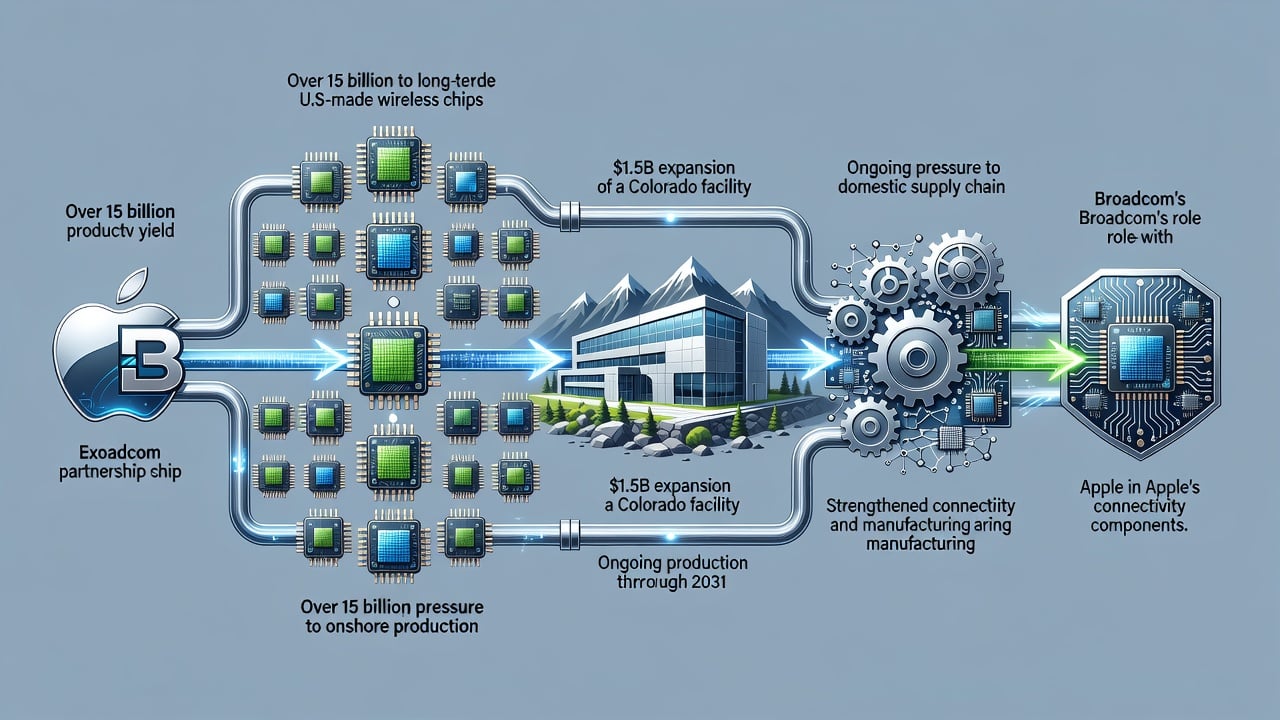
Apple just doubled down on American soil for its silicon needs. The iPhone maker announced a multiyear agreement with Broadcom expected to exceed $30 billion. It will result in more than 15 billion U.S.-made custom wireless connectivity chips. And the pact runs through 2031.
Details emerged first in a Reuters report on July 6. Broadcom followed with its own filing. Then Apple published its official statement yesterday. The numbers tell a story of deepening dependence mixed with strategic control. Broadcom already counts Apple as roughly 20% of its annual revenue, analysts say. This deal cements that bond for years ahead.
Tim Cook didn’t mince words. “Apple and Broadcom have a long history together, and this new phase of our partnership further accelerates our commitment to American manufacturing and innovation,” the CEO said in Apple’s July 8 newsroom release. He added that components from the Colorado facility deliver the performance customers expect. Hock Tan, Broadcom’s president and CEO, echoed the sentiment. “Broadcom is proud to continue to work with Apple after decades of success together, and we share a strong commitment to American innovation.”
The agreement builds directly on a 2023 multibillion-dollar pact. That earlier deal focused on 5G radio frequency components manufactured in the United States. Now the scope widens. Broadcom will develop and supply custom ASIC chips. These application-specific integrated circuits target multiple generations of Apple products. They handle radio frequency tasks. They manage Wi-Fi. They enable Bluetooth. They tie devices to cellular networks.
At the center sits Fort Collins, Colorado. Apple will direct $1.5 billion in capital expenditure to expand and modernize Broadcom’s facility there. The site will produce advanced radio frequency components, including FBAR filters, plus wireless connectivity technologies. Production ramps will support hundreds of American jobs. Hundreds. The figure lands with a thud against the $30 billion scale. Yet it fits Apple’s pattern. Investments target specific nodes in the supply chain rather than mass assembly.
This isn’t Apple’s first move stateside. The company launched its American Manufacturing Program last year. Today’s announcement marks the program’s largest commitment so far. It forms one piece of a broader $600 billion pledge to the U.S. economy over four years. That vow came amid pressure from the Trump administration. Recall last year’s tariff threats aimed at forcing iPhone production home. The policy shifted. Assembly stayed overseas. But component work keeps shifting.
Analysts see clear logic. “For Apple, locking in Broadcom through 2031 buys supply-chain certainty at a moment of chip scarcity, and spares Apple from having to in-source key iPhone components,” Emarketer analyst Jacob Bourne told Reuters. Apple designs many of its own processors. It relies on TSMC for fabrication of A-series and M-series chips. Yet wireless specialties remain Broadcom’s domain. Attempts to bring those in-house have progressed slowly.
Broadcom shares jumped more than 3% after the initial news. The reaction reflected relief. Apple had spent years trying to build some of these chips itself. The extension removes a cloud. For Broadcom, the deal provides steady revenue visibility. It also positions the company deeper in custom silicon as Apple eyes AI features that demand tighter hardware-software integration.
Recent coverage adds texture. A CNBC article published hours ago notes the deal produces more than 15 billion U.S.-made chips and includes the Colorado expansion. It highlights how wireless components help devices connect across cellular, Wi-Fi and Bluetooth networks. CNN’s report frames the announcement inside Apple’s August pledge for $600 billion in domestic spending. It quotes Cook directly on the long history and accelerated commitment.
TechCrunch’s piece today ties the agreement to Trump’s past threats and the reversal on tariffs. It observes that the job creation estimate appears modest relative to the dollars committed. Still, the chips matter. They sit inside billions of devices. Every iPhone, every Mac, every wearable depends on reliable connectivity. Disrupt that and user experience collapses.
Look closer at the numbers. The $30 billion spans roughly five years. That suggests annual spend well above prior baselines. Apple already buys heavily from Broadcom. The 2023 deal alone carried multibillion-dollar weight. This extension layers custom ASICs on top of existing RF and connectivity supply. It signals Apple prefers to pay for certainty rather than risk shortages or geopolitical friction in Asia.
Fort Collins gains new life. The facility already handles advanced manufacturing. The $1.5 billion injection will enlarge clean rooms, upgrade equipment and train staff. Such moves rarely make headlines like new fabs do. They matter just the same. They create a domestic source for components that once flowed almost entirely from overseas suppliers.
Broader supply chain questions linger. Apple talks with Intel about U.S. manufacturing for future chips, with volume possibly starting after 2027. Amkor’s advanced packaging plant in Arizona could complement these efforts. The pieces accumulate. A true end-to-end U.S. silicon chain remains distant. Yet each contract, each facility expansion narrows the gap.
Investors parsed the news for clues about Apple’s AI ambitions. Custom silicon often accelerates on-device machine learning. Wireless chips carry data that feeds those models. Secure, low-latency connectivity becomes table stakes. Broadcom’s expertise helps Apple deliver without depending solely on its own design teams.
Critics may dismiss the announcement as political theater. The job count is small. iPhone assembly won’t relocate soon. Tariffs came and went. But the capital flows are real. The chips will ship. The facility will grow. And the partnership, already decades old, gains fresh legal and financial anchors through the end of the decade.
So Apple keeps writing checks. Broadcom keeps delivering chips. Colorado gains a bigger footprint in the global tech stack. The rest of the supply chain watches. Next moves from TSMC, from Intel, from packaging specialists will determine whether this bet looks prescient or merely expensive. For now, the deal stands as Apple’s clearest statement yet on where it wants its wireless future built.


 WebProNews is an iEntry Publication