
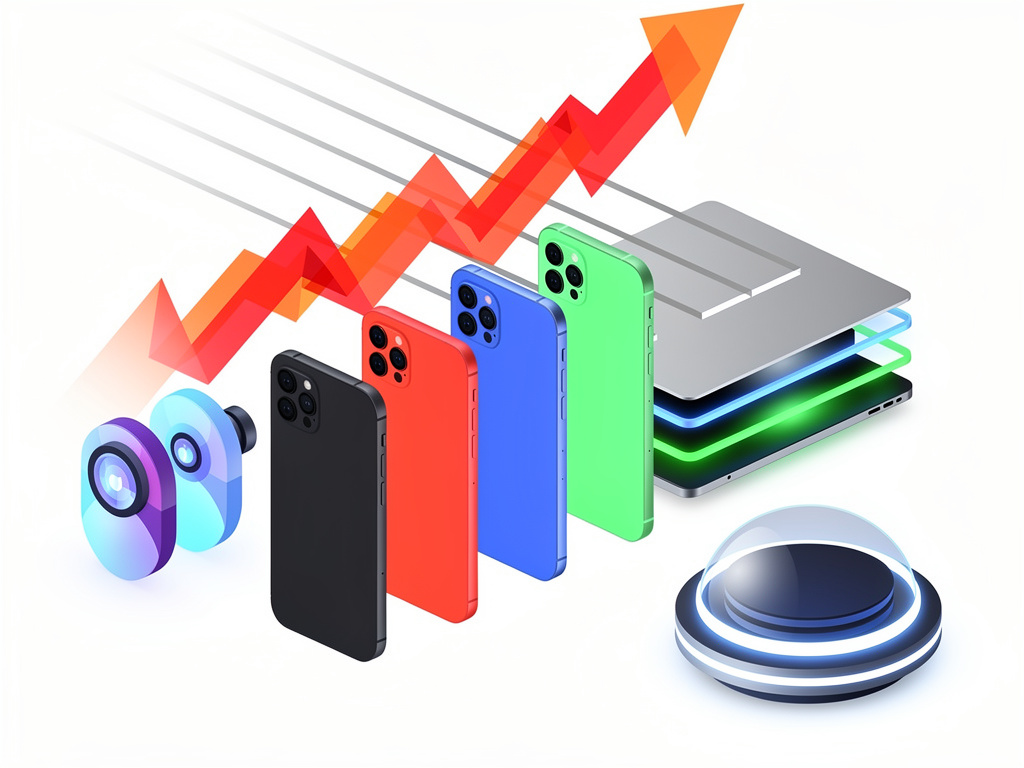
Mark Gurman dropped a bold assessment this month. 9to5Mac captured it cleanly: “2027 is going to be Apple’s biggest product year in its history.”
Analysts and supply-chain watchers have spent years mapping Apple’s roadmap. This time the signals point to an unusual wave. Not one hero device. A cluster of them. Six distinct iPhone models. New wearables built around cameras and artificial intelligence. A tabletop robot with a moving arm. Fresh chips powering thinner laptops and more powerful tablets. The volume looks unmatched in recent memory.
Inside the iPhone lineup that marks two decades
Gurman expects Apple to split its iPhone releases across two windows in 2027. Early in the year buyers could see the iPhone Air 2, the standard iPhone 18 and a budget-minded iPhone 18e. By fall the company would follow with the iPhone 20 Pro, iPhone 20 Pro Max and a second-generation iPhone Ultra.
The 20th-anniversary Pro models carry the highest expectations. Reports describe a quad-curved display that eliminates almost every visible bezel. The glass would wrap around the edges in a continuous sweep. Such a design demands new manufacturing precision at scale. Yet the payoff could justify the effort. A phone that feels closer to a single sheet of glass than any predecessor.
The iPhone Air 2 already shows signs of addressing first-generation limits. According to Gurman the successor adds a second rear camera and improves battery endurance while keeping the ultra-thin profile. Those changes matter. The original Air proved Apple could build strikingly slim hardware. Version two makes the device practical for daily use. But that’s just one piece.
Whispers of a second-generation foldable iPhone also circulate. Bloomberg’s Gurman and others tie it to the same 2027 window. A folding handset paired with the anniversary Pro models would give Apple multiple flagship stories in one calendar year. Few periods in company history offered that mix.
And the pressure builds from another direction. Memory and component prices have climbed because of AI infrastructure demand. Wirecutter noted this week that shortages could push laptop and phone prices higher through 2027. Apple has tried to absorb some increases. Tim Cook acknowledged the strain in recent interviews. The 2027 lineup arrives against that cost backdrop.
So the product volume must deliver enough new capability to support premium pricing. Cameras that feed visual intelligence. Chips built on two-nanometer processes. Displays that bend light in fresh ways. Each element has to pull its weight.
Apple’s home ambitions look equally crowded. A larger tabletop hub with a swiveling robotic arm sits on the drawing board. Earlier concepts described a 7-inch screen on a movable mount. The device would act as a more capable evolution of the upcoming HomePad. It could follow users around a room, maintain eye contact during video calls and serve as a central smart-home brain.
Privacy remains a stated priority. Any camera-equipped wearable would carry outward-facing lights to signal when data travels to the cloud. The same principle could extend to home devices. Trust becomes table stakes when products watch and listen.
New Apple Watch models are expected too. Details stay sparse but the category rarely sits idle. Health sensors usually advance in small but meaningful steps. Stress tracking and other metrics have surfaced in recent speculation.
M6-series chips will power much of this hardware. Next-generation iPad Pro, refreshed MacBook Air and additional Macs all sit on the list. A MacBook Ultra might land in this timeframe if it slips from 2026 plans. The silicon foundation matters. Performance gains and efficiency improvements give Apple room to add AI features without draining batteries in hours.
Two new AI-focused wearables top Gurman’s short list. One involves AirPods equipped with cameras. Not for photography. The sensors would give Siri visual context. Point at an object and ask questions. Receive turn-by-turn walking directions based on what the earbuds see. Contextual reminders tied to location and surroundings.
Development challenges pushed the camera AirPods into the second half of 2027. They now appear likely to launch alongside the foldable iPhone and anniversary models. The alignment creates a coherent artificial-intelligence hardware narrative. Voice, vision and spatial awareness working together.
Smart glasses form the second major wearable bet. Gurman has adjusted timelines before. Current expectations point to late 2027. The glasses would carry oval-shaped cameras, come in multiple frame styles and colors. They aim to compete with Meta’s Ray-Ban partnership but stay deeper inside Apple’s closed world.
Supply-chain analyst Ming-Chi Kuo has scaled back broader AR plans. His latest notes suggest display-less AI glasses for 2027 and more advanced waveguide models years later. The company appears to favor incremental steps over a single leap. That caution reflects the technical difficulty of comfortable all-day wearables.
Yet the cumulative effect still feels large. iPhones in three release clusters. Wearables that add sight to Siri’s repertoire. A robotic home device. Processor refreshes across computers and tablets. The list exceeds typical annual refreshes by a wide margin.
Investors watch these signals closely. Apple’s services business provides steady growth. Hardware still drives the narrative and the valuation. A year packed with new categories can reset conversations about innovation. It can also expose execution risks. Manufacturing six iPhone variants at scale while introducing robotic hardware and camera-equipped earbuds tests even Apple’s operations.
Recent reporting adds texture. Moomoo cited Caixin News on the camera AirPods timing and the 20th-anniversary phone. The pieces continue to align. No single source has the full picture. Taken together they paint a busy 2027.
Of course plans can shift. Apple has delayed or canceled projects before. The foldable iPhone has been rumored for years. The robotic arm device first appeared in concept form months ago. Yet the consistency across Gurman’s updates and Kuo’s supply-chain notes gives the 2027 story unusual weight.
Buyers face choices. Early 2027 brings thinner iPhones and budget options. Fall delivers flagship redesigns and new wearables. Home products could appear throughout the year. The calendar fragments in ways that challenge marketing teams and consumer attention.
Still the ambition stands out. Apple rarely signals this level of activity. When it does, the market tends to respond. Whether 2027 truly becomes the biggest year depends on delivery, reception and the intangible feel of the devices. For now the roadmap suggests Cupertino intends to flood the zone with new hardware. The next 18 months will test that intent at every level.


 WebProNews is an iEntry Publication