
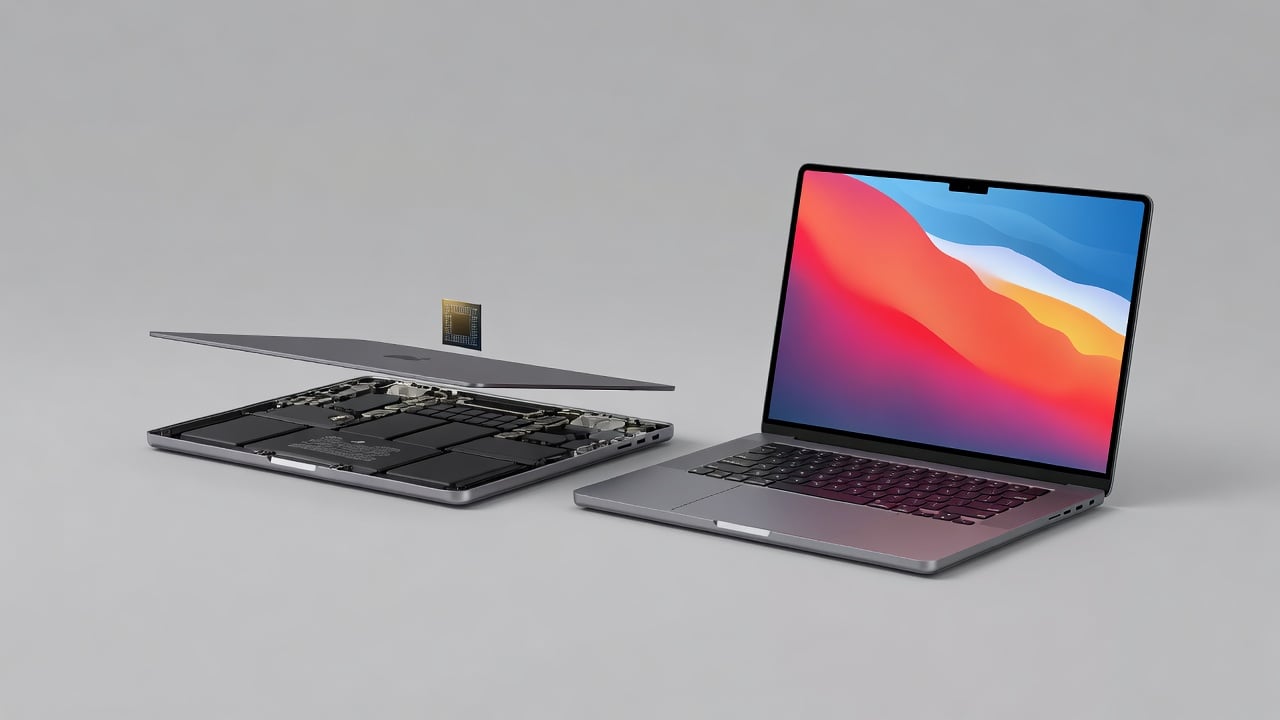
Apple is preparing a major update to its MacBook Pro lineup that will arrive in early 2027, according to reports from industry analysts and supply chain sources. The company plans to introduce the M7 series of chips alongside a redesigned chassis that includes a touchscreen display for the first time on a Mac notebook. This development marks a significant shift in Apple’s approach to its professional laptop range, which has maintained a consistent design language since the 2016 introduction of the Touch Bar.
The information, first reported by 9to5Mac, indicates that Apple intends to bring the new models to market in the first quarter of 2027. This timeline aligns with Apple’s recent pattern of annual silicon refreshes while allowing extra time for the hardware redesign that will accompany the M7 chips. Previous MacBook Pro generations have typically launched in the fall, so an early-year release would represent a departure from that schedule and could signal Apple’s desire to reset its professional computing calendar.
At the heart of the new MacBook Pro models will be the M7 family of processors. Building on the architecture established by the M4 series currently found in iPad Pro and MacBook Air devices, the M7 is expected to feature further improvements in both performance and power efficiency. Industry observers anticipate that Apple will continue refining its custom CPU and GPU cores while expanding the neural processing capabilities that have become central to the company’s artificial intelligence strategy. The M7 chips will likely come in multiple variants, ranging from base configurations suitable for developers and content creators to high-end versions aimed at users working with complex 3D rendering, scientific simulations, and professional video workflows.
One of the most talked-about aspects of the upcoming redesign involves the addition of touchscreen functionality. For years, Apple has resisted incorporating touchscreens into its Mac computers, with company executives repeatedly arguing that the interaction models for macOS and iPadOS are fundamentally different. However, recent statements from Apple leadership have hinted at a more flexible attitude toward input methods. The new MacBook Pro models are said to feature a display that supports both traditional keyboard and trackpad input as well as direct touch gestures. This hybrid approach could allow users to switch between precise cursor control and more intuitive finger-based interactions depending on the task at hand.
The display technology itself is expected to receive substantial upgrades beyond touch capabilities. Sources suggest Apple will increase the peak brightness and improve color accuracy across the entire lineup. The Liquid Retina XDR panels will likely maintain their mini-LED backlighting, though engineers have found ways to reduce power consumption while delivering even higher contrast ratios. Rumors also point to the possible inclusion of a higher refresh rate option that could reach 120Hz or beyond on the top-tier configurations, giving the MacBook Pro an advantage in applications that benefit from smoother motion such as video editing and motion graphics work.
Design changes to the body of the laptop appear relatively modest but meaningful. The overall thickness and weight are expected to decrease slightly thanks to more efficient component placement and a refined thermal system. The keyboard mechanism will receive another iteration, with Apple aiming to provide even better tactile feedback while reducing noise. Port selection should remain similar to current models, with multiple Thunderbolt connections, an HDMI port, SD card slot, and MagSafe charging. The notch at the top of the display will persist, though its integration with the new touchscreen layer may create a more unified appearance.
This move toward touch functionality on the MacBook Pro follows Apple’s gradual introduction of touch elements across its product categories. The company first experimented with touch on the iPhone, then expanded the concept through the iPad and Apple Watch. More recently, the Touch Bar on previous MacBook Pro models offered a limited glimpse of contextual touch controls. The full touchscreen implementation represents the logical next step in this progression, though Apple has taken care to ensure that macOS evolves alongside the hardware rather than simply adapting iPadOS.
Software support for the touchscreen will require significant updates to macOS. Developers expect Apple to enhance existing gesture recognition while introducing new ways to interact with windows, menus, and applications. The company has reportedly been testing touch-optimized versions of key professional applications including Final Cut Pro, Logic Pro, and Xcode. These adaptations could make complex tasks more approachable for users who prefer direct manipulation over traditional pointing devices. At the same time, Apple intends to preserve the full capabilities of macOS for users who prefer to work exclusively with the trackpad and keyboard.
The timing of this announcement carries particular weight given the competitive environment. Microsoft has steadily improved touch capabilities in Windows laptops, and several manufacturers now offer devices with high-quality touchscreens that also function as detachable tablets. By introducing touch to the MacBook Pro, Apple aims to address user requests while maintaining the performance characteristics that have distinguished its laptops from competitors. The M7 chips should provide enough processing power to handle both traditional desktop applications and new touch-centric interfaces without compromise.
Battery life remains a priority for the new generation. Apple has consistently delivered strong endurance figures with its Apple Silicon MacBooks, and the M7 series is projected to extend that advantage. More efficient manufacturing processes at the 3-nanometer scale, combined with software optimizations, could push average usage times beyond 20 hours for typical productivity tasks. For professionals who frequently work while traveling, this improvement could eliminate the need to carry chargers during shorter trips.
The introduction of the M7 MacBook Pro also coincides with broader changes in Apple’s manufacturing strategy. The company continues to shift production among different partners and regions to mitigate supply chain risks. Reports indicate that several key components for the 2027 models have already entered early production stages at suppliers in Vietnam and India, in addition to traditional facilities in China. This diversification helps Apple maintain consistent availability even as demand for the redesigned laptops is expected to be high.
Pricing for the new models should follow Apple’s established structure, with the 14-inch version starting around the same price point as the current M4 Pro MacBook Pro. The 16-inch configuration will carry a premium, particularly for configurations with maximum memory and storage. Apple may also introduce new color options to refresh the visual appeal of the lineup, though the signature Space Black and Silver finishes are likely to remain available.
Industry analysts have mixed predictions about how customers will receive the touchscreen MacBook Pro. Some suggest that creative professionals have long requested this feature and will quickly adopt the new models for their workflow advantages. Others express concern that the addition of touch could increase the device’s cost or potentially compromise the keyboard experience that many users value. Apple appears confident that its implementation will satisfy both groups by offering touch as an optional interaction method rather than a required one.
The development of the M7 chips reflects Apple’s continued investment in custom silicon design. Each generation has brought architectural improvements that deliver substantial gains over Intel-based predecessors. The M7 is expected to feature more CPU cores, a larger GPU configuration, and an upgraded neural engine capable of handling increasingly sophisticated AI tasks locally. This focus on on-device processing helps preserve user privacy while delivering responsive performance for features such as image generation, natural language processing, and intelligent system suggestions.
Memory configurations will likely expand as well. Current high-end MacBook Pro models support up to 128GB of unified memory, and the M7 generation could push that limit even higher for users working with massive datasets or complex multilayered projects. The unified memory architecture remains one of Apple’s strongest advantages, allowing the CPU, GPU, and neural engine to access data without the bottlenecks typically found in traditional systems that rely on discrete memory pools.
Storage options are also set to improve. Apple has been increasing the base storage across its Mac lineup, and the 2027 MacBook Pro models may start at 1TB rather than 512GB. Higher capacity SSDs will benefit users who work with large media files or need to maintain extensive local libraries of assets. The speed of these storage systems continues to impress, with read and write performance that exceeds what most external drives can deliver.
As development progresses, Apple will need to balance the excitement surrounding the new features with practical considerations about reliability and heat management. Touchscreen layers can sometimes affect display clarity or increase power draw, so the company’s engineers have focused on minimizing these potential drawbacks. Early testing reportedly shows that the new models maintain the quiet operation and cool exterior surfaces that users have come to expect from recent MacBook Pro generations.
The announcement also raises questions about the future of the MacBook Air line. While the MacBook Pro has traditionally served as Apple’s flagship notebook, the Air has captured a much larger share of the overall market. Apple may choose to bring similar design elements to the Air in subsequent years, though the Pro models will likely remain the first to receive the most advanced features and highest performance specifications.
Education and enterprise customers represent another important consideration. Many schools and businesses have standardized on Mac systems because of their reliability and long software support cycle. The addition of touchscreen capabilities could make these devices more appealing for interactive learning environments and collaborative workspaces. Apple has already begun demonstrating prototype versions to select partners to gather feedback before finalizing the design.
Developers working on macOS applications will need to consider how their software can best take advantage of touch input. Apple is expected to provide comprehensive guidelines and updated frameworks that make it relatively straightforward to add touch support without completely rewriting existing code. This approach should help ensure that the majority of professional applications feel natural on the new hardware from day one.
The competitive response to Apple’s plans will be interesting to observe. Other laptop manufacturers have already begun incorporating AI accelerators and high-quality touch displays into their products. However, few can match Apple’s combination of custom silicon, optimized software, and premium build quality. The M7 MacBook Pro could set a new standard for what professionals expect from a portable workstation.
Supply chain preparations suggest that Apple intends to launch the new models with ample inventory. By starting component production well in advance, the company aims to avoid the shortages that sometimes accompany major product redesigns. This strategy also allows Apple to offer a full range of configurations at launch rather than gradually introducing higher-end options over several months.
The integration of touch into the MacBook Pro represents more than just a hardware feature. It signals Apple’s willingness to reconsider long-held product philosophies when user needs and technological capabilities align. While the company maintained for years that Macs and iPads should remain distinct categories, the reality of modern workflows has shown that many users want elements of both experiences in a single device. The new MacBook Pro attempts to bridge that gap without sacrificing the precision and power that have defined the product line.
As the early 2027 launch date approaches, more details will likely emerge about specific performance metrics, exact display specifications, and software features. For now, the combination of the M7 chips and the touchscreen redesign positions the next MacBook Pro as a compelling option for professionals who want both traditional computing power and modern input flexibility. Apple’s careful approach to this transition suggests that the company has learned from past experiments with touch interfaces and is prepared to deliver an implementation that feels natural rather than forced.
The move also reflects broader trends in personal computing where boundaries between different device categories continue to blur. Tablets with keyboard attachments have grown more powerful, while traditional laptops have adopted characteristics once reserved for mobile devices. Apple’s decision to bring touch to its most premium notebook suggests confidence that the Mac platform can evolve while preserving the elements that have earned it a loyal following among creative and technical users worldwide.
With the M7 MacBook Pro slated for release in early 2027, Apple has set the stage for what could be one of its most significant laptop updates in recent memory. The combination of new processing technology, refined industrial design, and the long-awaited addition of touchscreen input creates a product that addresses many of the requests professionals have made over the years. How users ultimately respond to this hybrid approach will help determine the direction of Apple’s notebook strategy for years to come.


 WebProNews is an iEntry Publication