
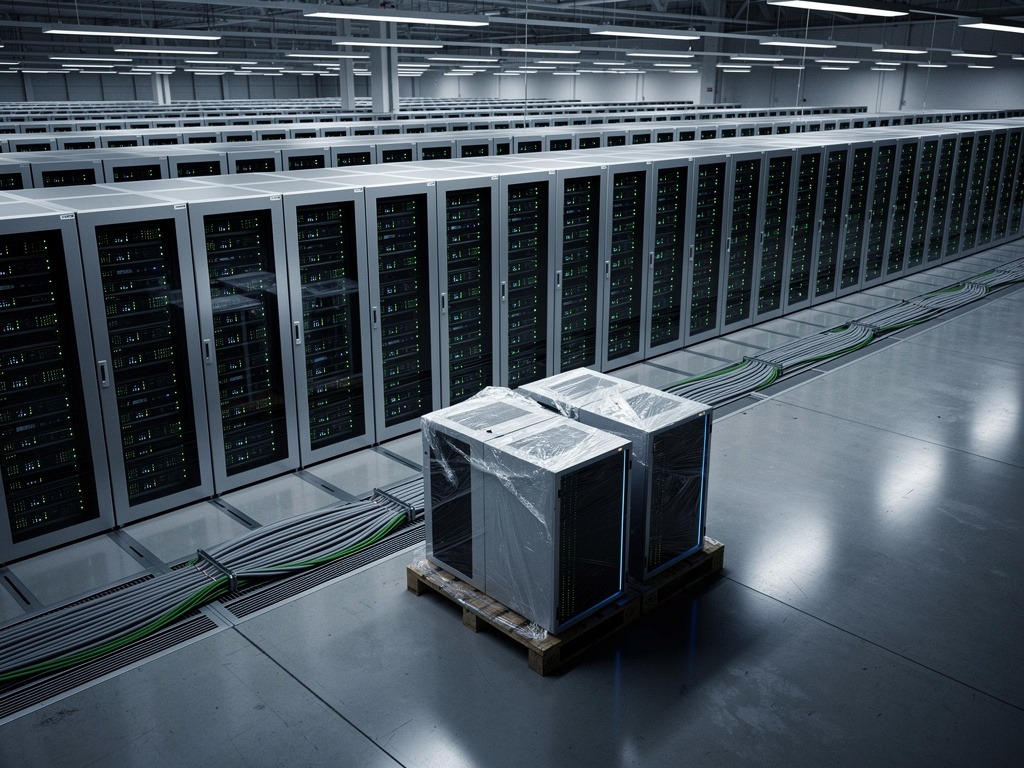
Apple Inc. spent billions of dollars building out a private cloud computing infrastructure to power its artificial intelligence ambitions. But according to multiple reports, a significant portion of those servers — purpose-built machines designed to run Apple Intelligence queries in the cloud — are sitting idle on warehouse shelves, gathering dust rather than processing requests. The revelation raises pointed questions about whether Apple misjudged consumer appetite for its AI features, and what the financial implications of that miscalculation might be.
The report, first surfaced by 9to5Mac, indicates that Apple’s Private Cloud Compute (PCC) servers — the backbone of the company’s on-device and cloud-based AI processing strategy — have not been deployed at the scale originally anticipated. The reason is straightforward: user demand for Apple Intelligence features has been far lower than Apple’s internal projections suggested. The servers were manufactured and shipped to data center staging areas, but with insufficient query volume to justify their installation, many remain boxed and warehoused.
A Grand Vision Meets Lukewarm Reception
When Apple unveiled Apple Intelligence at its Worldwide Developers Conference in June 2024, the company positioned the feature set as the most significant software advancement in years. CEO Tim Cook described it as a deeply personal intelligence system that would transform how users interact with their devices. The promise was sweeping: smarter Siri, generative writing tools, image generation, notification summaries, and context-aware suggestions — all powered by a combination of on-device processing and Apple’s proprietary Private Cloud Compute infrastructure.
Private Cloud Compute was itself a technical achievement. Apple designed custom server hardware running Apple silicon chips, operating inside secure enclaves that the company said would ensure user data was processed without being stored or accessible to Apple employees. The architecture was meant to address the privacy concerns that have long been central to Apple’s brand identity. But building out that infrastructure required enormous capital expenditure — billions of dollars in server hardware, data center leases, and operational costs that Apple committed to well before Apple Intelligence features began rolling out to consumers in late 2024 and into 2025.
The Numbers Tell a Sobering Story
Multiple industry analysts have noted that Apple Intelligence adoption has been tepid. A January 2026 survey by creative agency CIRP found that fewer than 30% of eligible iPhone users had actively engaged with Apple Intelligence features beyond the initial setup period. Notification summaries — one of the most visible features — drew early criticism for producing inaccurate or misleading condensations of news alerts and messages. Apple was forced to temporarily disable the feature for news applications after complaints from major publishers, including the BBC and CNN, that summaries were fabricating information.
Writing tools and image generation features, while functional, have not driven the kind of habitual usage that would strain server capacity. Siri’s promised upgrades — including the ability to take actions within third-party apps and maintain conversational context — have arrived in phases, with the most ambitious capabilities still not fully deployed as of early 2026. The result is a system that, while technically impressive in its architecture, has not generated the sustained, high-volume cloud compute demand that would justify the server fleet Apple assembled.
Financial Implications of Idle Hardware
The financial exposure is not trivial. Apple does not break out its AI infrastructure spending in earnings reports, but analysts at Morgan Stanley estimated in a February 2026 note that Apple had committed approximately $4.5 billion to Private Cloud Compute buildout through fiscal year 2025, with additional spending planned for 2026. Servers sitting in warehouses represent depreciating assets — hardware that loses value over time regardless of whether it is plugged in and processing queries.
Apple’s capital expenditure has been climbing. In its most recent quarterly earnings call, CFO Luca Maestri’s successor Kevan Parekh noted that capital spending had increased substantially year-over-year, driven in part by infrastructure investments related to Apple Intelligence. The company has not publicly acknowledged that any portion of its server fleet is underutilized, and Apple declined to comment for this article. But the gap between infrastructure investment and actual usage represents a classic overbuilding problem — one more commonly associated with telecom companies during the late 1990s fiber optic boom than with Apple’s historically disciplined capital allocation.
Why Apple May Have Overestimated Demand
Several factors appear to have contributed to the mismatch. First, Apple Intelligence rolled out gradually, with features arriving in stages across iOS 18.1, 18.2, 18.3, and 18.4 updates. This staggered approach meant that the full value proposition was never available to users at a single moment, reducing the likelihood of a dramatic adoption spike. Second, the features that did arrive first — writing tools, notification summaries, and basic image generation — were perceived by many users as incremental rather than transformative.
Third, and perhaps most significantly, Apple Intelligence is only available on iPhone 15 Pro and later models, along with iPads and Macs equipped with M-series chips. This hardware restriction means that hundreds of millions of active Apple devices are simply ineligible. As reported by 9to5Mac, this installed base limitation has been a persistent drag on adoption numbers. Users who purchased an iPhone 14 or earlier — still the majority of the global iPhone installed base — have no access to the features, regardless of their interest.
Competitors Are Not Standing Still
The idle server problem is particularly awkward given the competitive dynamics in consumer AI. Google has aggressively expanded its Gemini AI capabilities across Android devices, including lower-cost hardware. Samsung has integrated Galaxy AI features into a broader range of phones, including mid-range models. Microsoft’s Copilot is available across Windows PCs without the same hardware restrictions that Apple imposes. Each of these competitors is generating substantial cloud AI query volume, which in turn helps refine their models and improve user experiences — a virtuous cycle that Apple risks falling behind on if its own usage remains low.
OpenAI, Apple’s partner for ChatGPT integration within Siri, has also continued to advance its standalone products. The ChatGPT app on iPhone has seen strong download and engagement numbers, which creates an ironic dynamic: iPhone users are actively engaging with AI — just not Apple’s own AI. The partnership with OpenAI was meant to augment Apple Intelligence, but it may have inadvertently given users a reason to bypass Apple’s native features entirely.
What Comes Next for Apple’s AI Strategy
Apple is widely expected to announce significant expansions to Apple Intelligence at WWDC 2026 in June. Bloomberg’s Mark Gurman has reported that Apple is working on more advanced Siri capabilities, including deeper app integration and improved conversational abilities, that could drive higher engagement and, consequently, greater demand for Private Cloud Compute resources. If those features land well, the idle servers could be deployed relatively quickly.
There is also the possibility that Apple could repurpose some of its PCC infrastructure for other workloads. The company’s services business — which includes Apple TV+, Apple Music, iCloud, and the App Store — generates enormous data processing needs. While PCC servers were designed with specific security and processing characteristics for AI workloads, Apple silicon’s versatility could allow for some reallocation. However, industry sources familiar with the hardware told 9to5Mac that the servers are highly specialized, making repurposing less straightforward than it might appear.
A Cautionary Tale About AI Hype and Hardware Bets
The broader lesson may extend well beyond Apple. Across the technology industry, companies have been racing to build out AI infrastructure at unprecedented scale. Nvidia’s data center revenue has soared as hyperscalers and enterprise customers stockpile GPUs. Microsoft, Google, Amazon, and Meta have each committed tens of billions of dollars to AI-related capital expenditure. The assumption underlying all of this spending is that demand for AI compute will grow exponentially and indefinitely.
Apple’s experience suggests that assumption deserves scrutiny. Building supply ahead of demand is a time-honored strategy in technology — but it only works if demand eventually materializes. For Apple, the coming months will be critical. If WWDC 2026 delivers features that genuinely change how people use their iPhones and Macs, the warehoused servers will be deployed and the overbuilding narrative will fade. If not, Apple will face uncomfortable questions from investors about billions of dollars in infrastructure that was built for a future that has not yet arrived.
For now, the servers wait — silent, powered down, and expensive — a physical manifestation of the gap between AI ambition and consumer reality.


 WebProNews is an iEntry Publication