
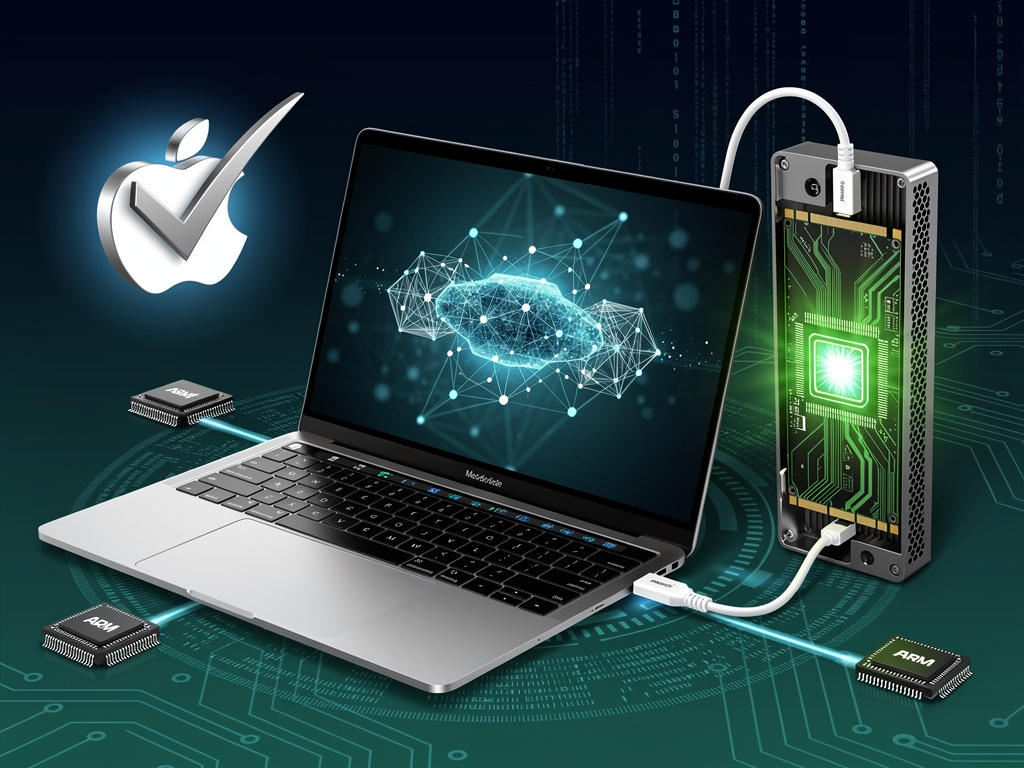
For years, the relationship between Apple and Nvidia has been defined by absence. A cold war, really. Apple abandoned Nvidia GPU support when it transitioned to Apple Silicon in 2020, and Nvidia showed little public interest in bridging the gap. Professional users who needed Nvidia’s CUDA-powered workflows — machine learning engineers, 3D artists, scientific researchers — were left with an uncomfortable choice: Apple hardware or Nvidia acceleration. Not both.
That changed this week.
Apple has approved a kernel extension driver, developed by a third-party company called Sapling, that enables Nvidia eGPUs to function with Arm-based Macs. The driver, called Miracle, works over Thunderbolt connections and supports recent Nvidia desktop GPUs, meaning a Mac Studio or MacBook Pro can now theoretically offload compute tasks to an external Nvidia card. As The Verge first reported, this marks the first time in years that Nvidia hardware has been usable on a Mac through a sanctioned software channel.
The implications are significant. And the timing isn’t accidental.
How Miracle Works — And What Apple Actually Approved
The technical details matter here. Sapling’s Miracle driver is a System Extension (technically a DriverKit extension), which operates in user space rather than deep in the kernel. Apple introduced DriverKit as a safer alternative to the old-style kernel extensions (kexts) it has been deprecating since macOS Catalina. The approval means Apple reviewed the driver through its standard notarization process and allowed it into the macOS security framework. This isn’t a hack. It’s not a jailbreak workaround. Apple signed off.
The driver communicates with Nvidia GPUs connected via Thunderbolt eGPU enclosures — the same kind of chassis that previously worked with AMD cards on Intel Macs. Sapling says Miracle supports CUDA workloads, which is the real prize. CUDA is Nvidia’s proprietary parallel computing platform, and it dominates machine learning training, molecular simulation, video rendering, and a long list of professional workflows that Apple’s own Metal API doesn’t fully cover.
There are limitations. Display output from the Nvidia eGPU isn’t supported in the initial release — this is a compute-only driver. Gaming isn’t the target. Neither is general-purpose graphics acceleration for the macOS desktop. The driver is aimed squarely at users who need CUDA for headless compute tasks: training neural networks, running inference, processing large datasets, or accelerating specific professional applications that have CUDA code paths.
Sapling is charging for the software. Pricing details are still emerging, but the company appears to be positioning Miracle as a professional tool, not a consumer curiosity.
The fact that Apple approved it at all is the real story.
Apple has spent five years building a tightly controlled hardware-software stack around Apple Silicon. The M-series chips integrate CPU, GPU, Neural Engine, and unified memory into a single package. Apple’s entire pitch to professional users has been that this integration delivers better performance per watt than discrete GPU setups. Allowing Nvidia back in — even through a third-party side door — represents a notable philosophical concession.
Or does it? One reading is that Apple simply processed a DriverKit extension through its normal review pipeline and didn’t specifically intervene to block it. Apple hasn’t issued a press release. There’s been no keynote slide. The company’s silence could mean tacit acceptance rather than enthusiastic endorsement.
But Apple could have rejected the extension. It controls the notarization process completely. The approval was a choice.
Why Now: The AI Pressure Cooker
The context for this development is the extraordinary demand for Nvidia GPU compute driven by the AI boom. Nvidia’s data center revenue hit $26.3 billion in its most recent quarter, a figure that would have seemed fantastical three years ago. Every major technology company is scrambling to acquire Nvidia hardware — H100s, B200s, GB200 NVL racks — for training and deploying large language models.
Apple has been notably quiet in the AI infrastructure race. Its on-device AI strategy, branded Apple Intelligence, runs inference on Apple Silicon. But for developers building AI models — the people who actually create the systems Apple wants to run on its devices — Nvidia’s CUDA platform remains the industry standard by a wide margin. PyTorch, TensorFlow, and virtually every major ML framework is optimized first for CUDA. Apple’s Metal Performance Shaders and MLX framework are improving, but they’re not yet at parity for training workloads.
This creates an awkward situation. Apple sells premium hardware to exactly the kind of knowledge workers and developers who need CUDA access. Many of these professionals maintain a separate Linux or Windows workstation with Nvidia GPUs specifically for ML training, then use their MacBook for everything else. It’s clunky. It’s expensive. And it pushes some users away from Apple hardware entirely.
Miracle doesn’t solve the data center side of this equation. Nobody is racking Mac Studios for large-scale model training. But for individual developers and small teams who want to run local training jobs, fine-tune models, or prototype on CUDA without leaving the Mac environment, an eGPU with a consumer Nvidia card like an RTX 4090 or upcoming RTX 5090 could be genuinely useful.
Recent reporting from 9to5Mac and other Apple-focused outlets has tracked growing frustration among ML developers who prefer macOS but feel locked out of the CUDA world. The Miracle driver directly addresses that frustration.
There’s also a competitive angle. Microsoft has been aggressively courting AI developers with Windows Copilot+ PCs and tight Nvidia integration. Qualcomm’s Snapdragon X Elite chips power some of those machines, but Nvidia’s own laptop GPUs remain the preferred tool for mobile ML development. If Apple wants to keep developers on Mac hardware, tolerating Nvidia eGPU support is a pragmatic move.
The financial incentive is straightforward. A developer who might otherwise buy a $3,000 Windows workstation for ML training could instead buy a $4,000 Mac Studio and a $500 eGPU enclosure with an Nvidia card they already own. Apple captures the sale. The developer gets the best of both worlds.
Sapling isn’t the first company to attempt Nvidia-on-Mac bridging. Various community efforts have existed over the years, most involving unsupported kernel extensions, patched drivers, or virtual machine passthrough techniques. None achieved official Apple approval. What makes Miracle different is the DriverKit approach, which aligns with Apple’s security model rather than fighting it.
Performance questions remain. Thunderbolt 4, standard on current Apple Silicon Macs, provides 40 Gbps of bandwidth. Thunderbolt 5, available on the latest M4 Pro and M4 Max machines, doubles that to 80 Gbps (with potential for 120 Gbps in asymmetric mode). An Nvidia RTX 4090 connected over Thunderbolt will see bandwidth constraints compared to a native PCIe 4.0 x16 slot, which offers 256 Gbps. For CUDA compute workloads that don’t require constant data shuffling between CPU and GPU memory — many training tasks involve loading a batch, processing, then updating weights — the bandwidth penalty may be tolerable. For workloads that are bandwidth-sensitive, it could be a real bottleneck.
Benchmarks from early testers will be critical. If Miracle delivers even 60-70% of native PCIe performance on representative ML training tasks, that’s likely good enough for most individual developers. If the overhead is steeper, the value proposition weakens.
There’s another wrinkle: Nvidia driver quality. On Windows and Linux, Nvidia’s proprietary drivers are mature and heavily optimized. Miracle is a third-party translation layer, not a native Nvidia driver. How efficiently it maps CUDA calls across the Thunderbolt link, handles memory management, and deals with error conditions will determine whether this is a professional-grade tool or a proof of concept.
What This Means for Apple’s Hardware Strategy
The longer-term question is whether this signals a broader thaw between Apple and Nvidia. The two companies’ estrangement dates back to the late 2000s, when faulty Nvidia GPUs in MacBook Pros led to a costly recall and legal action. Apple shifted to AMD for its discrete GPUs, then eliminated discrete GPUs entirely with Apple Silicon. Nvidia, meanwhile, built a $3 trillion empire without any Apple revenue to speak of.
A full Nvidia partnership — native macOS drivers, official CUDA support, Apple Silicon optimization — would be transformative for both companies. It would make Macs the default development platform for AI researchers. It would give Nvidia access to Apple’s installed base of tens of millions of professional users. But it would also undermine Apple’s argument that its integrated GPU architecture is sufficient for all professional workloads. And it would create a dependency on a company Apple has historically viewed as a difficult partner.
Don’t expect that full partnership anytime soon. What’s more likely is a continued tolerance of third-party solutions like Miracle, allowing Apple to maintain its official narrative about Apple Silicon’s capabilities while quietly letting power users fill gaps as needed.
The developer community’s response has been enthusiastic. Posts across X and various forums have described the Miracle approval as the most significant Mac-related development for ML practitioners in years. Some see it as a potential catalyst: if enough users adopt Nvidia eGPUs on Macs, Nvidia itself might eventually invest in official macOS support.
That’s speculative. But the mere existence of a sanctioned path from macOS to CUDA changes the calculus for a meaningful number of professional users. The wall between Apple and Nvidia hasn’t fallen. But someone just installed a door.
And Apple handed them the key.


 WebProNews is an iEntry Publication