
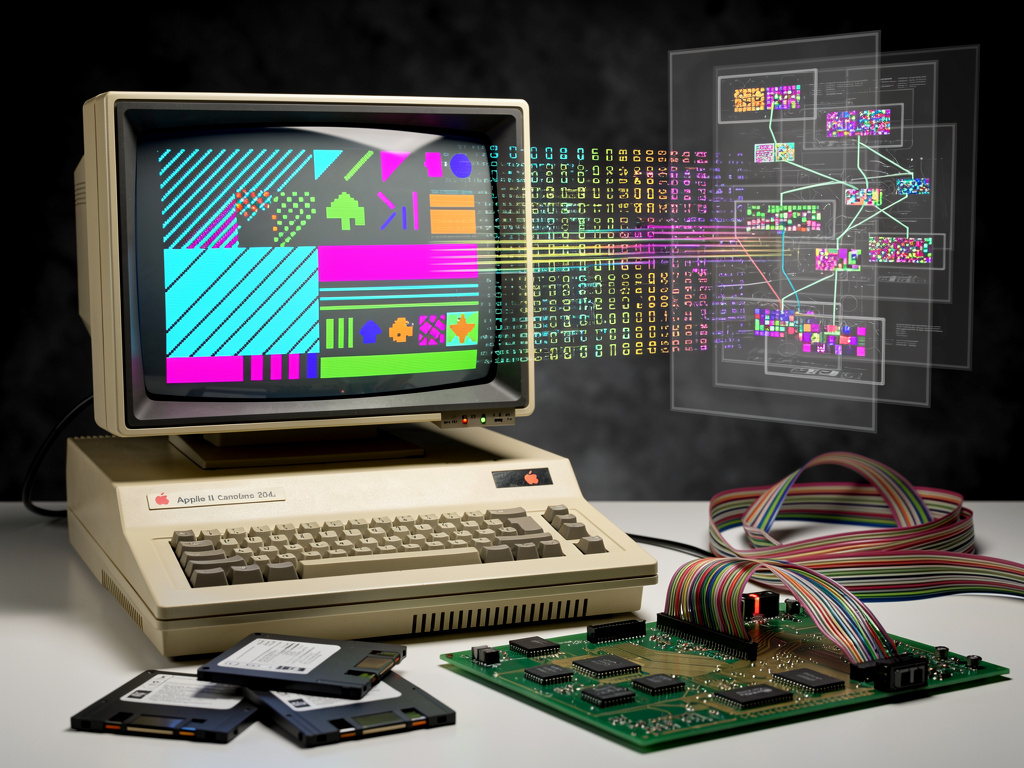
In the annals of computing history, few machines evoke as much nostalgia and technical intrigue as the Apple II, a device that not only democratized personal computing but also pioneered quirky yet ingenious approaches to visual display. Launched in 1977, the Apple II’s high-resolution graphics mode, known as HGR, offered a 280×192 pixel canvas with six colors, but its underlying architecture was anything but straightforward. Pixels weren’t stored in a linear fashion; instead, the system’s memory layout intertwined with the NTSC television signal, leading to artifacting and a palette dependent on clever hacks. This setup, designed by Steve Wozniak to minimize hardware costs, forced early programmers to grapple with compression techniques that squeezed every byte from the machine’s limited 48KB RAM.
Compression on the Apple II wasn’t just a nicety—it was a necessity. With disk storage hovering around 140KB per floppy and graphics data consuming up to 8KB per screen, developers devised methods to pack images efficiently for games, educational software, and demos. Early techniques relied on run-length encoding (RLE), where sequences of identical pixels were represented by a count and value, reducing redundancy in simple scenes. But for the Apple II’s peculiar bitmap structure—where each byte controlled seven pixels with a high bit for color shifting—these methods had to adapt to the hardware’s idiosyncrasies, often involving bit-packing to align with the display’s interlaced memory pages.
As the platform evolved through models like the IIe and IIGS, compression strategies grew more sophisticated. Programmers experimented with Huffman coding for variable-length prefixes on common pixel patterns, and some even borrowed ideas from emerging standards like those in telecommunications. Yet, the real innovation came from the community, where hobbyists and professionals alike shared tools via user groups and magazines, laying groundwork for what would influence modern image formats.
Evolution of Pixel Packing in Vintage Hardware
Vince Weaver’s exploration into HGR compression, detailed on his site deater.net, provides a fascinating case study. Weaver, a computer scientist known for retrocomputing projects, dissected various algorithms tailored to the Apple II’s high-res mode. His work highlights tools like “hgr2rgb,” which converts modern images to HGR format while applying compression, often achieving ratios of 2:1 or better by exploiting the mode’s limited color depth. For instance, delta encoding—storing differences between adjacent pixels rather than absolute values—proved effective for gradients common in early games like “Karateka.”
Historical context from Wikipedia’s entry on Apple II graphics underscores how these techniques emerged from necessity. The original HGR mode’s non-linear buffer, with “screen holes” (unused memory addresses for timing synchronization), meant raw dumps weren’t compressible without custom handling. By the 1980s, publications like BYTE Magazine featured articles on optimizing graphics storage, including Wozniak’s own descriptions in the May 1977 issue, as noted in a retrospective by Original Magazines. These insights reveal how compression wasn’t merely about size but also speed, as decompressing on-the-fly during rendering was crucial for fluid animations on the 1MHz 6502 processor.
Community-driven advancements further refined these methods. Forums and wikis, such as Just Solve the File Format Problem, catalog dozens of proprietary formats from the era, many involving slicing images into scanlines and applying LZ77-style dictionary compression. Unlike today’s JPEG or PNG, which use discrete cosine transforms or deflate algorithms, Apple II techniques were raw and hardware-specific, often sacrificing universality for efficiency on the platform.
From Artifact Colors to Efficient Encoding
Diving deeper, the Apple II’s color system added layers of complexity to compression. In HGR, colors arose from NTSC artifacts—green and purple from even pixel positions, orange and blue from odd—making true-color representation impossible without dithering. Compression algorithms had to preserve these artifacts, leading to techniques like palette remapping, where images were pre-processed to fit the six-color constraint before packing. Nicole Express’s blog post on Apple II graphics vividly describes this “idiosyncratic” setup, noting how it persisted until the IIGS introduced more conventional modes in 1986.
Modern recreations and analyses, such as those in the Higher Intellect Vintage Wiki, discuss double high-resolution (DHGR) on the IIe, which doubled horizontal resolution to 560 pixels using 16 colors. Compression here often involved interleaving two standard HGR pages, with tools applying block-based methods similar to early video codecs. For example, some utilities compressed by identifying repeated 7-bit patterns across bytes, achieving up to 50% savings on detailed artwork without visible loss, given the mode’s constraints.
Recent discussions on platforms like X highlight ongoing interest. Posts from retrocomputing enthusiasts, such as recreations of Van Gogh’s “Starry Night” in GraFORTH on emulated Apple II systems, show how these vintage techniques inspire contemporary projects. One user detailed compressing high-res images via singular value decomposition in C, echoing Apple II-era matrix-based approximations for grayscale equivalents, though adapted for modern hardware.
Bridging Retro and Modern Compression Paradigms
The influence of Apple II compression extends beyond nostalgia. As documented in Wikipedia’s Apple II overview, the machine’s BASIC interpreters included primitives for graphics, prompting users to write custom loaders that decompressed data from disk. This DIY ethos prefigured open-source tools today. For instance, Weaver’s page references “lz4” adaptations for HGR, a fast compressor originally by Yann Collet, retrofitted to handle the Apple II’s byte boundaries, yielding decompression speeds suitable for real-time use.
Industry insiders might note parallels with current formats. While Apple now pushes HEIF and HEVC for efficient media, as explained in Apple Support’s guide, the principles of lossy versus lossless echo HGR debates. Lossy methods on Apple II involved dithering to simulate shades, much like JPEG’s quantization, whereas lossless RLE preserved exact pixels for applications like educational diagrams.
Archival efforts, such as those on File Formats Archiveteam, preserve these formats, warning that without emulation, compressed HGR files become unreadable. Recent X posts discuss neural network-based compression, compressing gigabytes into kilobytes via shaders, a technique that could theoretically upscale Apple II graphics for modern displays, blending old and new.
Innovations in Double-Res and Beyond
The transition to DHGR brought new challenges and solutions. Technical notes from the era, like those in the Vintage Wiki, describe how doubling resolution required compressing 16KB screens, often via adaptive Huffman trees tailored to pixel distributions. Games like “The Bard’s Tale” used such methods to store intricate maps, decompressing segments into auxiliary memory on the IIe.
Community innovations persisted into the 1990s. The Apple IIGS, with its 320×200 super high-res mode, introduced palette-based graphics more akin to Amiga systems, allowing for LZW compression similar to GIF. However, backward compatibility meant many stuck with HGR variants. A Retrocomputing Stack Exchange thread on screen holes explains how these memory gaps complicated compression, requiring algorithms to skip or pad addresses.
Today, emulators like AppleWin incorporate decompression routines, enabling modern developers to experiment. X users share projects compressing images with Atkinson dithering—the Macintosh algorithm with Apple II roots—for that pixelated aesthetic, achieving high ratios on vintage-style art.
Legacy in Contemporary Computing
The enduring appeal lies in the Apple II’s constraints fostering creativity. As Apple II History recounts, the II Plus era saw firmware updates enhancing graphics, with add-ons like video cards expanding possibilities. Compression techniques evolved alongside, with some using fractal methods for natural scenes, prefiguring JPEG 2000.
In recent news, Apple’s focus on lossless audio and high-res displays, per Apple Support, contrasts with the Apple II’s lossy artifacting, yet shares a lineage in efficiency. X posts from 2025 discuss Zstd for images, a format that compresses faster than PNG, mirroring Apple II hacks for speed over perfection.
Weaver’s tools, for example, integrate modern libraries like zlib for HGR, bridging eras. This fusion keeps the platform relevant for educators and artists, who use compressed graphics in interactive exhibits.
Pushing Boundaries with Emulation and AI
Emulation has revitalized these techniques. Projects on X describe running neural compressors in browsers, shrinking baked imagery via fragment shaders—a far cry from but inspired by Apple II bit-twiddling. One post highlighted compressing 1.8GB into 200KB, techniques applicable to upscaling HGR for 4K displays.
Historically, the Apple II’s expansion slots enabled hardware-assisted compression, like the Macintosh II video card detailed on Low End Mac, though not directly for Apple II, it influenced cross-platform ideas.
As we look forward, the history of HGR compression reminds us that innovation often stems from limitation. Current trends in AI-driven compression, as seen in X discussions on Gaussian splatting for high-ratio packing, could reinterpret Apple II archives, ensuring their pixelated charm endures in an era of ultra-high definition.


 WebProNews is an iEntry Publication