
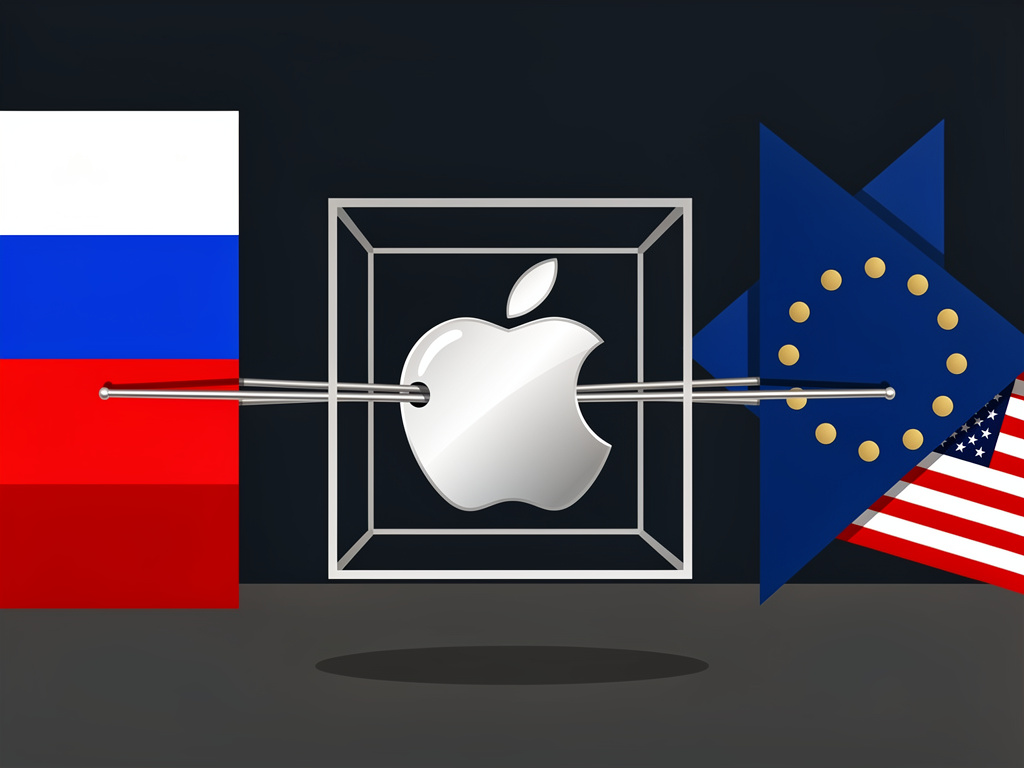
A Russian court has fined Apple approximately $12 million for refusing to store Russian citizens' personal data on servers located within the country. The penalty, handed down by a Moscow court, puts the iPhone maker in a familiar but increasingly uncomfortable position: caught between the regulatory demands of a foreign government and the sanctions regime imposed by its own.
The fine stems from violations of Russia's data localization law, Federal Law No. 242-FZ, which requires companies handling Russian citizens' personal data to store and process that information on servers physically located in Russia. Apple has repeatedly declined to comply. This is the latest — and largest — financial penalty Russia has imposed on the company over the issue, according to The Register.
But here's the bind. Even if Apple wanted to pay the fine, doing so would likely violate U.S. and EU sanctions imposed on Russia following its 2022 invasion of Ukraine. Transferring funds to Russian government entities or through Russian financial channels is heavily restricted under those sanctions. Apple is essentially being ordered to do something by Moscow that Washington won't let it do.
A legal no-man's-land.
Russia's Escalating Pressure Campaign on Western Tech
Apple isn't the only Western technology company facing this kind of squeeze. Russia has been steadily ratcheting up pressure on foreign tech firms for years, using data localization requirements, content moderation mandates, and fines as tools to assert digital sovereignty — or, depending on your perspective, to exert control over information flows within its borders.
The data localization law has been in effect since 2015. LinkedIn was blocked in Russia in 2016 for non-compliance, becoming the first major Western platform to be shut out entirely. Twitter, now X, was throttled in 2021 over its failure to remove content the Russian government deemed illegal. Google has faced billions of rubles in fines. And Meta's Facebook and Instagram have been banned outright since 2022, with Meta itself designated an "extremist organization" by Russian authorities.
Apple's situation is somewhat different because the company still maintains a limited presence in Russia. It pulled products from sale in Russia shortly after the invasion of Ukraine and halted Apple Pay services in the country. But the App Store remains accessible to Russian users, and Apple continues to process some data related to those accounts. That residual footprint gives Russian regulators a hook.
The $12 million fine is substantial but not crippling for a company with over $380 billion in annual revenue. What makes it significant is the precedent and the principle. Russia appears willing to keep escalating. Each successive fine has been larger than the last. And each one deepens the legal contradictions Apple faces.
According to reporting by The Register, the Moscow Tagansky District Court issued the ruling, finding Apple in violation of the data localization statute. Apple reportedly did not send representatives to the hearing. The company has not publicly commented on the fine.
This pattern of absence — both physical and rhetorical — reflects a broader strategy among Western tech companies dealing with Russian courts. Showing up confers a degree of legitimacy on proceedings that companies view as politically motivated. Not showing up means fines go uncontested and pile up.
The Sanctions Trap: Compliance in Two Directions at Once
The sanctions dimension transforms this from a routine regulatory dispute into something far more complex. U.S. sanctions on Russia, administered by the Treasury Department's Office of Foreign Assets Control (OFAC), broadly prohibit American companies from engaging in transactions with sanctioned Russian entities, including government bodies. The EU has its own parallel restrictions.
Paying a court-ordered fine to the Russian government would constitute a financial transfer that could trigger sanctions liability. Apple's legal team is almost certainly aware of this. So is Moscow.
Some legal analysts believe Russia is deliberately weaponizing this contradiction. By imposing fines it knows Western companies can't pay, Russia creates a pretext for further action — whether that's seizing assets, blocking services, or escalating rhetoric about Western non-compliance with Russian law. It's a strategy that costs Russia nothing and puts companies like Apple in an impossible position.
The dynamic isn't limited to tech. Western energy companies, banks, and manufacturers have all encountered variations of this trap since 2022. But technology companies are particularly visible targets because of their consumer-facing products and their role in information distribution.
For Apple specifically, the calculus involves weighing the risk of total exclusion from the Russian market — such as it still exists for the company — against the risk of sanctions violations. The former is a business loss. The latter is a legal catastrophe. There's no real contest between the two.
And yet the situation keeps getting more tangled. Russian authorities have previously threatened to slow down or block Apple services entirely if fines go unpaid. They've also floated the possibility of pursuing criminal charges against local representatives of non-compliant companies, though enforcement of such threats has been inconsistent.
Meanwhile, Apple continues to face scrutiny from multiple directions. In the EU, the Digital Markets Act is imposing new obligations on how the company operates its App Store and handles third-party payments. In the U.S., antitrust litigation continues. In China, Apple walks a delicate line between maintaining its massive manufacturing and retail presence and responding to periodic government pressure on data storage and content policies.
Russia is, in some ways, the simplest of these challenges — because the commercial stakes are relatively low and the moral clarity around sanctions is high. But simplicity doesn't mean the problem resolves itself.
The broader question for the technology industry is what happens when authoritarian governments systematically use legal and regulatory tools to create compliance conflicts with democratic governments' sanctions regimes. It's not a hypothetical. It's happening now, and not just in Russia. Companies operating in or adjacent to markets subject to international sanctions — Iran, North Korea, and increasingly segments of the Chinese economy — face analogous pressures.
No company has found an elegant solution. The standard playbook is to reduce exposure, limit operations, and absorb the fines as a cost of geopolitical reality. That's essentially what Apple is doing. But as fines grow and threats escalate, the cost of that approach rises too.
For now, the $12 million sits on a ledger in Moscow, unpaid and almost certainly destined to remain so. Apple won't pay it. Russia knows Apple won't pay it. And both sides will move on to the next round.
The fine itself is a footnote. The underlying conflict — between national data sovereignty demands and international sanctions enforcement — is not. It's a structural feature of the current geopolitical order, and it's one that every major technology company operating globally will continue to confront for years to come.


 WebProNews is an iEntry Publication