
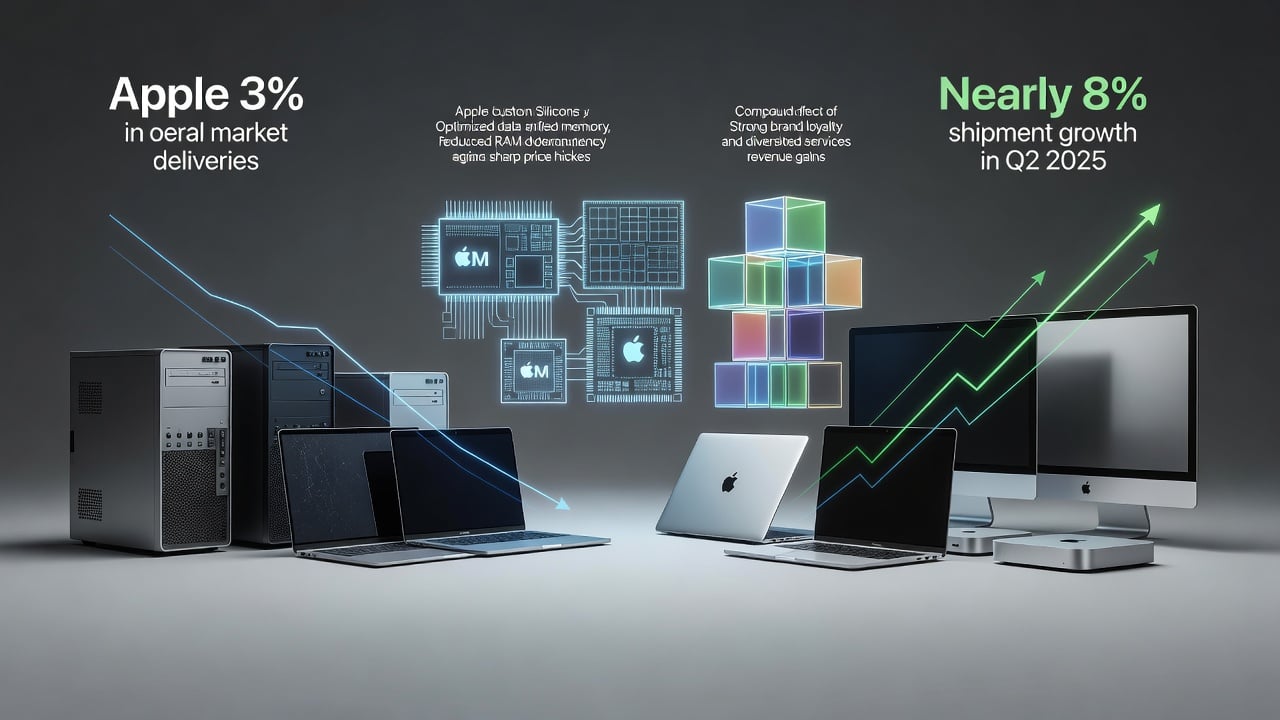
Apple stands out as the sole area of growth within a personal computer market that continues to shrink overall, according to recent industry reports. While global PC shipments fell by roughly 3 percent in the second quarter of 2025 compared with the same period a year earlier, Apple managed to increase its own deliveries by nearly 8 percent. This contrast highlights the unique position the company occupies even as broader economic pressures and component costs weigh heavily on competitors.
The PC sector has faced multiple headwinds over the past several years. After a brief surge during the pandemic when remote work and learning drove demand, the market entered a prolonged decline. Manufacturers such as Dell, HP, and Lenovo have reported weaker sales as businesses and consumers delay upgrades. Economic uncertainty, higher interest rates, and shifting priorities toward mobile devices have all contributed to the slowdown. Within this challenging environment, Apple has posted gains that other vendors have struggled to match.
One major factor suppressing growth across the industry involves sharp increases in memory prices. Random access memory, commonly known as RAM, has seen costs climb dramatically due to supply constraints and heightened demand from other sectors including artificial intelligence servers and smartphones. Industry analysts tracking these trends have pointed to a nearly 40 percent rise in DRAM pricing over recent quarters. This increase directly affects the bill of materials for PC makers, forcing them to either absorb the added expense or pass it along to buyers through higher retail prices. Either choice tends to dampen sales volume.
Apple has proven less vulnerable to these cost pressures than its rivals. The company designs its own silicon, including the M-series chips that power current Mac models. By tightly integrating hardware and software, Apple optimizes memory usage in ways that reduce the total amount of RAM required for comparable performance levels. A MacBook Air with 16 gigabytes of unified memory often delivers multitasking and creative application performance that exceeds Windows laptops carrying 32 gigabytes or more of traditional RAM. This efficiency allows Apple to maintain competitive pricing even when component costs rise.
Market research firm IDC released figures showing Apple’s worldwide PC shipments reached approximately 5.8 million units in the April-to-June period. That result represented an 7.8 percent increase from the prior year and lifted the company’s market share to just over 10 percent. By comparison, Lenovo remained the overall leader but saw shipments drop by 2 percent. HP and Dell posted declines of 4 percent and 6 percent respectively. These numbers come from AppleInsider’s coverage of the latest IDC and Canalys data, which consistently shows Apple bucking the downward trend.
Several elements explain Apple’s resilience. First, the transition to Apple silicon has produced machines that run cooler, use less power, and deliver longer battery life than previous Intel-based models. Customers who once viewed Macs as expensive niche products now see them as strong values, especially in professional segments such as software development, video editing, and data analysis. The MacBook Pro lineup, particularly models with M3 and M4 chips, continues to attract buyers willing to invest in premium hardware that holds its value over time.
Second, Apple’s services business provides a buffer against hardware market swings. Recurring revenue from iCloud, Apple Music, Apple TV+, and the App Store grows steadily regardless of PC shipment volumes. This financial stability gives Apple more flexibility to invest in research and development while maintaining healthy margins on its devices. When RAM prices spike, the company can adjust configurations or absorb some of the increase without immediately threatening overall profitability.
Third, enterprise adoption of Macs has accelerated. Many organizations that once standardized exclusively on Windows PCs have begun supporting Apple hardware as part of broader device diversity initiatives. Improved management tools in macOS, combined with the security advantages of the M-series architecture, have convinced IT departments to expand their fleets. The education market also remains strong, with school districts and universities equipping students and faculty with MacBooks that offer longevity and a consistent user experience across years of updates.
The RAM price surge stems from multiple supply chain dynamics. Manufacturers of memory chips allocate more production capacity toward high-margin AI accelerators and server components, leaving less for consumer PCs. Geopolitical tensions and natural disasters at key fabrication sites have further tightened supply. As a result, PC makers without Apple’s vertical integration face difficult choices. Some have introduced lower-specification models with reduced memory to keep prices steady, but these machines often receive poor reviews for sluggish performance in modern applications.
Apple’s approach to memory differs fundamentally from the rest of the industry. The company’s unified memory architecture shares a single pool between the CPU, GPU, and neural engine. This design eliminates the overhead of copying data between separate memory spaces, improving both speed and efficiency. Consequently, Apple can specify lower nominal RAM capacities while achieving higher real-world performance. Customers upgrading from older Intel Macs frequently report that 16 gigabytes of Apple silicon memory feels more responsive than 32 gigabytes in comparable Windows systems.
Looking at regional performance, Apple showed particular strength in North America and parts of Europe where brand loyalty runs high. The company also gained ground in emerging markets through aggressive education pricing and expanded retail presence. Meanwhile, traditional PC vendors have watched their volumes erode most sharply in Asia, where local brands and lower-cost alternatives compete aggressively on price.
Analysts expect the memory price situation to remain challenging through the remainder of 2025. New fabrication facilities will eventually increase supply, but those plants require years to build and bring online. In the interim, PC manufacturers must find ways to differentiate their products beyond simple hardware specifications. Many are turning to artificial intelligence features, hoping that on-device machine learning capabilities can justify premium pricing despite elevated component costs.
Apple has invested heavily in this area as well. The M4 chip includes a significantly enhanced neural processing unit capable of running advanced AI models locally. Features such as improved Siri intelligence, real-time image generation within creative apps, and enhanced security through on-device processing appeal to both consumers and businesses wary of cloud-only solutions. By controlling the entire stack from silicon to operating system, Apple can optimize these AI workloads more effectively than competitors relying on third-party chips and software layers.
The contrast between Apple and the broader market raises questions about the future structure of the PC industry. If current trends continue, further consolidation appears likely. Smaller vendors may exit the space or merge with larger players. Meanwhile, Apple’s ability to grow during a downturn suggests that tight hardware-software integration and control over key technologies provide meaningful advantages. The company’s focus on quality over quantity, combined with a loyal customer base that upgrades on a longer cycle, creates a more stable business model than the high-volume, low-margin approach many Windows PC makers have traditionally followed.
Supply chain experts tracking these developments note that Apple’s long-term contracts with memory suppliers and its practice of buying components years in advance help shield it from short-term price volatility. When shortages emerge, Apple often secures allocation that other manufacturers cannot obtain. This purchasing power, developed over decades of scale in consumer electronics, translates directly into competitive strength in the PC segment.
Consumer sentiment also plays a role. Reviews of recent Mac models consistently highlight reliability, display quality, keyboard comfort, and the overall polish of the macOS experience. While Windows laptops have improved considerably, particularly in areas such as convertible designs and gaming performance, many buyers still perceive Apple products as more refined. That perception supports higher average selling prices, which in turn generate the revenue needed to weather periods of component inflation.
As the industry moves toward greater emphasis on artificial intelligence, Apple’s hardware foundation positions it favorably. The company has already demonstrated local execution of large language models on Macs without requiring constant internet connectivity. This capability addresses privacy concerns that have slowed adoption of cloud-based AI tools in many organizations. Future updates to macOS are expected to expand these features, potentially widening the performance gap with competing platforms that depend more heavily on external processing.
Despite the positive results, Apple faces its own challenges. The high cost of entry for many Mac models still excludes price-sensitive buyers. Competition from increasingly capable Chromebooks in education and from high-end Windows machines in creative fields continues to intensify. Additionally, any slowdown in iPhone sales could indirectly affect Mac growth since many customers purchase across Apple’s product lines.
Still, the company’s second-quarter performance demonstrates that a different approach to personal computing can succeed even when traditional metrics point toward contraction. By focusing on efficiency, user experience, and long-term value rather than chasing quarterly shipment records, Apple has created a buffer against the cyclical nature of the PC market. As memory prices eventually stabilize and new technologies reach the market, this foundation may allow continued expansion while others struggle to regain momentum.
The coming months will reveal whether Apple can sustain its growth as the industry adapts to higher baseline costs. Early indications suggest the company’s combination of custom silicon, software optimization, and brand strength provides a formula that works in both expanding and contracting markets. For an industry that has grown accustomed to annual declines, Apple’s results offer a reminder that thoughtful design and vertical integration can produce outcomes that defy broader trends. The PC market may be shrinking overall, but within that contraction, Apple continues to find opportunities for expansion.


 WebProNews is an iEntry Publication