
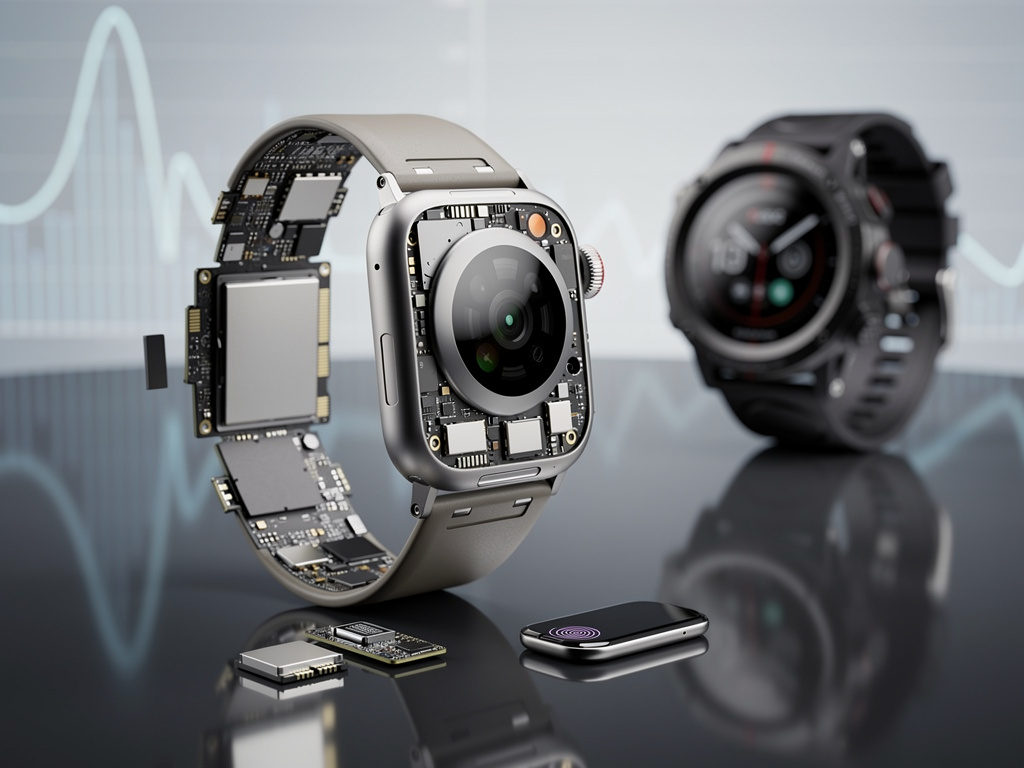
Apple has quietly set aside long-standing ideas for fingerprint authentication on its signature wearable. A prominent supply-chain source now says the company would rather devote scarce internal room to expanded battery capacity and sharper health-tracking components. The decision comes as the Apple Watch Series 11, released last fall, already delivers up to 24 hours of regular use. That marks a clear gain over the 18-hour rating of the Series 10. Yet for many owners the daily charge still feels like a chore.
Leaker Instant Digital laid out the shift in a post on Weibo this week. MacRumors reported the claim within hours. Apple, the source said, remains satisfied letting users unlock the watch through its paired iPhone. Adding a fingerprint sensor would raise costs and shrink the space available for a larger cell. The tradeoff, according to the leaker, simply does not justify itself right now.
The news lands after years of speculation. Back in 2020 Apple explored placing a sensor in the Digital Crown. Patent drawings left little doubt. Then last August code references to “AppleMesa” — the company’s internal name for Touch ID — surfaced in builds tied to 2026 models. 9to5Mac noted the discovery first surfaced via Macworld before MacRumors confirmed it. Observers pictured the sensor under the display or inside the side button, much like on recent iPads. Those expectations have now cooled.
But why drop the feature? Two practical reasons stand out. First, the added hardware carries real expense at a moment when memory prices and other component costs have tightened margins. Second, the circuitry needed to process fingerprint data would directly reduce room for battery volume. Instant Digital put it plainly. The current focus sits on stuffing larger batteries into the device and refining advanced health sensors.
That emphasis matches what Apple delivered in the Series 11. The model offers 24 hours of battery on a single charge and up to 38 hours in Low Power Mode. A 15-minute fast charge delivers eight hours of use. Apple’s own newsroom post highlighted the gains alongside new hypertension notifications, restored blood-oxygen sensing, and twice-as-scratch-resistant glass. Real-world tests back the claims. Many reviewers say the jump feels meaningful even if it does not reach multi-day endurance.
Still, the gap with dedicated fitness watches remains wide. Matt Evans, a TechRadar contributor who reviews wearables for a living, recently moved from Garmin’s Fenix 8 and Venu 4 to the Apple Watch Ultra 3. Ten days between charges had become his baseline. The Ultra demands attention every couple of days. “The need to charge it every couple of days is my biggest annoyance,” he wrote. TechRadar published his take alongside the latest rumor. Evans calls the reported battery priority “music to my ears.” He values the health-sensor accuracy Apple continues to chase. Yet the daily ritual of charging still frustrates.
Industry watchers see a clear strategic choice. Apple treats the iPhone as the primary authentication device. Once paired, the watch wakes with a simple wrist raise most of the time. It locks automatically when removed. For the small number of users who run LTE models independently, a passcode has sufficed. The added complexity and cost of Touch ID no longer seem urgent.
Design changes for the Apple Watch appear limited in the immediate future. The 2026 lineup is expected to look much like this year’s models. A more substantial refresh may wait until 2028. That later window could open space for features such as noninvasive glucose monitoring, though the technology remains early. Battery gains and sensor improvements will likely carry the marketing message until then.
Competitors have taken notice. Garmin continues to market watches that last weeks on a charge. Ultramarathoners and expedition hikers often cite that endurance as decisive. Apple, by contrast, has built its wearable around tight integration with the phone, constant notifications, and an expanding list of medical-grade sensors. The priorities differ. So do the tradeoffs.
Some users welcome the news. A longer-lasting Apple Watch without new biometric hardware might feel more practical than a device that adds complexity but still needs nightly power. Others lament the missed chance for true independence. An LTE watch with reliable fingerprint unlock could function more like a standalone communicator. The leaker’s report suggests Apple has calculated the numbers and chosen capacity instead.
The pattern fits Apple’s recent behavior. The Series 11 already stretched battery life by a third while adding hypertension detection and tougher materials. Further incremental gains in endurance and sensor precision appear more attainable than squeezing a high-quality fingerprint reader into the slim chassis. Cost pressures only reinforce that math.
Of course, plans can change. Leakers sometimes miss internal pivots. Apple has surprised observers before. For now the signals point one direction. Bigger cells. Sharper readings. Daily charging that, while improved, still defines the experience. The Touch ID dream, at least for the next cycle, sits on the shelf.
Analysts will watch the supply chain closely in coming months. Any shift in component orders could hint at last-minute adjustments. Until then, the message from Cupertino seems straightforward. The watch will get better at the things it already does well. And users who want week-long battery life may still need to look beyond the Apple logo.


 WebProNews is an iEntry Publication