
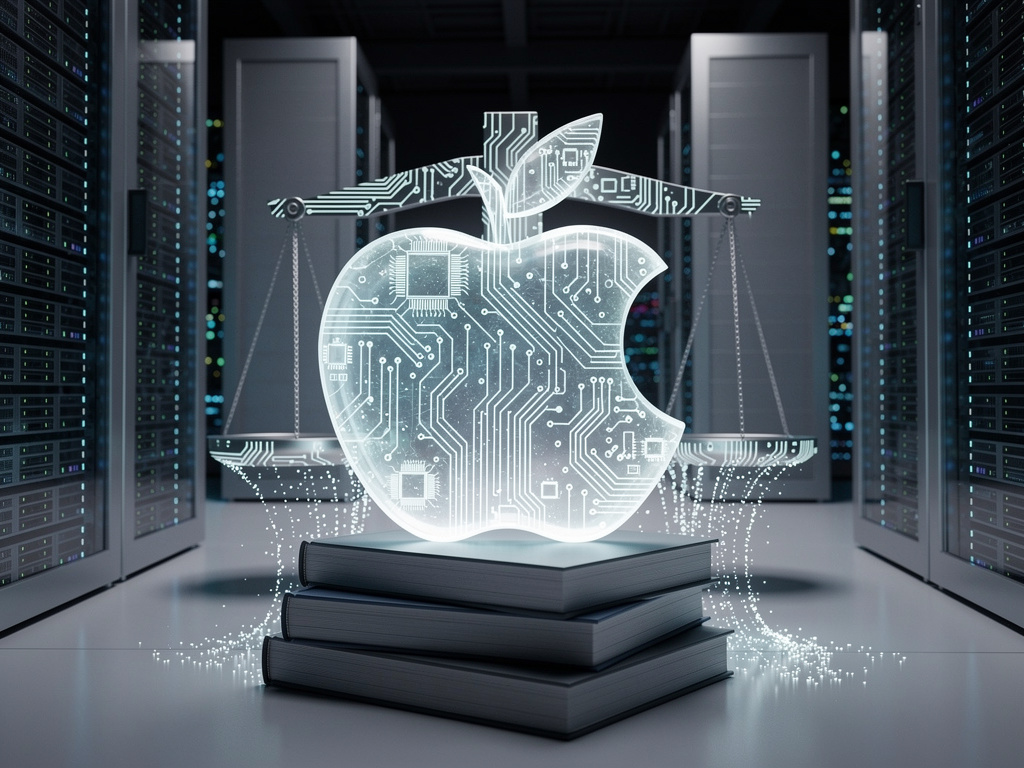
Apple has once again been pulled into a sprawling copyright infringement lawsuit alleging that the tech giant trained its artificial intelligence models on a massive dataset of pirated books. The complaint, which has been amended multiple times and now names Apple alongside other major AI developers, centers on a dataset known as Books3 — a collection of roughly 196,000 pirated books scraped from shadow library sites. The legal battle is intensifying at a moment when the entire AI industry faces an existential reckoning over where its training data actually comes from.
The case isn’t new. But the latest amended complaint, filed in a federal court in the Northern District of California, draws Apple deeper into the fray by alleging that the company used the Books3 dataset to train its AppleGPT and Ajax language models. According to AppleInsider, the plaintiffs — a group of authors — argue that Apple knowingly ingested copyrighted works without permission or compensation, violating their rights on a massive scale.
Apple isn’t alone in the crosshairs. The lawsuit also targets Nvidia, Meta, Bloomberg, and other corporations that allegedly used Books3 or similar pirated text corpora. But Apple’s inclusion is particularly notable because the company has long positioned itself as a champion of user privacy and ethical technology. Being accused of feeding pirated literature into its AI systems cuts against that brand identity in uncomfortable ways.
The Books3 Problem
Books3 was created by Shawn Presser and distributed as part of a larger collection called “The Pile,” an open-source dataset assembled by EleutherAI. The Pile was designed to give AI researchers access to diverse, high-quality text data. Books3 specifically contained full-text copies of books sourced from Bibliotik, a private torrent tracker for ebooks. In plain terms: the books were pirated.
The dataset was widely adopted across the AI research community before its legal and ethical problems became impossible to ignore. It has since been taken down from its original hosting location, but the damage — if courts determine it to be damage — was already done. Researchers and companies had already downloaded it and, allegedly, used it to train some of the most powerful language models in existence.
For authors, this feels like theft at industrial scale.
The plaintiffs in the case include writers whose works appeared in Books3 without any licensing agreement. Their argument is straightforward: these companies copied entire books, processed them through AI training pipelines, and now profit from models whose capabilities are built, in part, on that stolen intellectual property. The authors aren’t asking for a small settlement. They want damages, injunctive relief, and a precedent that makes clear this kind of mass ingestion of copyrighted material is illegal.
Apple’s specific exposure in the case relates to internal AI projects that have been the subject of growing public interest. Reports over the past two years have detailed Apple’s development of large language models under the internal codenames AppleGPT and Ajax. These models are believed to underpin features in Apple Intelligence, the company’s AI platform announced in 2024 and integrated across its devices. The plaintiffs allege that Apple used Books3 as part of the training data for these models, though the specifics of Apple’s training data pipeline remain closely guarded.
Apple has not publicly commented on the specific allegations in the amended complaint. The company has generally been tight-lipped about the datasets used to train its AI systems, which is standard practice in the industry but increasingly untenable as legal scrutiny mounts.
A Legal Reckoning That Extends Far Beyond One Lawsuit
This case is part of a much larger wave of copyright litigation crashing into the AI industry. The New York Times sued OpenAI and Microsoft in late 2023. Getty Images has pursued Stability AI over image generation trained on its photos. Authors including Sarah Silverman and Michael Chabon filed early suits against Meta and OpenAI. And the Authors Guild has been vocal in demanding that AI companies negotiate licensing agreements rather than treating the world’s published literature as free training fodder.
The legal theories vary, but the core question is the same everywhere: does training an AI model on copyrighted material constitute fair use, or is it infringement?
AI companies have generally argued that training is transformative — that the models don’t store or reproduce the original works but instead learn statistical patterns from them. This, they contend, falls squarely within fair use doctrine. The counterargument from authors and publishers is that the sheer commercial value extracted from these models, combined with the wholesale copying required during training, overwhelms any fair use defense.
No court has issued a definitive ruling on this question yet. But the volume of cases is building pressure for one. And the outcomes will shape how AI development works — and what it costs — for decades.
For Apple specifically, the stakes extend beyond this single lawsuit. The company is in the middle of a massive push to integrate AI across its product line. Apple Intelligence is now a flagship feature of the iPhone, iPad, and Mac. If courts determine that the training data underlying Apple’s models was obtained illegally, the company could face not only financial penalties but also orders to retrain its models from scratch — an enormously expensive and time-consuming process.
There’s also the reputational dimension. Apple charges a premium for its products and justifies that premium partly through a narrative of doing things the right way. Privacy. Security. Respect for creators. Being lumped in with companies accused of mass piracy undermines that narrative, regardless of the legal outcome.
The broader AI industry is watching these cases with intense interest. Some companies have started striking licensing deals preemptively — OpenAI has agreements with several major publishers, and Google has pursued similar arrangements. Apple, characteristically, has said little about its approach to data licensing. But the pressure to show clean provenance for training data is only growing.
So where does this go? The lawsuit will likely take years to resolve fully. Motions to dismiss, discovery battles over proprietary training data, and potential appeals could stretch the timeline well into the late 2020s. In the meantime, the amended complaint keeps the issue in the headlines and keeps Apple on the defensive.
And the authors aren’t backing down. Every amendment to the complaint has broadened the scope and added detail. The plaintiffs’ legal team appears to be building a case designed not just to win damages but to establish a legal framework that forces the entire AI industry to pay for the words it consumes. Whether they succeed will depend on how courts interpret copyright law in a context its drafters never imagined.
For now, Apple sits in an increasingly crowded defendant’s chair, alongside some of the biggest names in technology. The company that built its brand on thinking different may soon have to explain exactly how it trained its AI — and whether the books it allegedly used were ever its to read.


 WebProNews is an iEntry Publication