
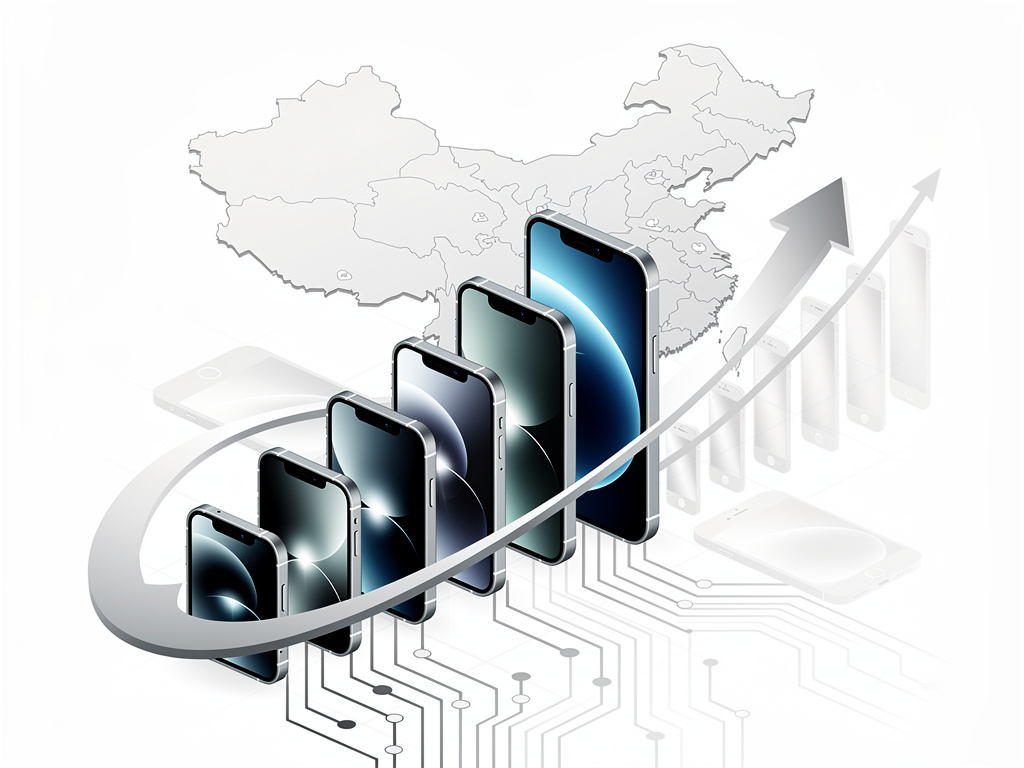
In a market where nearly every major smartphone brand is bleeding volume, Apple just posted growth. That alone would be notable. But the scale of China’s broader smartphone contraction — and the specific dynamics driving Apple’s resilience — tell a story that goes far beyond a single quarter’s shipment data.
According to MacRumors, Apple defied a significant downturn in China’s smartphone market during the first months of 2026, growing its shipments even as the overall market declined sharply. The data, compiled by research firms tracking sell-through and channel inventory across China’s complex retail and online distribution networks, paints a picture of a company that has figured out something its competitors haven’t — or at least something they can’t easily replicate.
China’s smartphone market shrank by an estimated double-digit percentage in the period, dragged down by softening consumer confidence, an uneven economic recovery, and what analysts describe as saturation fatigue. Consumers are holding onto their phones longer. Replacement cycles that once ran 18 to 24 months have stretched past three years for many buyers. The cheap-phone boom that once powered brands like Xiaomi, Oppo, and Vivo to massive volume gains has stalled as those buyers simply stop upgrading.
Apple, though, operates in a different stratum.
Its customers skew wealthier. They’re more likely to trade in devices regularly. And the iPhone’s integration with services — iCloud, Apple Pay, the App Store — creates a stickiness that pure hardware competitors struggle to match. When Apple releases a new flagship, its installed base responds. Not all of them, but enough. Enough to push shipments upward in a market where everyone else is contracting.
The numbers are striking. While Huawei has mounted an impressive comeback story of its own — powered by its domestically manufactured Kirin chipsets and a wave of nationalist consumer sentiment — even Huawei’s growth has shown signs of plateauing as supply constraints and component limitations cap its ceiling. Xiaomi and Oppo, meanwhile, have been locked in a brutal price war at the mid-range, eroding margins without meaningfully growing unit volumes. Vivo, once a top-three player in China, has seen its share slip further.
And then there’s Apple, shipping more iPhones into China than it did a year ago.
How? Part of the answer is product. The iPhone 17 lineup, expected to arrive later this year, has already begun shaping purchase decisions through what the industry calls the “anticipation effect” — but the current iPhone 16 series, particularly the Pro and Pro Max models, has performed well in China thanks to camera improvements, titanium design, and the cachet that Apple’s brand still carries in tier-one and tier-two Chinese cities. Apple’s aggressive trade-in and financing programs, run in partnership with major Chinese banks and through its own retail stores, have also lowered the effective purchase price for upgraders.
But product alone doesn’t explain it. Pricing strategy matters enormously in China, and Apple has been uncharacteristically flexible. Authorized resellers on platforms like JD.com and Tmall have offered discounts that would have been unthinkable five years ago. Apple hasn’t officially cut list prices — it rarely does — but the channel discounts are real, visible, and substantial. A Pro Max that lists for over 9,000 yuan can often be found for 7,500 to 8,000 yuan through promotional events. Apple tolerates this because it moves units. Volume matters when you’re trying to grow a services business that depends on an expanding installed base.
So the hardware margin takes a hit. Apple can absorb it. Its competitors, operating on already-thin margins, cannot play the same game without bleeding cash.
The geopolitical backdrop adds another layer of complexity. Relations between Washington and Beijing remain tense, and there have been periodic waves of social media campaigns encouraging Chinese consumers to buy domestic brands. Government procurement policies have increasingly favored Huawei and other local manufacturers. Some state-owned enterprises have quietly discouraged employees from using iPhones. Yet Apple’s consumer sales have held up, suggesting that for individual buyers — as opposed to institutional purchasers — brand preference still trumps political signaling.
This resilience isn’t guaranteed to last. Huawei’s next-generation devices, expected in the second half of 2026, could pose a more serious competitive threat if the company manages to close the performance gap with Apple’s A-series and upcoming chips. Huawei’s HarmonyOS has matured significantly, and its app library — once a glaring weakness after the company lost access to Google services — has grown to the point where most Chinese consumers don’t notice a meaningful deficit. In China, Google services were never widely used anyway, so the sanctions-driven divorce from Android has been less painful domestically than internationally.
There’s also the question of Apple Intelligence. Apple’s AI features, announced with great fanfare, have rolled out unevenly in China due to regulatory requirements around generative AI and data localization. Chinese consumers who see AI-powered features demonstrated in Western markets but unavailable on their own devices may eventually grow frustrated. For now, it hasn’t dented demand. But it’s a vulnerability.
Wall Street has taken notice of Apple’s China performance. The stock, which had been under pressure earlier in the year on fears of a China slowdown, has stabilized as the shipment data emerged. Analysts at several major banks revised their estimates upward for Apple’s Greater China revenue in the March and June quarters. Morgan Stanley’s Erik Woodring, one of the more closely followed Apple analysts, has pointed to China as a source of upside surprise potential — a reversal from late 2025, when it was widely seen as Apple’s biggest geographic risk.
The broader implications for the smartphone industry are sobering. If the world’s largest smartphone market by volume is contracting, and only the most premium brand is growing, that suggests the industry’s growth phase is definitively over in China. What remains is a share battle — and a margin battle — that favors companies with strong brands, loyal customers, and diversified revenue streams. Apple checks all three boxes. Most of its Chinese competitors check one at best.
Xiaomi has tried to move upmarket with its Ultra series and its electric vehicle business, which has generated enormous buzz in China. But smartphones remain the core business, and in that core business, Xiaomi is fighting for scraps of margin in a shrinking pool. Oppo’s parent company, BBK Electronics, which also controls Vivo and OnePlus, has the scale to weather a downturn, but scale without margin growth is just survival, not prosperity.
For Apple, China represents roughly 17% to 19% of total revenue in any given quarter — a share that has remained remarkably stable even as the headline risks have multiplied. Tim Cook visits China regularly, meets with government officials, and has cultivated relationships that give Apple a degree of political cover unusual for an American technology company operating in the country. Apple’s supply chain remains deeply embedded in China, with major assembly partners like Foxconn and Pegatron operating massive facilities there. This isn’t a company that can easily be disentangled from China, and Beijing knows it.
The mutual dependency cuts both ways. China needs Apple’s supply chain jobs and export revenue. Apple needs China’s consumers and its manufacturing infrastructure. Neither side has an incentive to blow up the relationship, even as both governments posture publicly.
Still, the risk calculus is shifting. Apple has been diversifying its manufacturing footprint toward India and Vietnam for years, and that process is accelerating. More iPhone models are now assembled in India than ever before, and Apple’s Indian manufacturing output is expected to double again over the next two years. This doesn’t reduce Apple’s dependence on China as a market, but it does reduce its dependence on China as a factory — a distinction that matters enormously if tariffs or export controls escalate.
Back in the Chinese retail trenches, the picture is one of quiet dominance. Apple’s flagship stores in Shanghai, Beijing, and Shenzhen continue to draw crowds. Its online presence on WeChat, Douyin, and other Chinese platforms has grown more sophisticated. The company has hired aggressively in China for marketing and retail roles, signaling that it sees the market as worth investing in even during a downturn.
None of this makes Apple invincible in China. A severe economic downturn, a sharp escalation in U.S.-China tensions, or a breakthrough product from Huawei could all change the trajectory. But right now, in March 2026, Apple is doing something that almost no other foreign technology company has managed in China: growing while the market shrinks, commanding premium prices while competitors slash theirs, and maintaining brand desirability in a country where economic nationalism is a real and rising force.
That’s not luck. It’s the compounding result of years of investment in brand, product, retail, services, and political relationships. And it’s a position that will be extraordinarily difficult for any competitor — Chinese or otherwise — to replicate.


 WebProNews is an iEntry Publication