
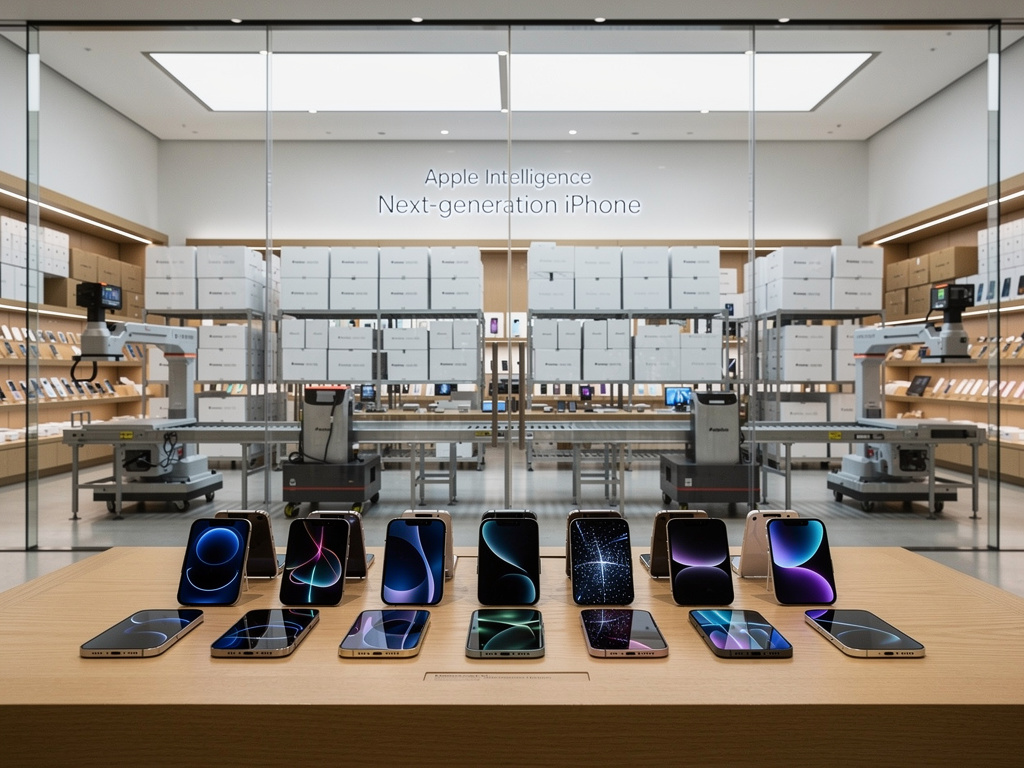
Apple Inc. is gearing up for what it expects to be one of the most frenzied customer rushes in recent memory, with internal planning documents and retail staffing strategies pointing to a product launch cycle that could rival the fervor of the iPhone 6 era. According to a report from MacRumors, the Cupertino-based tech giant has been quietly marshaling resources across its global retail footprint, signaling that what’s coming next is not just another incremental update — it’s the kind of release that moves lines around city blocks.
The company’s preparations extend well beyond the usual pre-launch choreography. Apple has reportedly begun extending retail employee schedules, canceling planned time off for store staff during key windows, and coordinating with third-party logistics partners to handle what it anticipates will be extraordinary demand. These are the kinds of operational signals that Wall Street analysts have learned to watch closely, as they often precede quarters with outsized revenue performance.
Retail Mobilization Signals Confidence in Consumer Demand
Apple’s retail stores have long served as the company’s most visible barometer of consumer enthusiasm. When Apple expects a major product cycle, the signs show up first in its stores: additional hiring, extended hours, reconfigured floor layouts, and intensified employee training sessions. All of these indicators are now flashing, according to the MacRumors report, which cited sources familiar with Apple’s internal retail communications.
Store managers across multiple regions have reportedly been briefed on new crowd-management protocols, including revised queuing systems and expanded appointment-based purchasing options. Apple has been refining its in-store pickup and reservation systems since the pandemic years, and the current preparations suggest the company plans to stress-test those systems at scale. The message from Cupertino to its retail leadership has been unambiguous: prepare for volume that exceeds recent launch cycles by a significant margin.
What’s Driving the Anticipated Surge?
While Apple has not publicly confirmed the specific products driving this level of preparation, industry observers point to several converging factors. The company is widely expected to release a significantly redesigned iPhone lineup later this year, potentially incorporating new display technology, a revamped camera system, and — most critically — a substantially upgraded Apple Intelligence platform that has been in development for more than two years. The integration of advanced on-device AI capabilities has been a central theme of Apple’s recent strategy, and the next iPhone generation is expected to be the first where those capabilities are fully mature and broadly accessible.
Beyond the iPhone, Apple is also believed to be preparing updates across its Mac, iPad, and wearable lines that could contribute to a concentrated wave of consumer spending. The company’s decision to align multiple product refreshes within a tight launch window is itself a strategic choice, one designed to maximize foot traffic and cross-selling opportunities in its retail stores. Analysts at Morgan Stanley and JPMorgan have both noted in recent research notes that Apple’s supply chain activity in early 2026 has been notably aggressive, with component orders running ahead of historical patterns for this point in the product cycle.
The Supply Chain Tells Its Own Story
Apple’s supply chain partners in Asia have been ramping production capacity since late 2025, according to multiple reports from industry trackers. Foxconn, Apple’s largest assembly partner, has been on an aggressive hiring spree at its facilities in Zhengzhou and Chennai, adding tens of thousands of workers in recent months. TSMC, which fabricates Apple’s custom silicon, has reportedly allocated additional wafer capacity to Apple’s next-generation chip designs, a move that suggests Apple is planning for unit volumes that exceed prior years.
These supply chain signals are consistent with Apple’s internal retail preparations. When a company simultaneously ramps manufacturing, logistics, and retail operations, it typically reflects a high degree of internal conviction about demand. Apple has been burned before by both over- and under-forecasting — the iPhone 14 Plus was a notable example of misread demand, while the iPhone 6 and iPhone 6 Plus saw shortages that persisted for months. The current level of coordination suggests Apple is trying to thread the needle: build enough inventory to meet a massive initial wave without creating the kind of excess that leads to write-downs.
Wall Street Is Watching the Signals Closely
For investors, Apple’s pre-launch behavior carries real informational value. The stock has historically outperformed in quarters where launch-related indicators are strongest, and the current constellation of signals — retail mobilization, supply chain ramp, and logistics coordination — is among the most bullish in recent years. Apple shares have already climbed roughly 8% year-to-date as of early March 2026, and several analysts have flagged the potential for further upside if the launch cycle delivers on the company’s apparent expectations.
Erik Woodring, an analyst at Morgan Stanley, wrote in a recent note to clients that Apple’s operational posture heading into the second half of 2026 “suggests a level of confidence in the product cycle that we haven’t seen since the iPhone 12 super-cycle in 2020.” He maintained an Overweight rating on the stock with a price target that implies roughly 15% additional upside from current levels. Separately, Samik Chatterjee at JPMorgan has pointed to Apple’s inventory build patterns as evidence that the company is preparing for a launch that could drive a meaningful acceleration in iPhone unit sales after two years of relatively flat volumes.
The Apple Intelligence Factor
Much of the anticipated demand centers on Apple Intelligence, the company’s branded AI platform that debuted in a limited form with iOS 18 in late 2024 and has been expanding steadily since. The next major iteration, expected to ship with the fall 2026 product lineup, is believed to include significantly more capable on-device language models, advanced photo and video editing tools powered by generative AI, and a deeply integrated personal assistant experience that goes well beyond what Siri has offered historically.
Apple’s approach to AI has been characteristically deliberate. While competitors like Google, Samsung, and Microsoft moved quickly to integrate large language models into their products — sometimes with mixed results — Apple has taken a slower path, emphasizing privacy, on-device processing, and tight hardware-software integration. That patience may be about to pay off. Consumer surveys conducted by firms including Counterpoint Research and Creative Strategies have shown that awareness of and interest in AI-powered smartphone features has grown substantially over the past 18 months, and Apple’s brand carries a level of trust on privacy issues that its competitors have struggled to match.
Retail Experience as Competitive Advantage
Apple’s physical retail presence remains a formidable asset in an era when most consumer electronics are purchased online. The company operates more than 500 stores worldwide, and those locations serve not just as points of sale but as experiential showrooms where customers can interact with products before buying. For a launch cycle that includes significant new hardware features — potentially including new display form factors and camera capabilities — the ability to put devices in customers’ hands is a meaningful advantage.
The preparations described in the MacRumors report suggest Apple intends to make the in-store experience a central part of its launch strategy. Enhanced demo stations, dedicated zones for Apple Intelligence features, and expanded Genius Bar availability are all reportedly part of the plan. Apple has also been investing in its online store infrastructure, with server capacity upgrades and revised checkout flows designed to handle the kind of traffic spikes that have historically caused site outages on launch day.
Historical Context and What Comes Next
Apple has seen several “super-cycles” in its history — periods where pent-up demand, a compelling product upgrade, and favorable market conditions combine to produce outsized sales. The iPhone 6 cycle in 2014-2015, driven by the first large-screen iPhones, was perhaps the most dramatic example, generating record quarterly revenue that stood for years. The iPhone 12 cycle in 2020-2021, powered by the transition to 5G, produced another significant spike. If Apple’s internal preparations are any guide, the company believes the 2026 cycle could belong in that same category.
The stakes are considerable. Apple’s services business, which now generates more than $100 billion in annual revenue, depends heavily on a large and growing installed base of hardware users. Every major iPhone cycle doesn’t just drive device revenue — it pulls new customers into Apple’s orbit of subscriptions, apps, and digital content. A successful launch cycle in the second half of 2026 could set the stage for years of downstream services growth, a dynamic that Wall Street has increasingly come to value in Apple’s stock.
For now, Apple’s official communications remain characteristically tight-lipped. The company has not confirmed specific launch dates, product details, or demand forecasts. But the operational evidence — from retail floors in Manhattan to factory lines in Zhengzhou — tells a story of a company that is betting big on what comes next. If history is any guide, when Apple prepares at this scale, the customers tend to show up.


 WebProNews is an iEntry Publication