
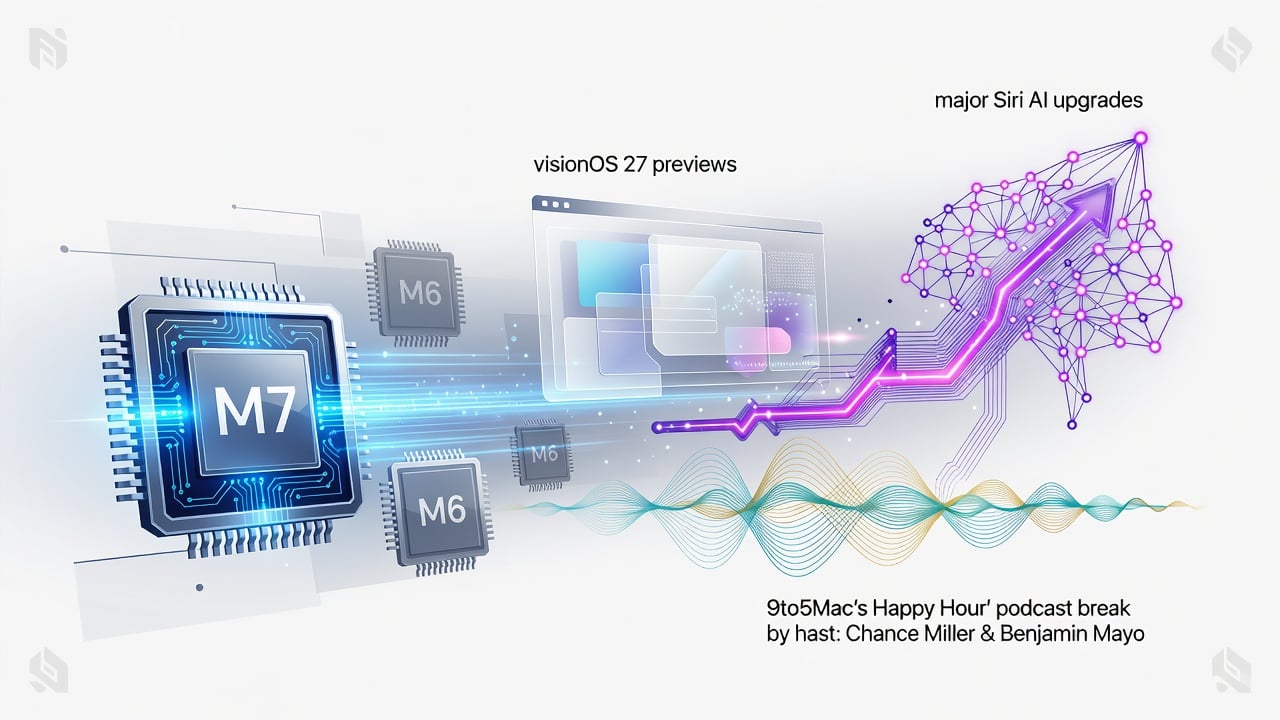
Apple’s chip development schedule just received a major jolt. Bloomberg reporter Mark Gurman revealed that the company plans to speed up work on its M7 series of processors. The move comes at the expense of the still-unreleased M6 line. Engineers now face tighter deadlines. Resources shift. The entire silicon roadmap bends in new directions.
Chance Miller and Benjamin Mayo unpacked the implications on the latest episode of 9to5Mac’s Happy Hour podcast. They noted how Apple intends to skip certain M6 variants entirely. Pro and Max configurations may never see daylight. Instead the focus turns sharply toward M7 silicon that could power devices sooner than analysts once projected. The hosts described the decision as a calculated bet on faster iteration cycles.
But the chip news represents only one thread in a broader story. Apple’s software teams delivered extensive previews at WWDC 2026. The company introduced the next generation of Apple Intelligence features alongside a profoundly upgraded Siri. Tim Cook, in what appears to be his final keynote as CEO, opened the event with measured remarks. “Today we’re looking forward to sharing some exciting announcements, including our latest advances in Apple Intelligence and Siri,” he said, according to CNBC coverage.
Craig Federighi took center stage for much of the technical detail. “Today we’re taking a big step forward,” the software chief declared during the Cupertino presentation, as reported by NPR. The new Siri can hold back-and-forth conversations. It draws on personal context. On-screen awareness improves. App actions become more fluid. Privacy controls remain front and center. Apple positioned the updates as thoughtful advances rather than flashy demonstrations.
Those software gains now intersect with hardware decisions. The accelerated M7 timeline could bring faster neural engines. More efficient cores. Greater capacity for on-device processing. Such capabilities matter when Siri AI must reason across apps and user data without constant cloud calls. The partnership with Google supplies Gemini models as a backbone for certain tasks. Yet Apple insists the core experience stays anchored in its own silicon and privacy architecture.
VisionOS 27 received close attention on the Happy Hour episode. New features target spatial computing users. Interface refinements make interactions feel more natural. Performance gains appear across the board. The hosts walked through changes that range from subtle visual tweaks to deeper integration with the upcoming intelligence tools. They also fielded listener questions in the summer edition of Ask9to5Mac. Topics ranged from practical device advice to speculation about future product categories.
One related report from 9to5Mac highlighted that Apple’s anticipated touchscreen MacBook will rely on M5 Pro and M5 Max chips rather than M6 variants. The story, published days earlier, added context to the shifting roadmap. Development priorities clearly favor certain product lines over others. Mac notebooks slated for touch capabilities may arrive with proven silicon instead of waiting for the next full generation.
Meanwhile the iOS 27 update carries forward many of the WWDC announcements. Parental controls gain strength. Child safety tools expand. The operating system feels more responsive. Design language receives polish. Apple described the collection of changes as improvements that elevate everyday experiences while maintaining the company’s focus on security. Apple’s official newsroom post detailed the scope across iOS, iPadOS, macOS, watchOS, visionOS and tvOS.
Analysts watch these moves with keen interest. Tim Cook’s impending transition adds another layer. John Ternus stands poised to assume the CEO role in September. The WWDC presentation carried the feel of a capstone for Cook’s tenure. He closed with a personal note. “I still believe the best is yet ahead,” Cook told the audience, per WIRED’s recap. The remark struck a forward-looking tone even as the company confronts intense competition in artificial intelligence.
Recent coverage reinforces the narrative. PCMag examined every major announcement from the conference and questioned whether the Siri overhaul arrives in time to restore Apple’s position. “Can Tim Cook save Siri and Apple’s AI ambitions on his way out the door?” the publication asked in its headline. The piece highlighted both the promise of conversational capabilities and the remaining hurdles in real-world deployment.
AP News emphasized the privacy angle. Apple continues to stress on-device processing where possible. The company critiques rivals for looser data practices. Yet it also acknowledges the need to integrate external models for peak performance. That balance defines much of the current strategy.
Hardware rumors continue to swirl. A Bloomberg report cited in the Happy Hour discussion suggested M7 silicon could appear in devices as early as next year. Exact timing remains fluid. Supply chain partners adjust forecasts. Manufacturers prepare for potential shifts in volume and specifications. The decision to de-emphasize certain M6 chips creates ripple effects across the Mac and iPad lineup.
Listeners who subscribe to Happy Hour Plus heard Miller and Mayo select their favorite smaller features from the iOS 27 keynote. The bonus episode highlighted clever but under-discussed additions. Those details often shape user experience more than headline features. The hosts encouraged feedback through email and social channels. Questions continue to arrive on Twitter, Mastodon and Threads.
The broader technology press has weighed in heavily since June. Fox News distilled twelve key takeaways from the AI announcements. The newsletter noted expanded support for older devices in some cases. It also observed the careful language around autonomous agents. Apple mentioned the term sparingly during the keynote.
Barron’s tracked stock reaction and live commentary. Shares turned negative in the immediate aftermath. Investors appeared to seek more concrete product timelines. The coverage captured the blend of enthusiasm for Siri improvements and skepticism about execution speed.
Apple’s newsroom aggregated highlights from the entire week. Student developers received recognition. Swift Student Challenge winners earned praise. The company framed WWDC as both a technical showcase and a community event. That dual purpose has defined the conference for years.
So the M7 acceleration fits a pattern. Apple rarely stands still. When one roadmap element slows, another accelerates. The company reallocates talent. It compresses schedules. The result may deliver capable hardware to consumers earlier than expected. Yet it also carries risks. Rushed development can introduce defects. Market reception remains uncertain until devices actually ship.
VisionOS 27 builds on that foundation. Spatial computing still occupies a niche. The headset audience grows slowly. New software must justify the investment. Features that blend intelligence with immersive interfaces could sway more buyers. The Happy Hour discussion suggested several such possibilities without overpromising.
Industry observers note the contrast with previous years. Earlier AI announcements met delays. Some capabilities slipped from one release to the next. This time Apple presented a more coherent vision. Siri gains personality and context. Intelligence features spread across the operating systems. Hardware plans adapt to support those ambitions.
The transition at the top adds poignancy. Cook steered Apple through unprecedented growth. His departure marks an era’s close. Yet the product pipeline shows no sign of interruption. M7 chips. Enhanced Siri. Refined visionOS. Each element points toward continued ambition.
Questions linger. How quickly will developers adopt the new tools? Will users embrace conversational AI in daily routines? Can Apple maintain its privacy edge while partnering for compute power? The coming months will test these assumptions.
Miller and Mayo plan to revisit many of these topics in future episodes. Their podcast serves as a steady guide through the noise. They ground speculation in reported facts. They probe the practical impact on real devices. That approach resonates with listeners who follow Apple closely.
One thing feels clear. The company’s direction has sharpened. Chip schedules compress. Software intelligence expands. Hardware and code evolve in tighter coordination. The next wave of products will reflect those choices. Observers inside the industry will track every signal. The stakes remain high. The pace shows no sign of slowing.


 WebProNews is an iEntry Publication