
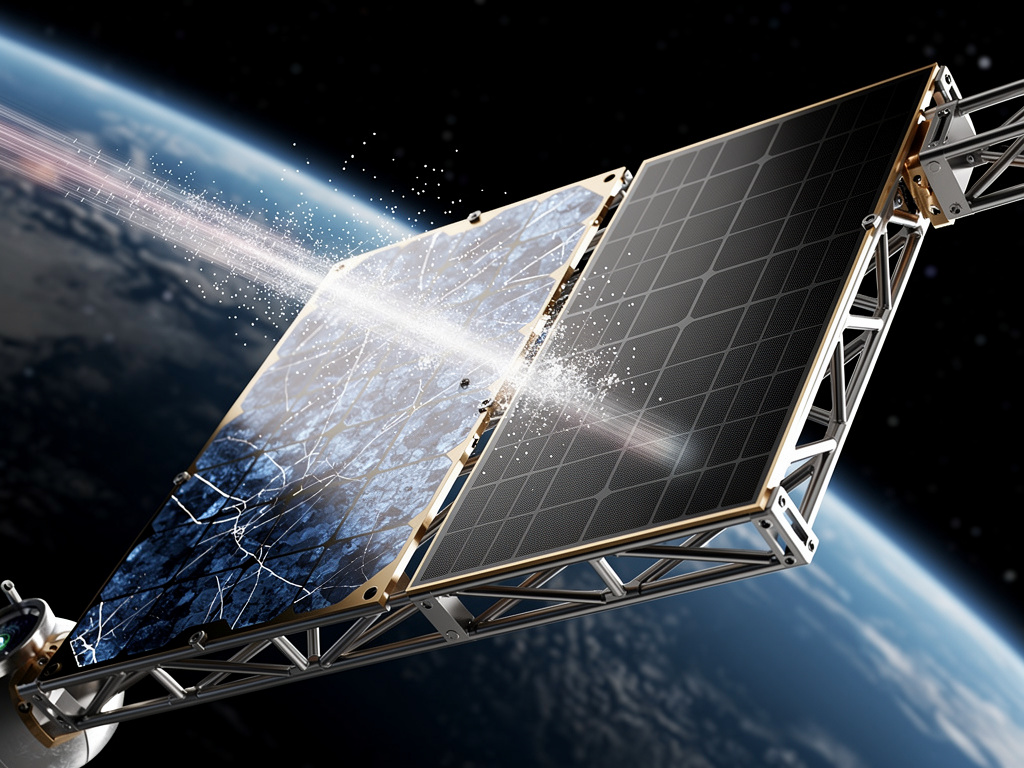
In the unforgiving void of space, where high-energy protons bombard solar arrays relentlessly, a team at the University of Toledo has uncovered a promising contender: antimony chalcogenide thin-film solar cells. These devices, blending earth-abundant materials with exceptional radiation tolerance, outperformed state-of-the-art III-V technologies in proton exposure tests, retaining higher photovoltaic parameters after doses up to 1013 MeV/g. Published in Solar RRL, the study marks the first comprehensive assessment of these cells for orbital power generation.
“Antimony chalcogenide solar cells exhibit superior radiation robustness compared to the conventional technologies we’re deploying in space,” said Alisha Adhikari, a doctoral student in physics who co-led the research alongside fellow student Scott Lambright and post-doctoral researcher Dr. Vijay Karade. The work, conducted at UToledo’s Wright Center for Photovoltaics Innovation and Commercialization, exposed Sb2S3 and Sb2(S,Se)3 cells to 100 keV and 300 keV protons at fluences from 1011 to 1014 protons/cm2, simulating space orbits.
End-of-life projections from the data suggest viability in high-proton environments, a critical edge as satellites and missions demand lighter, cheaper power sources amid rising launch costs. Yet efficiencies hover around 10%, trailing III-V cells’ 30% mark, prompting calls for bandgap engineering and tandem designs.
Radiation Trials Reveal Hidden Strengths
The experiments quantified displacement damage dose (DDD), a metric capturing atomic disruptions from protons. Antimony chalcogenide devices maintained superior remaining factors in short-circuit current, open-circuit voltage, and fill factor versus III-V benchmarks. “The devices exhibited ‘superior radiation robustness’ compared to the III-V devices,” noted pv magazine International, highlighting retention up to extreme fluences.
Collaborators from Auburn University aided irradiation at facilities mimicking geostationary orbits, where protons dominate degradation. UToledo’s heavy ion accelerator in McMaster Hall further validated materials under galactic cosmic rays. “Antimony chalcogenide-based solar cells have garnered significant attention due to their simple composition, suitable bandgaps, high absorption coefficients, low fabrication costs, and material robustness,” Adhikari told pv magazine.
Thin-film architecture—deposited via autoclaves—yields lightweight panels ideal for flexible arrays on satellites or habitats. The Air Force Research Laboratory (AFRL), funding UToledo since 2002 with up to $15 million, drives this via contracts for space-grade photovoltaics, as detailed in a 2024 UToledo News release.
Material Science at the Core
Antimony chalcogenides like Sb2S3 (1.7 eV bandgap) and Sb2Se3 (1.2 eV) boast absorption coefficients over 105 cm-1, quasi-1D crystal structures for stability, and non-toxic, abundant elements. Record lab efficiencies hit 10.7% certified by CSIRO, per a Technology Networks report on UNSW advances, up from stagnation since 2020 via uniform sulfur-selenium distribution.
Professors Randall Ellingson, Yanfa Yan, and Zhaoning Song oversee the effort, leveraging UToledo’s legacy—First Solar originated here. Yan and Song rank among the world’s most influential researchers. “While researchers continue to advance known pathways… a next challenge is to develop and discover new materials,” Ellingson stated in AFRL funding announcements.
Challenges persist: voltage deficits from defects like antimony vacancies demand passivation. Recent Solar RRL cover feature underscores momentum, with photonic curing yielding 10.12% PCE by suppressing recombination, as in an ACS Chemistry of Materials study.
Funding Fuels Orbital Ambitions
AFRL’s multi-million investments, including $12.5 million in 2021 for flexible sheets assemblable into vast arrays, target wireless power beaming to Earth or satellites. “The harsh environment of outer space presents unique challenges… higher levels of potentially damaging particle radiation,” per UToledo News. Tandem stacks with perovskites or CdTe aim for 30%+ efficiencies.
UToledo’s $7.4 million 2019 AFRL grant tested curved-surface tandems. “In outer space, the radiation environment is much more harsh,” Ellingson noted then. Partnerships with NREL extend to CdSeTe for space, building a pipeline from lab to orbit.
Broader context: Space solar demand surges with Starlink-scale constellations. Current gallium arsenide dominates but costs $10,000s per kg. Antimony’s scalability via close-space sublimation promises affordability, echoing CdTe’s terrestrial success.
Path to Mission-Ready Panels
“To become more competitive… greater research effort is needed to overcome the efficiency barrier,” the team urged in Solar RRL, eyeing interface optimization and novel deposition. Adhikari plans efficiency boosts via advanced techniques. Earth-abundant traits sidestep supply risks plaguing indium or tellurium.
Simulations project end-of-life performance rivaling incumbents in proton-heavy regimes like Jupiter missions. UToledo’s full-field imaging systems probe losses in related CdSeTe cells, transferable to antimony.
Industry insiders watch closely: AFRL’s long bet signals defense priorities for resilient power amid hypersonic and drone proliferation. As efficiencies climb—9% Sb2S3 records in 2025 per pv magazine—antimony chalcogenides near the inflection for space qualification.
Strategic Implications for Power
Beyond satellites, visions include space-based solar power stations microwaving energy Earthward, where radiation hardness proves decisive. UToledo’s ecosystem, from Wright Center to DoE consortia, positions it centrally. “Our goal is to protect our troops and enhance national security,” Ellingson affirmed in prior grants.
Global race intensifies: UNSW’s 11.02% lab mark hints tandem potential with silicon for hybrids. Defect engineering via additives, per RSC EES Solar, targets 33% Shockley-Queisser limits.
For insiders, this isn’t hype—it’s validated data from proton chambers, peer-reviewed metrics, and sustained funding. Antimony chalcogenides stand poised to redefine orbital energy resilience.


 WebProNews is an iEntry Publication