
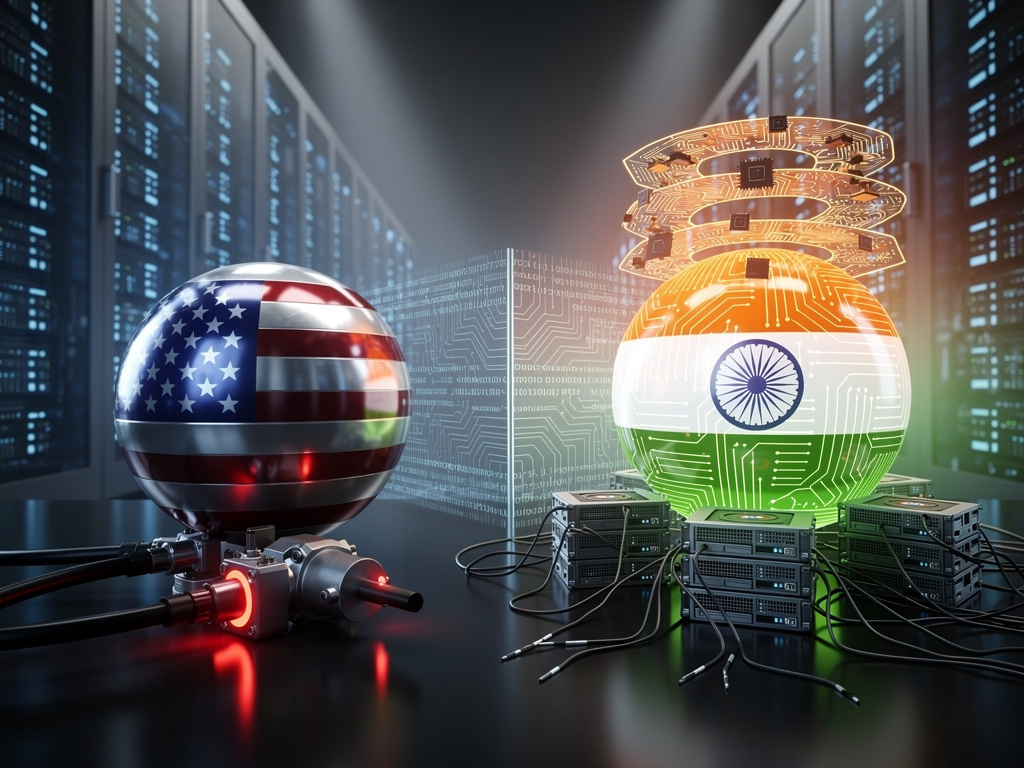
A US government directive arrived without fanfare on June 12. It ordered Anthropic to cut off access to its newest and most capable models, Fable 5 and Mythos 5, for every foreign national on the planet. The company complied immediately. Indian developers, enterprises, and even some of its own employees in Bengaluru suddenly found themselves locked out.
The move, framed as an export control on national security grounds, has done more than disrupt workflows. It has crystallized a debate that Indian technology leaders have carried on for years. Dependence on American frontier models carries a hidden cost. That cost is control. And the bill just came due.
Anthropic described the order as abrupt. In its official statement the company noted it must “abruptly disable Fable 5 and Mythos 5 for all our customers to ensure compliance.” It added that the government appeared concerned about a jailbreak technique that could bypass safeguards. Anthropic reviewed the demonstration and judged the identified vulnerabilities minor and replicable in other public models. The firm called the response disproportionate. Compliance, however, was not optional. (BBC)
The timing sharpened the sting. One day earlier Tata Consultancy Services had announced a major partnership with Anthropic to train 50,000 employees on Claude and establish a dedicated business unit. India’s Claude usage had doubled since October 2025. The country stood as the company’s second-largest market after the United States. All that momentum now sits in limbo.
Indian voices wasted no time. Sridhar Vembu, founder of Zoho, delivered a blunt verdict. “Technology is the ultimate weapon. National sovereignty, national security, all of it is now about technology.” He declared that “globalisation is dead and Bharat must find her own way ahead.” Vembu urged a turn toward smaller, open-source models, including those from China, rather than reliance on systems that can vanish by executive order. (The Next Web)
Mohandas Pai, former chief financial officer of Infosys and a prominent investor, went further with concrete numbers. He called for an annual fund of ₹50,000 crore dedicated to deeptech and AI. He paired that with a ₹2 lakh crore credit guarantee to back cloud infrastructure, hardware purchases, and semiconductor work. The scale dwarfs the existing IndiaAI Mission, approved in March 2024 with a total outlay of ₹10,372 crore and roughly 38,000 GPUs deployed to date. Pai’s proposal would multiply annual spending several times over. (Moneycontrol)
But not every leader sees the episode as a call to race toward frontier-scale models. Shayak Mazumder, founder of Adya.ai, labeled the US action a “knee-jerk reaction” that will likely prove temporary. He argued that advantages claimed for Fable 5 over rivals such as GPT-5.5 or Gemini are often overstated. India, in his view, should concentrate resources on smaller models, fine-tuning studios, and tightly harnessed systems rather than chase its own massive foundational models. (Inc42)
Hemant Mohapatra, partner at Lightspeed Venture Partners, struck a middle note. He called the moment one in which “sovereign AI is real.” Yet he stressed that talent remains the true bottleneck for India. Compute gaps can be closed through investment or continued foreign cloud access. Massive capital alone does not guarantee success.
Aakrit Vaish, founder of Activate, captured a widespread sentiment among founders. The suspension “completely changes things” for the sovereign AI conversation. Vijay Rayapati, chief executive of Atomicwork, warned that any nation building multi-country teams around American AI tools now operates one policy shift away from operational disruption. (The Next Web)
Prasanto Roy, a policy expert, put the structural problem in plain terms. “American AI models are bound to American geopolitics.” The directive demonstrated exactly that linkage. Reports suggest Amazon chief executive Andy Jassy contacted Treasury Secretary Scott Bessent after researchers used Fable 5 to surface information that could aid attacks. The resulting order applied globally and instantly. (Moneycontrol)
India’s startup community has already begun adjusting. Sarvam AI released open-source models with 30 billion and 105 billion parameters at the India AI Impact Summit earlier this year. Krutrim, started by Ola founder Bhavish Aggarwal, shifted emphasis from pure foundational model development to cloud and AI infrastructure services. The company reported ₹3 billion in revenue for fiscal 2026. Neither outfit claims parity with Fable 5. Their value lies in resilience. No foreign switch can turn them off.
The IndiaAI Mission continues to expand subsidized compute and financing for domestic players. HCL Technologies recently led a $150 million investment in Sarvam as part of a larger $300 million round. Government officials have spoken of sovereign models trained on Indian data and languages. Progress is measurable yet incremental. The sudden cutoff of Fable 5 has made the pace feel inadequate to many observers.
Broader context adds urgency. The United States has tightened AI-related export controls for four years, beginning with advanced chips and extending to model-level restrictions. Each step reinforces the logic that critical technology carries geopolitical strings. European officials echoed similar concerns. The European Union, which had only recently gained access to Mythos, noted the episode underscores its own push for technological sovereignty.
Indian leaders now wrestle with practical questions. How much must the country spend to own its AI stack? Can open-source alternatives close the capability gap fast enough? Should policy favor a few large frontier efforts or thousands of specialized, fine-tuned systems? The answers will shape budgets, procurement rules, and research priorities for the next decade.
Pratyush Kumar of Sarvam AI framed the core vulnerability. External control loops create single points of failure. “Own your data, own your AI” has become a refrain among those pushing hardest for change. Pai’s proposed annual fund and credit guarantee aim to translate that slogan into infrastructure and talent pipelines that cannot be interrupted from abroad.
The episode arrives as India’s technology sector navigates other pressures. Layoffs at some US firms, including Opendoor’s closure of its India office affecting 250 workers, have been linked partly to AI-native processes that reduce demand for certain engineering roles. The interplay between American innovation and Indian execution grows more competitive and less purely complementary.
Anthropic maintains an office in Bengaluru. Its partnership with TCS sought to embed Claude deeply into Indian enterprise. Whether those initiatives recover depends on how soon access returns and whether trust survives the demonstration that even flagship models can disappear overnight. For now the models remain unavailable to non-US persons worldwide.
Technology leaders across the spectrum agree on one point. The suspension is not an isolated regulatory quirk. It marks a shift in how nations view access to the most powerful artificial intelligence systems. Countries that treat these systems as utilities risk waking up to find the utility controlled by another capital. India, with its vast population, ambitious digital infrastructure, and growing AI talent base, faces a choice sharpened by events of the past week.
Proposals remain just that. No legislation yet backs Pai’s massive fund. No comprehensive policy framework has embraced Vembu’s call for open-source and Chinese models. The IndiaAI Mission advances, but its current scale looks modest against the ambitions now voiced. The debate, however, has moved from conference rooms to boardrooms and policy tables with new intensity.
So the question lingers. When the next frontier model launches from a US lab, will Indian users simply hope the switch stays on? Or will the country invest the capital, talent, and patience required to build systems it can count on regardless of decisions made in Washington? The Fable 5 episode has made that choice concrete. Indian technology leaders are no longer content to wait for the answer.


 WebProNews is an iEntry Publication