
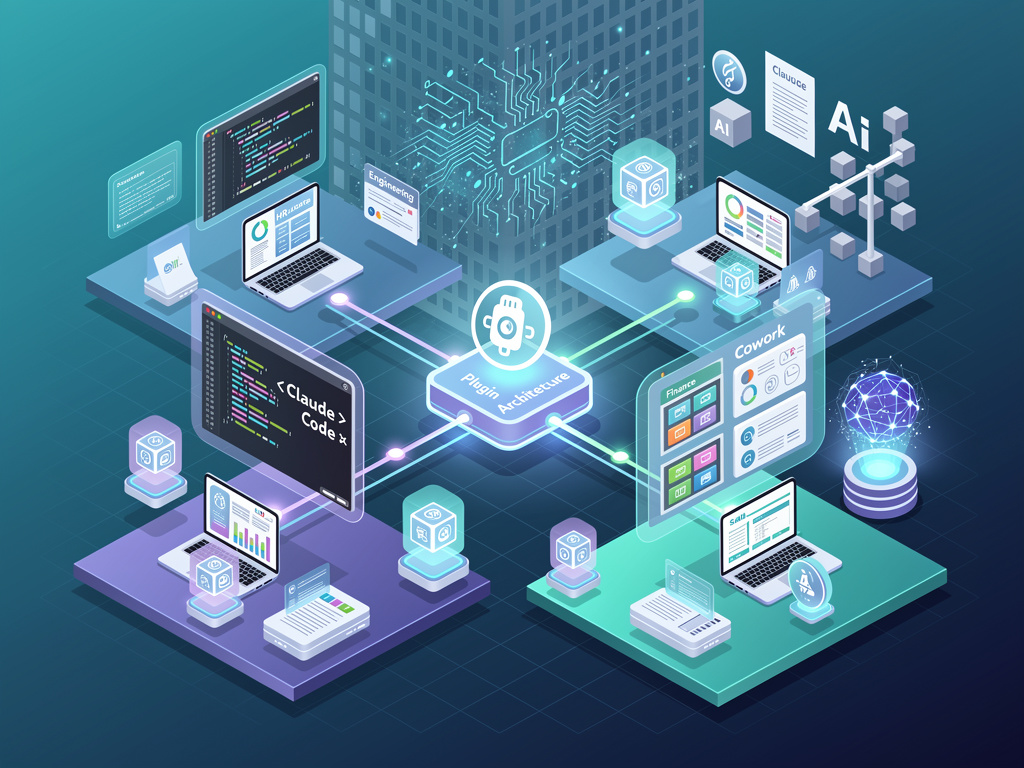
Anthropic has unveiled a significant expansion of its agentic AI capabilities, extending the plugin architecture that powered its Claude Code assistant to Cowork, its general-purpose workplace automation tool. This strategic move signals the company’s ambition to transform how enterprises approach department-specific workflows, moving beyond the developer-focused applications that have dominated the AI assistant market. The introduction of Cowork plugins represents a fundamental shift in how artificial intelligence can be deployed across organizational functions, from legal document review to financial analysis and marketing operations.
According to TechCrunch, the launch of Cowork earlier this month marked Anthropic’s entry into the broader workplace automation sector, but the rapid addition of plugins demonstrates the company’s commitment to creating a comprehensive ecosystem for enterprise AI deployment. The plugin architecture allows organizations to customize Claude’s capabilities for specific departmental needs without requiring extensive technical expertise or custom development work. This approach democratizes access to sophisticated AI automation, enabling business users across functions to leverage the technology’s potential without relying solely on engineering resources.
The expansion builds on lessons learned from Claude Code, which Anthropic’s official blog describes as having validated the plugin model for developer workflows. By extending this architecture to Cowork, the company is betting that the same principles of modularity and specialization can transform knowledge work across industries. The timing is particularly significant as enterprises increasingly seek AI solutions that can deliver immediate value while integrating seamlessly with existing business processes and data systems.
The Architecture of Specialized Intelligence
The plugin system represents a departure from the one-size-fits-all approach that has characterized many enterprise AI deployments. Rather than forcing organizations to adapt their workflows to fit generic AI capabilities, Cowork plugins enable the reverse: AI assistants that conform to specific departmental requirements and industry standards. The Verge reports that this architecture allows Claude to function as a specialized assistant for knowledge workers, with each plugin adding domain-specific capabilities that would be impractical to build into a general-purpose model.
The technical implementation enables plugins to access specialized knowledge bases, integrate with industry-specific software platforms, and execute complex multi-step workflows that previously required human oversight at every stage. This agentic approach—where AI systems can take autonomous actions within defined parameters—represents a maturation of enterprise AI beyond simple question-answering or content generation. Organizations can now deploy AI assistants that understand regulatory requirements in healthcare, compliance frameworks in financial services, or creative briefs in marketing contexts, all while maintaining the flexibility to customize behavior for their unique operational needs.
Enterprise Adoption and Department-Specific Use Cases
Early adopters are already exploring how Cowork plugins can transform specific business functions. The Decoder highlights how the plugin architecture addresses a critical challenge in enterprise AI adoption: the gap between generic capabilities and specialized requirements. Legal departments, for instance, can deploy plugins that understand contract language, track regulatory changes, and flag potential compliance issues—all while maintaining the conversational interface that makes AI assistants accessible to non-technical users.
Financial services firms are leveraging plugins for analytical workflows that combine data extraction, modeling, and reporting in ways that previously required coordination across multiple software tools and team members. Marketing departments are using specialized plugins to manage campaign workflows, analyze performance data, and generate creative variations while maintaining brand consistency and compliance with advertising standards. The common thread across these applications is the ability to automate complex, multi-step processes that involve both structured data manipulation and unstructured content generation, tasks that sit at the intersection of human judgment and computational efficiency.
The Competitive Implications for Enterprise AI
Anthropic’s move intensifies competition in the enterprise AI market, where companies like OpenAI, Google, and Microsoft have established significant footholds. By focusing on department-specific automation through plugins, Anthropic is differentiating itself from competitors who have primarily emphasized either developer tools or general-purpose assistants. The New Stack notes that this strategy could prove particularly effective in industries with specialized requirements that generic AI models struggle to address adequately.
The plugin architecture also creates potential for an ecosystem effect, where third-party developers and industry specialists can build specialized plugins that extend Cowork’s capabilities into niche domains. This approach mirrors successful platform strategies in other technology sectors, where extensibility and customization have proven crucial for enterprise adoption. However, it also raises questions about quality control, security, and the potential for fragmentation as organizations deploy increasingly customized AI configurations across their operations.
Technical Foundations and Agentic Capabilities
The underlying technology enabling Cowork plugins relies on Anthropic’s advances in agentic AI—systems capable of planning, executing, and adapting multi-step workflows with minimal human intervention. On X, Anthropic announced the plugin expansion, emphasizing how these capabilities allow Claude to function as a true workplace assistant rather than merely a conversational interface. The distinction is crucial: while traditional AI assistants require users to break down complex tasks into discrete prompts, agentic systems can understand high-level objectives and determine the necessary steps to achieve them.
This capability is particularly valuable in enterprise contexts where workflows often involve coordination across multiple systems, data sources, and approval processes. A Cowork plugin designed for procurement, for example, might autonomously gather vendor quotes, compare them against historical pricing data, check budget availability, and draft approval requests—all based on a simple instruction to source a particular item. The system’s ability to handle exceptions, seek clarification when needed, and adapt to changing circumstances distinguishes it from traditional workflow automation tools that follow rigid, predetermined paths.
Security, Governance, and Enterprise Control
As organizations deploy AI systems with greater autonomy, questions of security and governance become paramount. Anthropic has positioned Cowork plugins with enterprise controls that allow organizations to define boundaries for AI actions, require human approval for sensitive operations, and maintain audit trails of all automated decisions. In a follow-up post on X, the company emphasized its commitment to responsible AI deployment, noting that plugins operate within carefully defined parameters that organizations can customize based on their risk tolerance and regulatory requirements.
The governance framework includes role-based access controls, allowing organizations to determine which employees can access specific plugins and what actions those plugins can perform on their behalf. This granular control is essential for industries like healthcare and finance, where regulatory compliance requires detailed documentation of who made what decisions and on what basis. The system also incorporates mechanisms for human oversight, enabling organizations to require approval for certain types of actions while allowing full automation for routine tasks that fall within established guidelines.
The Developer and Integration Ecosystem
Beyond the plugins Anthropic develops internally, the company is fostering an ecosystem where third-party developers can create specialized tools for specific industries or use cases. User @edsim noted on X the potential for domain experts to build plugins that encode industry best practices and specialized knowledge, creating a marketplace of AI capabilities that organizations can mix and match based on their needs. This approach could accelerate adoption by allowing companies to leverage pre-built solutions rather than developing custom integrations from scratch.
The integration architecture supports connections to popular enterprise software platforms, enabling Cowork plugins to read data from CRM systems, update project management tools, and interact with specialized industry applications. This interoperability is crucial for enterprise adoption, as organizations are unlikely to embrace AI tools that require wholesale replacement of existing systems. Instead, Cowork positions itself as a coordination layer that enhances existing software investments by adding intelligent automation and natural language interfaces.
Market Response and Early Indicators
Initial market response suggests significant interest from enterprise customers seeking to move beyond experimental AI deployments to production systems that deliver measurable business value. On X, user @morqon highlighted how the plugin approach addresses a common frustration with general-purpose AI assistants: their inability to handle the specific requirements and contexts that define real-world business processes. By enabling specialization without sacrificing the flexibility of a general-purpose model, Cowork plugins offer a potential solution to this adoption barrier.
Industry analysts are watching closely to see whether Anthropic’s strategy can gain traction against competitors with larger market shares and more established enterprise relationships. The success of the plugin approach may depend on the company’s ability to attract both enterprise customers willing to invest in customization and developers interested in building specialized tools for the platform. Anthropic’s X account has been actively promoting examples of plugin applications, suggesting a concerted effort to demonstrate value across diverse use cases and industries.
Pricing, Deployment, and Organizational Considerations
The economics of plugin-based AI automation present both opportunities and challenges for organizations considering adoption. While Anthropic has not disclosed detailed pricing for individual plugins, the model likely involves some combination of base platform fees and additional charges for specialized capabilities. This structure could make advanced AI automation accessible to mid-market companies that previously found custom AI development prohibitively expensive, while also providing enterprise customers with the flexibility to invest heavily in capabilities that deliver the most value for their specific operations.
Deployment considerations extend beyond technical integration to organizational change management. As @_simonsmith observed on X, the introduction of agentic AI tools requires organizations to rethink workflows, redefine roles, and establish new protocols for human-AI collaboration. Departments must determine which tasks are appropriate for automation, how to maintain quality control when AI systems operate autonomously, and how to upskill employees to work effectively alongside increasingly capable AI assistants. These organizational challenges may prove more significant than technical barriers for many enterprises.
The Future of Knowledge Work Automation
Anthropic’s expansion of Cowork plugins represents a bet on a future where AI assistants become integral to how organizations operate, not merely tools that employees consult occasionally. The vision extends beyond productivity gains to fundamental transformations in how work gets done: AI systems that can manage complex projects, coordinate across departments, and handle the routine aspects of knowledge work while humans focus on strategy, creativity, and judgment calls that require uniquely human capabilities.
This future raises profound questions about the nature of knowledge work itself. If AI systems can handle increasingly sophisticated analytical, creative, and coordination tasks, what remains distinctly human about professional work? User @bcherny suggested on X that the answer may lie in areas where context, relationships, and ethical judgment matter most—domains where human expertise involves not just processing information but understanding stakeholder needs, navigating organizational politics, and making decisions that balance competing values and priorities.
Industry-Specific Implications and Regulatory Considerations
Different industries face distinct challenges and opportunities as agentic AI tools become more capable. In healthcare, Cowork plugins could streamline administrative workflows, assist with clinical documentation, and help providers navigate complex treatment guidelines—but only if they can meet stringent privacy requirements and accuracy standards. Financial services firms see potential for automating compliance monitoring, risk assessment, and client service tasks, but regulators are increasingly scrutinizing AI systems for bias, explainability, and accountability.
Legal departments represent a particularly promising application area, as much legal work involves analyzing documents, researching precedents, and drafting standard agreements—tasks well-suited to AI automation. However, professional responsibility rules and liability concerns create barriers to adoption that go beyond technical capabilities. Anthropic’s approach of providing granular controls and audit trails addresses some of these concerns, but widespread adoption in regulated industries will likely require continued evolution of both the technology and the regulatory frameworks governing its use.
Strategic Positioning and Long-Term Vision
By expanding from Claude Code to Cowork and now introducing plugins for both platforms, Anthropic is executing a strategy that positions the company as a comprehensive provider of enterprise AI solutions rather than a point solution for specific tasks. This positioning could prove advantageous as organizations seek to consolidate their AI vendors and establish consistent governance frameworks across different use cases. The plugin architecture provides a unifying structure that allows organizations to deploy specialized capabilities while maintaining centralized control and oversight.
The long-term vision appears to involve creating an ecosystem where AI capabilities can be composed and customized to match any organizational need, much as modern software architectures allow developers to assemble applications from reusable components. If successful, this approach could make Anthropic’s platform the foundation for how organizations deploy AI across their operations, creating significant competitive advantages through network effects and switching costs. However, realizing this vision will require sustained investment in platform capabilities, ecosystem development, and customer success—all while competing against well-funded rivals pursuing similar objectives.
As enterprises move beyond experimentation to production deployment of AI systems, Anthropic’s plugin strategy offers a compelling model for how organizations can harness the power of large language models while maintaining the control, specialization, and integration with existing systems that enterprise adoption requires. The success of this approach will depend not only on technical execution but on Anthropic’s ability to build an ecosystem of developers, partners, and customers who see value in a platform approach to enterprise AI. The coming months will reveal whether this strategy can differentiate Anthropic in an increasingly crowded market and establish new standards for how organizations deploy AI to transform knowledge work.


 WebProNews is an iEntry Publication