
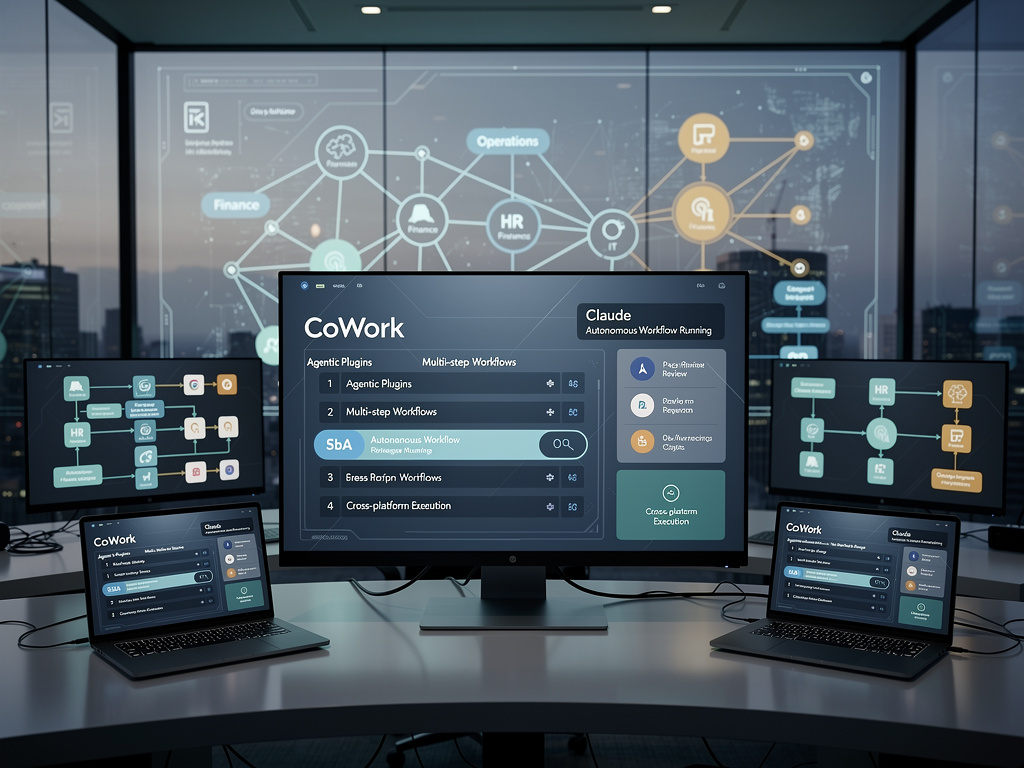
In a move that signals a fundamental shift in how artificial intelligence integrates with workplace productivity tools, Anthropic has introduced agentic plugins to its CoWork platform, marking what industry analysts describe as the most significant evolution in enterprise AI deployment since the launch of ChatGPT Enterprise. The announcement, made public on January 30, 2025, represents more than a mere feature addition—it embodies a strategic repositioning in the increasingly competitive enterprise AI market where autonomy and seamless integration have become the new battlegrounds.
According to TechCrunch, the new agentic plugins enable Claude, Anthropic’s flagship AI assistant, to take autonomous actions across multiple enterprise applications without requiring constant human intervention. This capability fundamentally distinguishes these plugins from traditional API integrations, which typically function as passive responders to direct commands. The agentic approach allows Claude to initiate workflows, make contextual decisions, and execute multi-step processes across platforms like Slack, Notion, Google Workspace, and Salesforce—all while maintaining the safety guardrails that have become Anthropic’s hallmark.
The timing of this release is particularly noteworthy given the intensifying competition in the enterprise AI sector. While OpenAI has focused on expanding ChatGPT’s consumer reach and Microsoft has embedded Copilot throughout its ecosystem, Anthropic appears to be carving out a differentiated position by emphasizing responsible autonomy in business contexts. The company’s approach reflects a calculated bet that enterprises will prioritize AI systems capable of independent action within clearly defined boundaries over more powerful but less predictable alternatives.
The Architecture of Autonomous Action
The technical infrastructure underlying Anthropic’s agentic plugins represents a sophisticated orchestration layer that goes well beyond simple automation. Unlike traditional robotic process automation (RPA) tools that follow rigid, pre-programmed sequences, these plugins leverage Claude’s advanced reasoning capabilities to interpret context, assess situations, and determine appropriate courses of action. The system employs what Anthropic engineers describe as “constitutional AI” principles, where the autonomous agent operates within a framework of explicit rules and values that govern its decision-making processes.
Each plugin functions as a specialized module with domain-specific knowledge about particular enterprise applications. When a user assigns Claude a task that spans multiple platforms—such as “compile this week’s sales data from Salesforce, summarize key trends, and share findings with the marketing team in Slack”—the agentic system breaks down the request into discrete actions, determines the optimal sequence, executes each step, and handles any exceptions or errors that arise. This level of autonomous orchestration previously required custom development by enterprise IT teams, often taking months to implement and maintain.
Enterprise Security and Compliance Considerations
The introduction of autonomous AI agents into enterprise workflows naturally raises significant security and compliance questions. Anthropic has addressed these concerns through a multi-layered permission system that allows organizations to define precisely what actions Claude can take across different applications and data sources. IT administrators can establish role-based access controls, create approval workflows for sensitive operations, and maintain comprehensive audit logs of all agentic actions—capabilities that enterprise security teams have identified as non-negotiable requirements for AI deployment.
The company’s emphasis on interpretability also distinguishes its approach from competitors. Each autonomous action taken by Claude includes a reasoning trace that explains why the agent made particular decisions, which actions it considered but rejected, and what information informed its choices. This transparency addresses a critical pain point in enterprise AI adoption: the “black box” problem where organizations deploy systems whose decision-making processes remain opaque to users and auditors alike.
Market Positioning and Competitive Dynamics
Anthropic’s move into agentic plugins positions the company at the intersection of several converging trends in enterprise software. The workflow automation market, currently valued at over $20 billion annually, has been dominated by established players like UiPath, Automation Anywhere, and Blue Prism. However, these traditional RPA vendors have struggled to incorporate the contextual understanding and flexible reasoning that large language models provide. By combining Claude’s natural language capabilities with autonomous execution, Anthropic is effectively creating a new category that threatens to disrupt both the RPA market and traditional enterprise integration platforms.
The competitive implications extend beyond pure-play automation vendors. Microsoft’s Copilot, which has achieved significant penetration across enterprise customers through bundling with Microsoft 365, offers similar integration capabilities but operates primarily in a reactive mode, responding to user prompts rather than initiating actions autonomously. Google’s Workspace AI features similarly focus on augmentation rather than automation. Anthropic’s agentic approach represents a more ambitious vision where AI systems function as autonomous team members rather than sophisticated assistants.
Implementation Challenges and Organizational Change
Despite the technological sophistication of agentic plugins, their successful deployment depends heavily on organizational readiness—a factor that has historically determined the success or failure of enterprise software initiatives. Early adopters of the CoWork platform with agentic capabilities report that the most significant challenges are not technical but cultural. Employees accustomed to directly controlling every aspect of their workflows must develop trust in autonomous systems, while managers need to reconceptualize supervision and accountability when AI agents perform tasks previously assigned to human team members.
Organizations implementing agentic AI also face the challenge of redefining roles and responsibilities. When Claude autonomously handles routine data compilation, report generation, and cross-platform coordination, knowledge workers must evolve toward higher-value activities that require uniquely human capabilities like strategic thinking, relationship building, and creative problem-solving. This transition mirrors previous waves of workplace automation but occurs at a dramatically accelerated pace, compressing changes that previously unfolded over years into months or quarters.
Economic Implications and Productivity Metrics
The economic case for agentic AI plugins rests on their potential to eliminate what management consultants call “digital friction”—the countless small tasks required to move information and coordinate actions across disconnected enterprise systems. Studies of knowledge worker productivity consistently identify context-switching and manual data transfer as major time sinks, with some research suggesting that workers spend up to 20% of their time simply moving information between applications. If agentic systems can reclaim even half of this lost productivity, the return on investment becomes compelling even at premium pricing tiers.
However, measuring the true productivity impact of agentic AI presents methodological challenges. Traditional metrics like time saved or tasks completed fail to capture the more subtle benefits of reduced cognitive load, faster decision-making cycles, and improved information flow across organizational silos. Early enterprise customers of CoWork report qualitative improvements in team coordination and decision quality that resist easy quantification but nonetheless represent significant value creation.
Regulatory Considerations and Future Outlook
As agentic AI systems assume greater autonomy in enterprise contexts, they inevitably attract regulatory scrutiny. The European Union’s AI Act, which entered into force in 2024, establishes risk-based requirements for AI systems, with high-risk applications facing stringent obligations around transparency, human oversight, and accountability. Anthropic’s emphasis on constitutional AI and interpretability appears designed to align with these emerging regulatory frameworks, potentially providing a competitive advantage in markets where compliance requirements constrain deployment options.
The trajectory of agentic plugins in enterprise software will likely follow a pattern familiar from previous technology transitions: initial adoption by tech-forward organizations willing to accept some implementation friction in exchange for competitive advantage, followed by gradual mainstream adoption as the technology matures and best practices emerge. What remains uncertain is whether the agentic approach pioneered by Anthropic will become the dominant paradigm for enterprise AI or whether alternative architectures—perhaps emphasizing human-in-the-loop workflows or specialized vertical applications—will prove more practical for most organizations.
The introduction of agentic plugins to CoWork represents more than an incremental product enhancement. It signals Anthropic’s ambition to define how AI systems integrate into the fabric of organizational work, moving beyond the assistant metaphor toward something closer to autonomous collaboration. Whether this vision resonates with enterprise customers will depend not only on technical capabilities but on Anthropic’s ability to navigate the complex interplay of organizational culture, regulatory requirements, and competitive dynamics that characterize the enterprise software market. For now, the company has staked out distinctive territory in the rapidly evolving enterprise AI sector, offering a glimpse of a future where artificial intelligence doesn’t just augment human work but actively participates in it.


 WebProNews is an iEntry Publication