
Dario Amodei did not mince words. The Anthropic chief executive told audiences earlier this year that his company had budgeted for tenfold growth in 2026. Reality delivered something closer to eighty times. Demand for its Claude models simply outran every forecast.
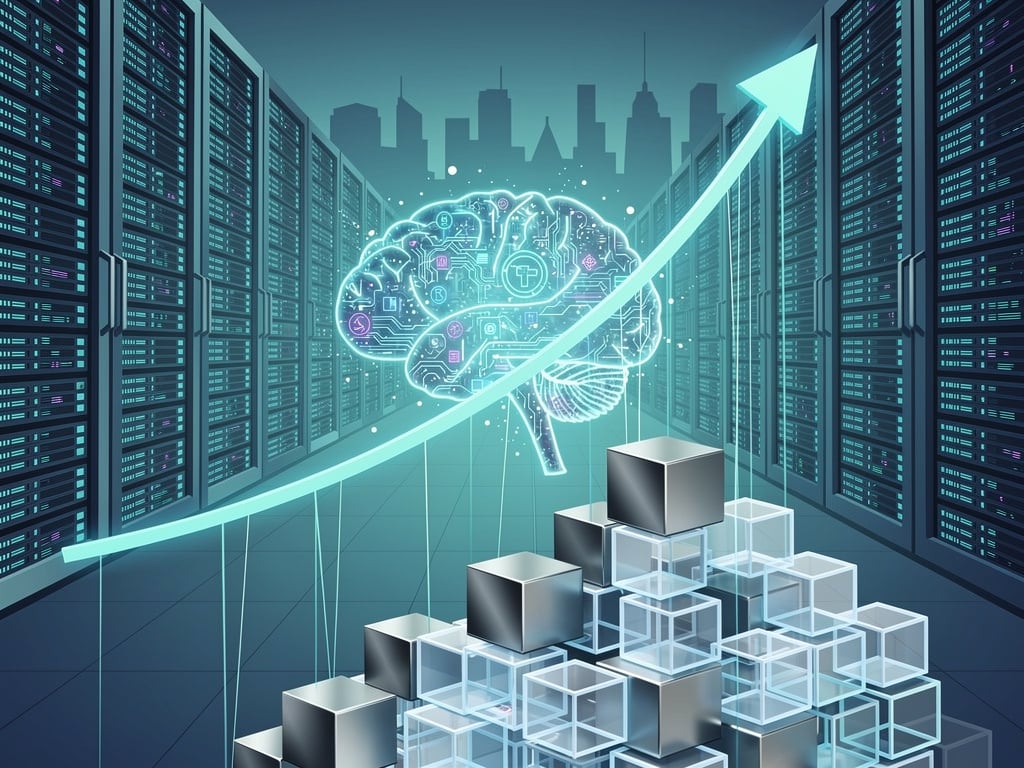
That mismatch captures the pressure now bearing down on frontier AI labs. Compute shortages bite harder each quarter. Revenue runs skyrocket. Yet the underlying technical progress follows a smoother curve than headlines suggest. Amodei laid out his view in a lengthy personal essay. He argued that scaling laws, first documented more than a decade ago, continue to deliver predictable gains in cognitive performance across virtually every measurable domain.
“AI’s scaling laws, which predict an exponential increase in general cognitive capabilities with increasing computing power, now have over a decade of empirical evidence behind them,” he wrote. A few more years of that trend, he added, and society could see what he has termed powerful AI.
The claim lands amid fresh data points. Anthropic announced a $65 billion Series H funding round in late May that valued the company at $965 billion post-money. Proceeds target safety research, interpretability work, and above all else, more compute. The firm has struck deals with Amazon for up to five gigawatts, partnered with Google and Broadcom on next-generation TPU capacity, and tapped SpaceX for access to massive GPU clusters. Run-rate revenue surpassed $30 billion recently, up from roughly $9 billion at the end of 2025.
But growth at that pace creates its own problems. Internal systems strain. Hiring cannot keep up. And the models themselves, while impressive, still reveal gaps when examined closely. A Mashable analysis of Anthropic’s own system cards for Claude Mythos and Fable highlighted discrepancies. The CEO’s public optimism about unbroken exponential gains contrasted with research findings that showed more nuanced, sometimes sub-exponential behavior in specific capabilities. Mashable reported the tension directly.
Amodei sees a feedback loop already forming. AI now writes a substantial share of the code used at Anthropic to build the next generation of models. That automation speeds research. Faster research yields better models. Better models accelerate automation still further. “This feedback loop is gathering steam month by month, and may be only 1–2 years away from a point where the current generation of AI autonomously builds the next,” he observed in his essay hosted at darioamodei.com.
Observers inside the company feel the acceleration. Three years ago, models struggled with elementary arithmetic and produced barely functional code. Today they handle complex tasks in biology, finance, physics and agentic workflows. The New York Times captured Amodei’s surprise at the surge. He expected 10x growth. The business may deliver 80x. “I hope that 80-times growth doesn’t continue because that’s just crazy and it’s too hard to handle,” he told the paper. The New York Times detailed the operational strain.
Such expansion requires infrastructure on a previously unseen scale. Recent weeks brought announcements of expanded partnerships that secure gigawatts of capacity coming online in 2027 and beyond. Private capital has stepped in aggressively. Broadcom, Apollo and Blackstone launched a $35 billion AI infrastructure platform targeting more than 20 gigawatts by 2028, with Anthropic among the first customers. Discussions on X this week highlighted how traditional infrastructure players now finance data centers directly, shifting risk away from AI firms struggling to show profitability ahead of potential public listings.
Yet the exponential Amodei describes may be approaching its later stages. Training compute has grown four to five times per year since 2010. That pace cannot continue forever without hitting physical or economic walls. In a February 2026 conversation with Dwarkesh Patel, Amodei spoke of being “near the end of the exponential.” He meant the steep part of the capability curve. Models already score near 92 percent on HumanEval coding benchmarks. Full software automation could arrive within two years. Economic effects might generate trillions in revenue by 2030.
Those forecasts carry weight because they come from one of the three labs setting the frontier. Anthropic’s own research papers document how Claude usage maps to theoretical task feasibility. AI covers a large fraction of cognitive work that experts once considered out of reach. Still, actual deployment lags far behind potential. Only 33 percent of tasks in computer and math categories see real usage despite higher theoretical scores.
Public perception lags further. Amodei has repeatedly expressed surprise that society has not grasped how close the transition feels from inside the leading labs. Progress appears smooth and relentless to those watching daily metrics. Public debate swings between declarations of imminent plateaus and breathless predictions of sudden breakthroughs. The data, he maintains, support neither extreme.
Concerns extend beyond technical performance. Amodei devoted sections of his essay to governance risks. Non-democratic states with large data centers could seize running models for their own purposes. AI companies themselves warrant scrutiny because they control vast compute, possess unique expertise, and maintain direct relationships with millions of users. “It is somewhat awkward to say this as the CEO of an AI company, but I think the next tier of risk is actually AI companies themselves,” he wrote.
His prescription involves close cooperation with U.S. intelligence and defense communities. Anthropic supplies models to democratic allies precisely to maintain strategic advantage during what he sees as a critical window of several years. China trails in frontier chip production. That gap matters while the most powerful systems remain concentrated.
Recent Stanford HAI AI Index data reinforces the competitive picture. The U.S.-China performance gap has narrowed dramatically. As of March 2026, Anthropic’s top model held only a 2.7 percent lead. Industry produced over 90 percent of notable frontier systems in 2025. SWE-bench Verified scores jumped from 60 percent to nearly 100 percent in a single year. Capability is not leveling off. Adoption has reached 88 percent of organizations.
Market dynamics reflect the frenzy. Anthropic’s annualized revenue growth has run at roughly 10 times per year since crossing $1 billion, faster than OpenAI’s pace. Some forecasts suggest it could surpass its rival by late 2026, though recent trends show a possible slowdown to seven times annual growth. Epoch AI tracked those figures closely. Epoch AI published the analysis in February.
Compute remains the binding constraint. Even with massive fundraising, new data centers take 12 to 24 months to materialize. Power, land, and regulatory approvals create bottlenecks. Users of Claude have noticed tighter rate limits throughout 2026. The company acknowledges demand has accelerated faster than infrastructure can expand.
Amodei frames the moment as adolescence. Technology matures rapidly. Society must adapt just as quickly. Economic growth could reach 5 to 10 percent annually in a world of abundant AI capability. Millions of jobs may still vanish in specific categories. Yet history suggests new work emerges, often more productive. Recent comments from Amodei and OpenAI’s Sam Altman have softened earlier warnings about mass white-collar displacement. Both now speak of automation expanding the scope of human output rather than simply eliminating roles. Fortune examined that shift in late May. Fortune reported the evolving rhetoric.
The coming years will test these predictions. If scaling continues, models could surpass human performance across nearly all cognitive domains within a small number of years. Self-improving AI loops could compress timelines further. But physical limits on energy and chips may force efficiency breakthroughs or slower growth.
Anthropic bets it can compete on smarter architectures and better data efficiency even if it does not always command the largest clusters. That stance sets it apart from labs chasing brute-force scale. Early 2026 interviews suggested the strategy may prove decisive.
One thing appears clear. The exponential phase has delivered more than anyone outside the labs anticipated. Whether it ends soon or stretches further will shape economies, labor markets, and national security for decades. Amodei feels the clock ticking. So do his competitors. The rest of the world is only beginning to catch up.


 WebProNews is an iEntry Publication