
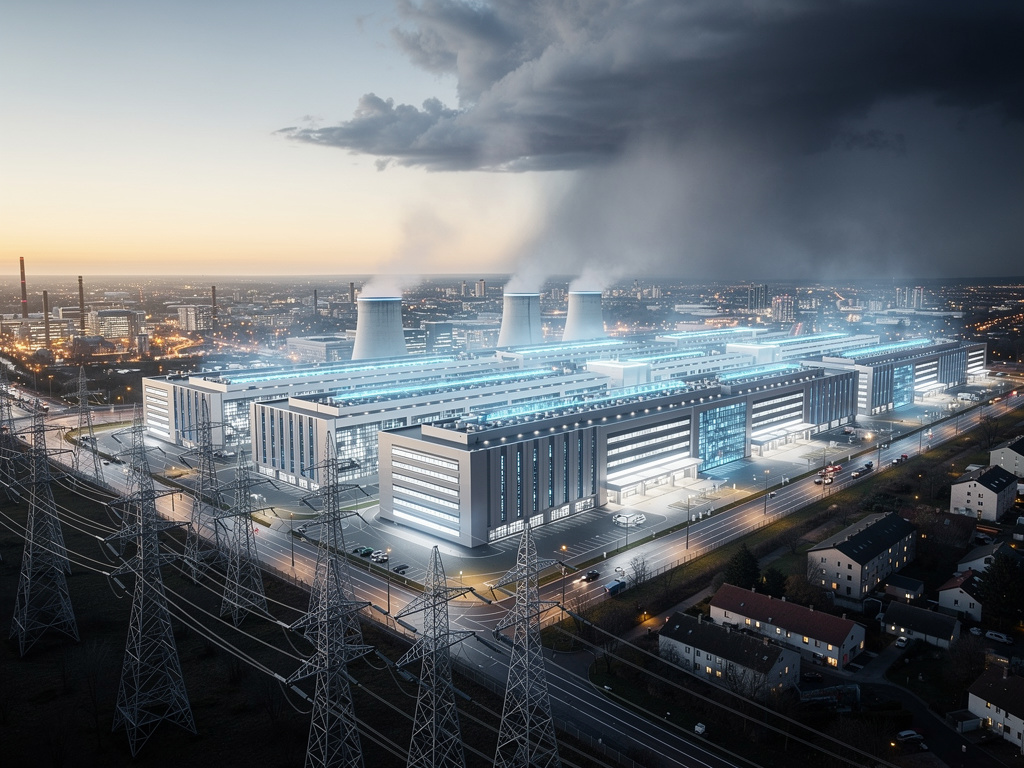
The artificial intelligence arms race has entered a new and consequential phase — one measured not in parameters or benchmark scores, but in megawatts. Anthropic, the San Francisco–based AI safety company behind the Claude chatbot, has joined a growing roster of technology firms whose massive data center commitments are raising hard questions about energy costs, grid reliability, and the future of American electricity markets.
According to a report from The Information, Anthropic is now among the companies whose data center expansion plans are contributing to projections of sharply higher electricity prices across the United States. The company’s infrastructure ambitions place it alongside hyperscalers like Microsoft, Google, Amazon, and Meta — all of which have been racing to secure power capacity sufficient to train and run the next generation of large language models.
The Insatiable Appetite for Power
The scale of electricity demand from AI data centers has caught utilities, regulators, and grid operators off guard. What was once a steady, predictable growth trajectory for U.S. power consumption has been upended by the sudden and enormous energy requirements of GPU-dense computing clusters. A single modern AI training facility can consume as much electricity as a small city — and the industry is planning to build dozens of them.
Anthropic’s entry into this conversation is particularly notable because the company has historically positioned itself as a more cautious, safety-focused alternative to rivals like OpenAI. But the realities of competing at the frontier of AI development demand computational resources on a staggering scale. Training models like Claude requires thousands of advanced chips running continuously for months, and the inference workloads that follow — serving millions of users — add yet another layer of persistent energy demand. The company raised $2 billion from Google and has secured additional billions from Amazon, capital that is flowing directly into the infrastructure needed to keep pace.
A Grid Under Strain
The consequences of this buildout are already being felt. Grid operators across the country, from PJM Interconnection in the Mid-Atlantic to ERCOT in Texas, have been revising their demand forecasts upward at an unprecedented rate. PJM, which manages the electric grid for 65 million people across 13 states and the District of Columbia, recently projected that data center load in its territory could more than double by the end of the decade. Dominion Energy, the utility that serves Northern Virginia — the world’s largest data center market — has warned that it may not be able to keep up with interconnection requests.
The pricing implications are significant. As data center operators compete for limited power capacity, they are willing to pay premium rates and sign long-term contracts that lock in supply. This dynamic threatens to push electricity prices higher for residential and commercial customers who lack the bargaining power of a multibillion-dollar tech company. Consumer advocates and state regulators have begun raising alarms. In Virginia, the State Corporation Commission has scrutinized whether ordinary ratepayers are subsidizing the infrastructure upgrades needed to serve data centers. Similar debates are unfolding in Georgia, where Georgia Power has proposed significant rate increases partly driven by data center demand, and in the Midwest, where utilities are scrambling to accommodate new facilities.
Anthropic’s Strategic Calculus
For Anthropic, the push into large-scale data center capacity is both a strategic necessity and a competitive imperative. The company’s chief executive, Dario Amodei, has spoken publicly about the escalating costs of training frontier AI models, suggesting that the next generation of systems could require investments of $5 billion to $10 billion or more. Without dedicated, reliable access to massive amounts of compute — and by extension, massive amounts of power — Anthropic risks falling behind in a race where the stakes are existential for the companies involved.
The company’s relationship with Amazon Web Services is central to this strategy. Amazon has invested up to $4 billion in Anthropic and designated AWS as its primary cloud provider. This arrangement gives Anthropic access to Amazon’s sprawling global data center network, but it also ties the AI company’s fortunes to Amazon’s own ability to secure power. AWS has been among the most aggressive hyperscalers in locking down energy supply, pursuing deals with nuclear power operators, investing in renewable energy projects, and exploring next-generation power sources including small modular reactors. As reported by The Information, the collective effect of these commitments from Anthropic and its peers is a fundamental reshaping of American energy economics.
The Nuclear Renaissance and Alternative Power Plays
The search for reliable, carbon-free baseload power has led several tech giants to revisit nuclear energy. Microsoft signed a landmark deal with Constellation Energy to restart the Three Mile Island Unit 1 reactor in Pennsylvania. Google has entered into agreements with Kairos Power to purchase electricity from small modular reactors that are still in development. Amazon has acquired a data center campus adjacent to a nuclear plant in Pennsylvania and has invested in multiple nuclear energy startups.
Anthropic, through its AWS partnership, stands to benefit from Amazon’s nuclear investments. But the timeline for new nuclear capacity remains uncertain. Small modular reactors are not expected to come online at commercial scale until the early 2030s at the earliest, and even the restart of existing plants faces regulatory hurdles. In the interim, natural gas remains the default source of new generating capacity in much of the country, raising uncomfortable questions for companies that have made ambitious climate commitments. The tension between AI growth and decarbonization goals is becoming one of the defining contradictions of the technology industry’s current era.
Regulatory and Political Crosscurrents
The political dimensions of the AI power buildout are becoming impossible to ignore. The Trump administration has signaled strong support for data center construction, viewing it as central to maintaining American dominance in artificial intelligence. Executive orders aimed at streamlining permitting for energy infrastructure and data centers have been issued, and federal agencies have been directed to prioritize these projects. At the state level, however, the reception has been more mixed. Communities near proposed data center sites have raised concerns about noise, water usage, and the visual impact of massive industrial facilities in previously rural or suburban areas.
Utilities find themselves in a difficult position. On one hand, data centers represent lucrative, high-load customers that can improve the economics of new power generation investments. On the other, the speed and scale of demand growth are straining the planning processes that utilities and regulators have relied on for decades. Interconnection queues — the waiting lists for new facilities to connect to the grid — have ballooned, with some projects facing wait times of five years or more. The Federal Energy Regulatory Commission has been exploring reforms to speed up the process, but progress has been slow.
What Anthropic’s Move Means for the Industry
Anthropic’s growing data center footprint is a bellwether for the broader AI industry. If even the company most closely associated with AI safety and caution is making massive infrastructure bets, it signals that the competitive dynamics of the field leave little room for restraint. The capital expenditure plans announced by the major cloud providers for 2025 are staggering — Microsoft has outlined more than $80 billion in spending, much of it on data centers; Google and Amazon have each committed tens of billions more.
The downstream effects on energy markets will be profound and long-lasting. Electricity demand from data centers is projected to account for up to 12% of total U.S. power consumption by 2030, up from roughly 4% today, according to estimates from Goldman Sachs and the Electric Power Research Institute. This growth will require not just new generation but significant investments in transmission infrastructure, grid modernization, and energy storage — all of which take years to plan and build.
The Price of Progress
For consumers, the most immediate concern is cost. If data center demand pushes electricity prices higher, it will affect household budgets, manufacturing competitiveness, and the economics of electrification in sectors like transportation and heating. Some analysts argue that the economic benefits of AI — increased productivity, new industries, scientific breakthroughs — will more than offset the energy costs. Others worry that the benefits will accrue disproportionately to technology companies and their investors, while the costs are socialized across the broader population.
Anthropic’s trajectory illustrates the paradox at the heart of the AI boom: building systems intended to benefit humanity requires industrial-scale resource consumption that imposes real costs on communities and ecosystems. How the company, its peers, regulators, and the public navigate this tension will shape not just the future of artificial intelligence, but the future of American energy infrastructure for decades to come. The data center gold rush is no longer a sideshow — it is the main event, and every watt matters.


 WebProNews is an iEntry Publication