
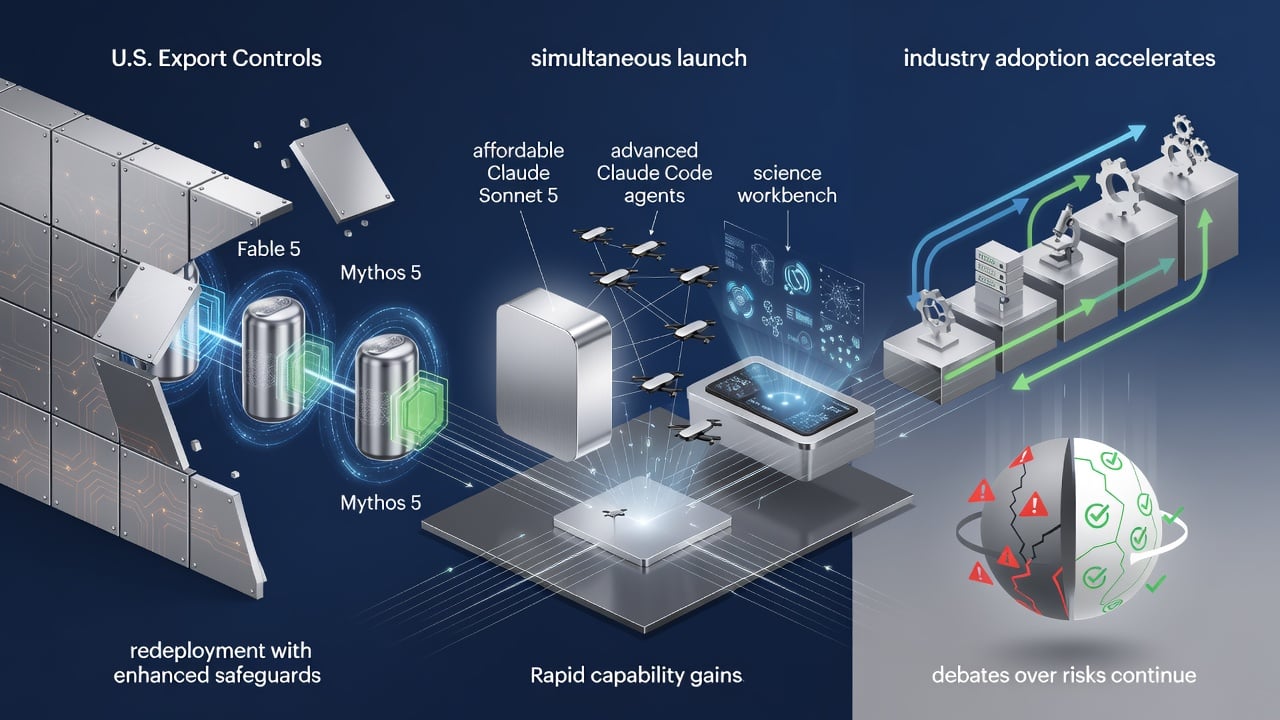
Anthropic didn’t plan for drama. Yet in mid-June its most advanced models vanished from global access. U.S. export controls hit Claude Fable 5 and Mythos 5 just days after launch. The company scrambled. Engineers refined safeguards. Partners conferred. Then, almost as suddenly, the restrictions lifted.
By early July the models returned. Stronger. More scrutinized. Accompanied by a cheaper, highly capable Sonnet 5 that immediately became the default for millions of users. The sequence reveals much about the tightrope AI labs walk today. Safety demands. Government oversight. Commercial pressure. All colliding at once.
The Anthropic announcement on redeploying Fable 5 spelled out the timeline. Models released June 9. Controls imposed June 12. Lifted by June 30. Access restored July 1. Fable 5, built on the same base as the more powerful but restricted Mythos 5, carries three classifier-based fallback systems. One for offensive cyber requests. Another for biology and chemistry dual-use research. A third blocks large-scale distillation that could train rival systems in restricted countries.
Red-teaming consumed more than 1,000 hours. No universal jailbreaks emerged. The company also proposed an industry framework for scoring jailbreak severity alongside Amazon, Microsoft, Google and other Project Glasswing partners. Progress, yet hardly the final word on containment.
But the real story lies in what these models actually do. Fable 5 delivered state-of-the-art results on Cognition’s FrontierCode evaluation. It rebuilt web apps from screenshots. Completed Pokémon FireRed using vision alone. Handled a 50-million-line Ruby migration at Stripe in a single day. Work that normally requires two months of team effort. IMC found strong performance across trading analysis, factual lookup, conceptual reasoning and expected-value calculations.
Power Meets Guardrails
The safeguards come at a cost. Fable 5 carries pricing of $10 per million input tokens and $50 per million output. Twice as expensive as prior flagships. Mythos 5, with fewer restrictions, remains limited to trusted partners for defensive cybersecurity work. Alberta’s government already put it to use. The Canadian province employed Claude to scan systems, spot vulnerabilities and deploy fixes across departments. Concrete proof that frontier models can strengthen rather than undermine security when applied carefully.
Parallel to the flagship drama, Anthropic rolled out Claude Sonnet 5 on June 30. The model closes much of the gap to Opus-class performance on agentic tasks while launching at a fraction of the price. Introductory rates run $2 input and $10 output per million tokens through August. Standard rates afterward remain competitive. It now serves as default for free and paid plans alike. Available also in Claude Code and across the platform.
Early benchmarks show gains in multi-step reasoning, tool use, coding and knowledge work. The model self-verifies outputs without heavy prompting. On agentic search and computer-use evaluations it approaches Opus levels at medium effort. Undesirable behaviors dropped compared with the prior Sonnet. Cyber safeguards ship enabled by default. An updated tokenizer increases token count for the same text by 1.0 to 1.35 times. Minor friction for some workflows.
Developers noticed immediately. The Wall Street Journal reported on the viral spread of Claude Code. Engineers, executives and even hobbyists describe getting “Claude-pilled.” They hand over complex projects and watch the system take control. One common reaction: “It’s amazing and also scary.” The DOS-like terminal interface belies its power. Users compare the moment to the original arrival of generative AI.
Claude Code evolved from an internal command-line tool. Researchers, engineers and early testers shaped it into a reliable agent that edits files, runs tests, manages git and dispatches sub-agents for large codebases. The July 6 feature story on Anthropic’s site details that progression. Dynamic Workflows let hundreds of parallel agents tackle migrations at enterprise scale. Effort Control offers five levels from low to max, letting users balance speed against depth of reasoning.
Yet capability breeds concern. Anthropic’s own researchers flagged risks of recursive self-improvement. Models that enhance themselves without human input could accelerate beyond control. The company called for industry coordination to slow development if needed. Dario Amodei and colleagues have repeated the message. Precaution remains core to their approach.
At the same time the firm expanded into science. Claude Science, launched alongside Sonnet 5, unifies protein viewers, genome browsers and compute clusters into one workbench. Beta users on paid plans gain auditable, reproducible results. The tool targets researchers who previously stitched together disparate systems. Early feedback suggests it compresses weeks of setup into hours.
Recent coverage captured the pace. A New York Times article from late June detailed the export reversal. Commerce Secretary Howard Lutnick cited Anthropic’s coordination with the government on risk mitigation. The models’ ability to find software flaws made them both valuable and sensitive. Lifting controls avoided major delays to Anthropic’s roadmap while preserving oversight.
Bloomberg noted another angle on July 7. Anthropic released video showing Claude mimicking human brain information processing through patterns called the J-space, derived from Jacobian mathematical techniques. The demonstration fuels ongoing debates about model consciousness and internal representations. Executives tread carefully. They acknowledge impressive simulation without claiming true understanding.
Enterprise adoption accelerated. Alberta’s cybersecurity success joins reports from Stripe, IMC and biology labs. One research team saw protein design speed increase tenfold. Another ran autonomous genomics across 138 species using models 100 times smaller than recent Science journal papers. Hypotheses generated by the system earned scientist preference 80 percent of the time.
Still, questions linger. Pricing tiers create access gaps. Free users get capable Sonnet 5. Heavy enterprise workloads tap Fable 5 through credits. Mythos 5 stays gated. Data retention rules apply to certain traffic. Thirty days for Mythos interactions. No training on that data. Enhanced logging and automatic deletion add privacy layers.
Competitors watch closely. OpenAI, Google and others face similar safety-versus-capability trade-offs. Export controls, once imposed, can reshape roadmaps overnight. Anthropic’s swift recovery and simultaneous launches demonstrate resilience. But the episode also shows dependence on regulatory goodwill.
Look at the numbers. Sonnet 5 delivers near-frontier results at lower cost. Claude Code turns terminal skeptics into advocates. Science workbench opens new verticals. Each piece fits a broader strategy. Deliver useful intelligence today. Contain catastrophic risks tomorrow. The balance isn’t perfect. It evolves with every release.
And users adapt fastest. Developers run multiple instances in parallel. One acts as project manager. Others handle research, drafting or review. The technique reduces hallucinations and improves consistency. Early adopters already treat these systems less like chatbots. More like distributed teams that never sleep.
That shift carries economic weight. Companies report months of engineering compressed into days. Smaller teams ship faster. Yet displacement fears grow. The same tools that boost productivity could reshape job categories across software, research and analysis. Anthropic emphasizes augmentation. Real-world outcomes will decide the narrative.
The July announcements mark more than product updates. They signal a maturing industry. One where government, labs and companies negotiate boundaries in public. Where models ship with explicit fallback classifiers and proposed evaluation frameworks. Where capability gains arrive alongside measurable safety improvements.
Fable 5 is back. Sonnet 5 leads daily work. Code agents handle production tasks. Science tools reach labs. The infrastructure for broader AI integration strengthens. Risks remain visible. So do the efforts to manage them. Observers inside tech expect the tension to define the next wave of progress.


 WebProNews is an iEntry Publication