
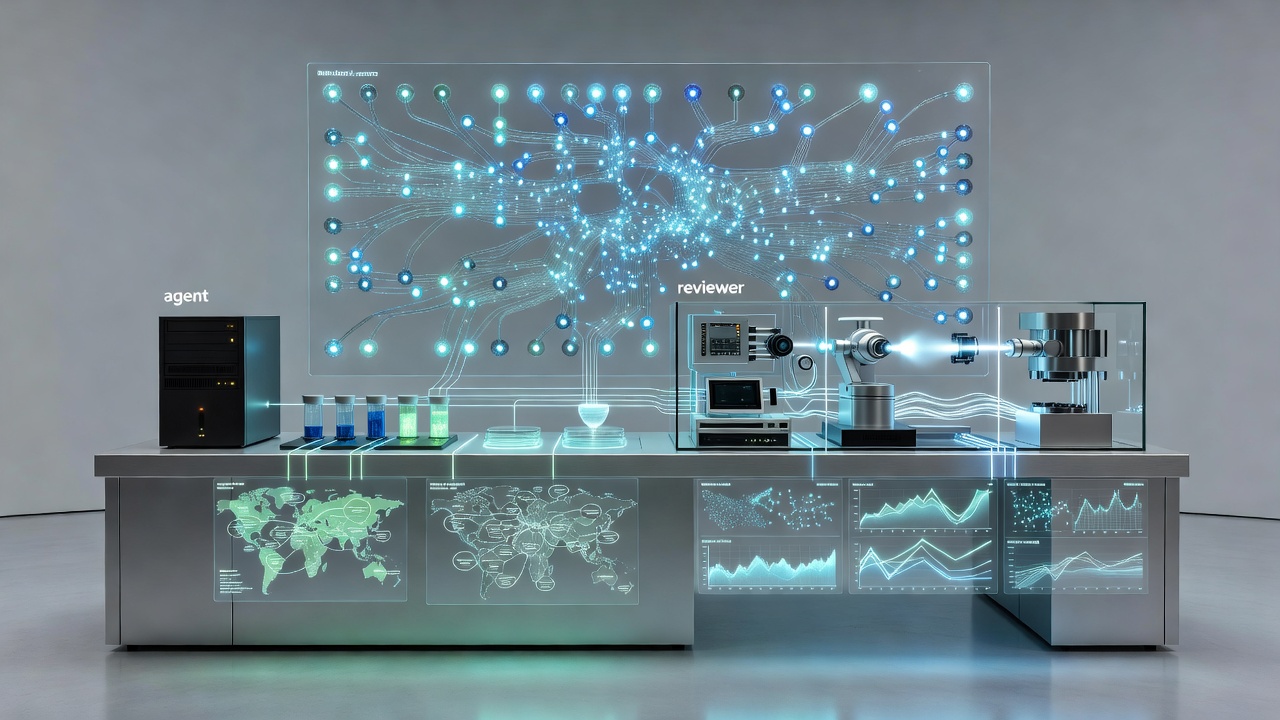
Anthropic rolled out Claude Science on June 30. The beta app targets researchers who spend too many hours jumping between databases, notebooks and compute clusters. It pulls those pieces into one place. No new model powers it. The same Claude that powers chat interfaces now coordinates tasks inside a dedicated environment built for science.
Scientists already rely on PubMed for literature. They switch to Jupyter for analysis. Then comes the terminal for cluster jobs. Fragmentation eats time. Anthropic’s announcement calls this the core problem. Claude Science brings those fragmented tools into a single research environment where scientists can conduct all stages of their work.
One main AI assistant acts as project manager. It taps more than 60 scientific databases. Prebuilt toolkits cover genomics, protein structure prediction and chemistry. The assistant spins up specialized sub-agents for subtasks. A separate reviewer agent checks every citation and calculation before results reach the human. But the same underlying model runs both. Accuracy comes from the review loop, not superior intelligence.
Outputs carry full provenance. Generate a figure. The system stores the exact code, the compute environment, a plain-language description and the complete message history. Edit the figure with ordinary sentences. The agent updates the underlying code. Reproducibility becomes automatic. Auditors or collaborators can trace every decision.
Data stays private. The workbench runs on the lab’s own infrastructure. Only necessary context travels to Anthropic’s servers. Sensitive datasets never leave home. TechRadar reported that everything from literature review to publication preparation happens without exposing large or sensitive information.
Early testers already put the system through real work. Jérôme Lecoq at the Allen Institute built a multi-agent review pipeline. Stephen Francis at UCSF sped up germline variant analysis for glioma research. Manifold Bio used it for single-cell RNA sequencing and CRISPR screen design. These cases show the workbench handling concrete laboratory bottlenecks rather than abstract theory.
John Drake, an ecologist, ran his own experiment. He fed Claude Science 6,576 papers, including 490 on zoonotic spillover. The system built a latent ontology with 1,240 classes and 864 relations. It found that 864 of 915 repeated relationships from the literature had no counterpart in formal ontologies. Another 1,200 conceptual categories were missing from standards. The field turned out roughly four times richer than existing maps suggested. Total cost. Twenty-six dollars.
Drake’s test, detailed in Forbes, illustrates the workbench’s reach beyond traditional wet labs. Ecology, epidemiology and other data-heavy domains gain the same automation that drug developers receive. The tool compresses weeks of synthesis into hours. Scientists shift effort toward judgment and validation. Those steps remain the true rate limiters.
Anthropic built on earlier moves. The company launched Claude for Life Sciences in October 2025. That effort sharpened the chatbot for biology and medicine. Claude Science creates a dedicated workspace instead of an improved chat. TechCrunch noted the parallel to Claude Code, which became the operating layer for software development. The pattern looks deliberate. Anthropic wants to own the workflow layer in vertical industries rather than simply supply models.
Compute flexibility matters. Users gain access to scalable resources without leaving the app. Modal provides up to $2,000 in credits for selected projects. The company also offers grants totaling $30,000 across 50 projects, focused on postdoctoral researchers and graduate students in biomedical fields. Applications close July 15, 2026. Winners run experiments from September through December.
Eric Kauderer-Abrams, who leads life sciences at Anthropic, explained the company’s approach. To build the right models and tools to accelerate the industry, we need to live it alongside all of you. The statement appears in recent coverage and on X discussions following the launch. It signals that Anthropic runs its own internal drug discovery program for neglected diseases. The firm becomes its own first customer. Observers on X described the move as strategic. Selling a workbench works better when the seller has used it in production.
Reactions split along familiar lines. Some researchers welcome relief from tedious pipeline glue and figure iteration. Others worry about over-reliance on black-box coordination. The reviewer agent helps address trust. Yet every generated artifact still requires human oversight. The system produces auditable records, not unquestioned truth.
Availability remains limited for now. The beta runs on macOS and Linux. Access requires Claude Pro, Max, Team or Enterprise subscriptions. No Windows support yet. Anthropic plans iterative updates based on user feedback. The company released the tool early precisely to gather that input on real scientific problems.
Broader industry context adds weight. OpenAI has its own science initiatives. Nvidia pushes hardware for AI-driven discovery. Anthropic differentiates through workflow integration and emphasis on auditability. The bet rests on process, not raw model scale. Intelligence stays constant. The harness around it changes.
Drake’s $26 ontology map offers a glimpse. One researcher mapped an entire subdomain and uncovered hidden structure. Scale that across thousands of labs. Literature synthesis, hypothesis generation and experiment design could accelerate. Publication drafting might follow. The workbench already supports manuscript preparation.
Challenges persist. Integration with every legacy instrument or database won’t happen overnight. Training scientists to trust agent outputs takes time. Data governance rules in some institutions may complicate even private deployments. Still, the core promise holds. Reduce the 80 percent of research work that produces little visible progress. Free experts for the creative and interpretive tasks only humans perform well.
Anthropic positioned Claude Science as one step in a longer effort to speed scientific discovery and healthcare advances. The announcement opens with that ambition. Delivery depends on adoption, refinement and measurable gains in research output. Early signs from testers suggest the foundation exists. The next months of beta use will reveal how far it stretches.


 WebProNews is an iEntry Publication