
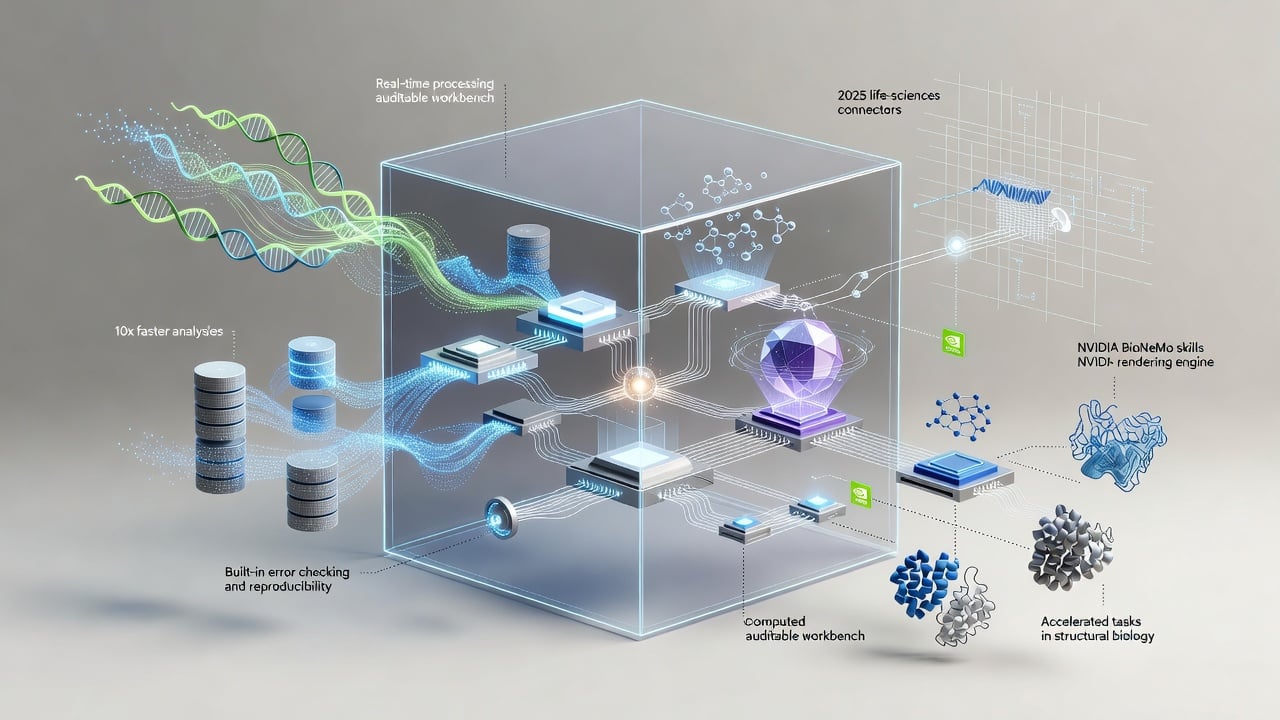
Researchers have spent decades piecing together fractured digital environments. One window for literature. Another for data analysis. A terminal for cluster jobs. Notebooks that break when environments drift. The friction slows discovery. It invites errors. Now Anthropic aims to collapse those silos into one auditable space.
Claude Science, released in beta this year, functions as a desktop application for macOS and Linux. It connects directly to scientific databases, electronic lab notebooks, protein models, high-performance computing clusters and more. The system doesn’t just answer questions. It runs analyses, renders results, checks its own work and produces outputs complete with provenance. Anthropic announced the workbench alongside earlier life-sciences connectors that already showed gains on protocol comprehension tasks.
Every figure, table or notebook generated carries its full history. Exact code. Software environment. Conversation thread. A reviewer agent scans for mismatched numbers, untraceable citations or plots that fail to match underlying data. It flags problems. It corrects some on its own. Scientists can annotate a chart in plain English. The agent rewrites its code accordingly. But the emphasis stays on reproducibility. No black boxes here.
Early users report striking time savings. Jérôme Lecoq, a neuroscientist at the Allen Institute, previously needed up to two years for certain literature reviews. With Claude Science he has produced about 10 reviews, many exceeding 100 pages. The system built a multi-agent template with roughly 20 custom skills. Sub-agents read papers, extract claims and quantitative findings, store them in an evidence database, then construct narrative sections and figures. Actor-critic pairs handle creation and verification. “Before Claude Science, it could take Jérôme Lecoq’s team as many as two years to write such a review,” the announcement noted.
At UCSF, associate professor Stephen Francis applied the tool to molecular epidemiology of glioma. His team performed comprehensive germline variant workups across multiple approaches. The analysis ran in roughly one-tenth the previous time. His group independently validated the outputs. They found the results both rapid and reliable. Francis described how the tool accelerated work that predated its formal availability yet benefited from its capabilities once integrated.
Manifold Bio develops tissue-targeting medicines. The company used Claude Science to nominate experimental targets. For each tissue and candidate binder the system evaluated surface expression, trafficking and safety profiles. It ranked options against Manifold’s proprietary internal criteria. The key advantage, according to the firm, lay in end-to-end execution. Claude Science gathered relevant data, applied domain judgment and retained context from prior pipelines. A generalist coordinating agent oversees more than 60 pre-configured skills across genomics, single-cell analysis, proteomics, structural biology and cheminformatics. It can spin up specialist agents or tap reviewer agents as needed.
The workbench queries dozens of specialized resources without forcing users to master each interface. UniProt, PDB, Ensembl, Reactome, ClinVar, ChEMBL, GEO, journals, preprints. It synthesizes across them in plain language. Persistent Python and R kernels keep variables and large datasets in memory. No repeated loading. Compute management spans local laptops, Linux machines, SSH-connected clusters or on-demand GPUs through services such as Modal. The system drafts job plans, seeks confirmation before scaling from one graphics card to hundreds, then submits and monitors execution. All while keeping sensitive data on the lab’s own infrastructure.
Native renderers display proteins in 3D, genomic tracks, chemical structures and PDF content directly inside the interface. No export to separate viewers. Draft manuscripts emerge in Markdown or LaTeX alongside the supporting analysis. These features build on work Anthropic began in late 2025 with Claude for Life Sciences. That October release introduced connectors to Benchling, 10x Genomics, BioRender, PubMed and Wiley’s Scholar Gateway. It also delivered performance improvements. On a Protocol QA benchmark, an updated Sonnet model scored 0.83 compared with a human baseline of 0.79. Bioinformatics gains appeared on BixBench as well.
Claude Science incorporates skills from NVIDIA’s BioNeMo Agent Toolkit. This grants native access to models including Evo 2, Boltz-2 and OpenFold3 for structural and sequence tasks. Labs can save their own pipelines as reusable skills. Custom connectors link to internal application programming interfaces or existing electronic lab notebooks. Future sessions inherit these extensions automatically. The result feels less like a chatbot and more like a persistent research colleague that remembers the stack.
Availability remains limited for now. Beta access sits behind Claude Pro, Max, Team or Enterprise plans. Team and Enterprise administrators must explicitly enable it. Academic and nonprofit labs receive discounted seats after principal investigator verification. Anthropic also offers its AI for Science program, providing free API credits to selected high-impact projects, particularly in biology. Applications for up to 50 such projects, with credits reaching $30,000 each, closed on July 15, 2026. Modal contributed compute grants for qualifying work. A dedicated discourse community has formed for user feedback and shared workflows.
Yet challenges persist. The system is still in beta. Its performance depends on the underlying Claude models, which continue to evolve. Data privacy holds firm because computation occurs on user infrastructure, yet prompts and responses still route through Anthropic servers for processing. Self-correction helps but cannot eliminate every hallucination. Complex novel research may still demand human oversight at critical junctures. And the learning curve, while gentler than stitching together disparate tools, requires familiarity with agentic prompting.
Even so, the early signals point toward genuine workflow compression. Literature synthesis that once consumed months now yields structured evidence databases. Single-cell RNA-seq clustering and annotation happen with traceable code. Manuscript drafts emerge with figures that can be iterated through conversation rather than manual redesign. One lab lead described the shift as moving from task executor to thinking partner. Another noted that Claude consistently caught details the team had overlooked, each time yielding verifiable discoveries.
Anthropic has positioned scientific acceleration as a core mission. Its science blog, launched earlier in 2026, explores practical workflows, collaborations and internal research such as long-running Claude instances for computational tasks. The company’s economic index reports track AI adoption across sectors, including coding agents in social sciences where only about 20 percent of surveyed researchers had integrated tools like Claude Code by early 2026. Life sciences appear to be moving faster.
Pharmaceutical partners have echoed the momentum. Sanofi called Claude integral to its AI transformation. Schrödinger reported moving up to 10 times faster on certain code-heavy tasks. The Broad Institute highlighted agents operating at new scales. These statements accompanied the 2025 life-sciences launch but foreshadow the workbench now in testers’ hands.
Claude Science does not promise to replace scientists. It instead removes much of the mechanical drag that consumes their days. By embedding provenance at every step, it addresses a perennial reproducibility crisis. By managing compute and environments, it frees attention for hypothesis and interpretation. The bet is that when tools become this integrated and auditable, the pace of insight quickens. Early adopters at the Allen Institute, UCSF and Manifold Bio suggest the hypothesis is already producing results.
Whether that acceleration compounds into breakthroughs or merely streamlines routine work remains an open question. The beta phase will supply more data. Feedback from the research community will shape refinements. For labs weary of context-switching across databases and terminals, however, the arrival of a unified, self-checking scientific environment marks a tangible shift. The fragments are starting to cohere.


 WebProNews is an iEntry Publication