
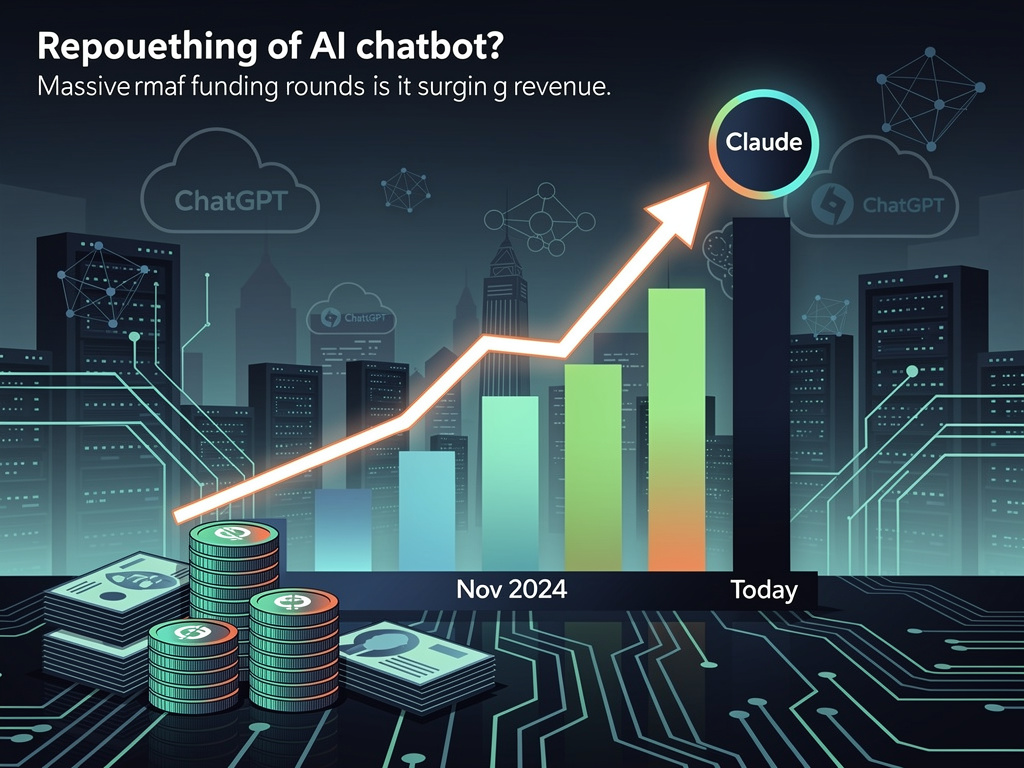
Anthropic, the San Francisco–based artificial intelligence company founded by former OpenAI executives, has seen daily signups for its Claude chatbot triple since November, according to a report from The Information. The revelation marks a significant inflection point for a company that has long been regarded as a formidable technical competitor to OpenAI but has struggled to match ChatGPT’s consumer traction. Now, with a rapidly expanding user base and a valuation that has soared past $60 billion, Anthropic appears to be closing the gap in the race for AI consumer dominance.
The tripling of daily signups is particularly notable given the timing. November 2024 was when Anthropic released Claude 3.5 Sonnet, an updated version of its flagship model that garnered widespread praise from developers and enterprise users for its coding abilities and general reasoning performance. The surge suggests that positive word-of-mouth, combined with aggressive product improvements, is finally translating into the kind of mainstream consumer adoption that had previously eluded the company.
From Research Lab to Consumer Contender
Anthropic was founded in 2021 by Dario Amodei and Daniela Amodei, siblings who left OpenAI over disagreements about the pace and safety of AI development. From the outset, the company positioned itself as a safety-focused alternative, building its Claude models with what it calls “Constitutional AI” — a training methodology designed to make the system more helpful, harmless, and honest. For much of its existence, Anthropic’s reputation was strongest among developers and enterprise clients, particularly through its API business, which allows companies to integrate Claude into their own products and workflows.
But the consumer-facing chatbot market — the one that ChatGPT essentially created when it launched in late 2022 — remained a different story. OpenAI’s ChatGPT rocketed to over 100 million weekly active users, a figure CEO Sam Altman touted publicly in late 2024. Google’s Gemini, backed by the company’s massive distribution advantages across Android and Search, also commands significant consumer attention. Against these incumbents, Claude’s consumer product was often described as a well-kept secret among power users rather than a household name.
What’s Driving the Surge in Signups
Several factors appear to be converging to fuel Anthropic’s growth. First, the technical performance of Claude’s latest models has earned consistently strong reviews. Independent benchmarks and user testimonials have frequently placed Claude 3.5 Sonnet at or near the top of rankings for tasks like coding assistance, long-document analysis, and nuanced conversational interactions. The model’s 200,000-token context window — far larger than what most competitors offered at the time of its release — has made it particularly attractive for professionals working with large volumes of text.
Second, Anthropic has been investing more heavily in its consumer product experience. The company launched features like “Artifacts,” which allow Claude to generate interactive content such as code snippets, documents, and visualizations directly within the chat interface. It also introduced a “Projects” feature that lets users organize conversations and upload reference materials for more sustained, context-rich interactions. These product moves signal that Anthropic is no longer content to compete solely on model quality — it wants to build a consumer application that can stand on its own merits against ChatGPT’s increasingly feature-rich interface.
A Funding Juggernaut With Momentum
The user growth numbers come at a time when Anthropic’s financial position has never been stronger. In early 2025, the company closed a $2 billion funding round led by Lightspeed Venture Partners, bringing its total funding to approximately $13.7 billion. Its valuation reached $61.5 billion, making it one of the most valuable private companies in the world. Amazon has been the company’s largest financial backer, having committed up to $4 billion in investment, while Google has also invested $2 billion. These strategic partnerships provide Anthropic not only with capital but also with cloud computing infrastructure — a critical resource given the enormous costs of training and running large AI models.
Revenue has also been climbing. Reports from late 2024 indicated that Anthropic was on track to generate roughly $900 million in annualized revenue, a figure that was growing rapidly thanks to both enterprise API contracts and consumer subscription revenue from Claude Pro, which costs $20 per month. If the tripling of daily signups is sustained, that revenue trajectory could accelerate meaningfully in 2025, particularly as more free users convert to paying subscribers.
The Competitive Pressure on OpenAI Intensifies
For OpenAI, Anthropic’s growth represents an increasingly serious competitive threat. While ChatGPT remains the dominant consumer AI product by a wide margin, the market is no longer a one-horse race. OpenAI has responded with a flurry of product launches and model updates, including GPT-4o, its multimodal model, and a series of enterprise-focused features. The company has also been pursuing its own massive fundraising efforts, reportedly seeking to raise tens of billions of dollars to fund its compute-intensive research agenda.
But OpenAI faces its own challenges. The company has been embroiled in a controversial corporate restructuring, moving from its original nonprofit governance structure to a for-profit entity — a transition that has drawn scrutiny from regulators, former board members, and Elon Musk, who has filed lawsuits challenging the move. Anthropic, by contrast, has largely avoided such public controversies, maintaining a lower profile while steadily building its technology and user base. The Amodei siblings have positioned their company as the responsible alternative in AI development, a narrative that resonates with a growing segment of users and enterprise clients who are concerned about AI safety and alignment.
Enterprise Adoption and the API Business
While the consumer signup numbers are grabbing headlines, Anthropic’s enterprise business remains a critical pillar of its strategy. Major companies across finance, healthcare, legal services, and technology have adopted Claude through Anthropic’s API, and the model is available through both Amazon Web Services (via Amazon Bedrock) and Google Cloud. This multi-cloud availability gives enterprise customers flexibility and has helped Anthropic win deals that might otherwise have gone to OpenAI or Google.
The enterprise market is where the largest revenue opportunities likely reside. Companies are willing to pay premium prices for AI models that can handle sensitive data securely, perform reliably on domain-specific tasks, and integrate smoothly into existing technology stacks. Anthropic has invested in features like longer context windows, improved instruction-following, and reduced hallucination rates — all of which are particularly valued by enterprise buyers. The consumer growth, meanwhile, serves a dual purpose: it builds brand awareness and provides a massive feedback loop that helps Anthropic improve its models faster.
The Broader AI Market Is Heating Up
Anthropic’s growth is unfolding against the backdrop of an AI industry that is attracting unprecedented levels of investment and attention. According to recent reporting, global AI investment is expected to exceed $200 billion in 2025, with much of that capital flowing into foundation model companies, AI infrastructure, and enterprise AI applications. The competition among frontier AI labs — including OpenAI, Anthropic, Google DeepMind, Meta AI, and newcomers like xAI (Elon Musk’s AI venture) and Mistral — is intensifying on multiple fronts, from model performance to product design to pricing.
The consumer chatbot market, in particular, is becoming a fierce battleground. Google recently integrated Gemini more deeply into its core products, including Gmail, Docs, and Search. Meta has embedded its Llama-based AI assistant across Facebook, Instagram, and WhatsApp, giving it access to billions of potential users. And xAI’s Grok, initially available only to X (formerly Twitter) premium subscribers, has been expanding its reach. In this crowded field, Anthropic’s ability to triple its daily signups is a testament to the strength of its underlying technology and the growing appetite among consumers for alternatives to ChatGPT.
What Comes Next for Anthropic
Looking ahead, Anthropic faces the challenge of converting its signup momentum into sustained engagement and revenue growth. The company is expected to release Claude 4 in 2025, which could further differentiate its offering if it delivers meaningful performance improvements. Anthropic has also signaled interest in expanding into agentic AI — systems that can take actions on behalf of users, such as browsing the web, executing code, and managing workflows — a frontier that OpenAI, Google, and others are also pursuing aggressively.
The tripling of daily signups is a data point, not a destination. But for Anthropic, it represents something the company has been working toward since its founding: proof that building AI with a focus on safety and technical excellence can also be a winning commercial strategy. As the AI industry enters what many expect to be its most consequential year yet, Anthropic has positioned itself not just as a credible alternative to OpenAI, but as a genuine rival for the throne.


 WebProNews is an iEntry Publication