
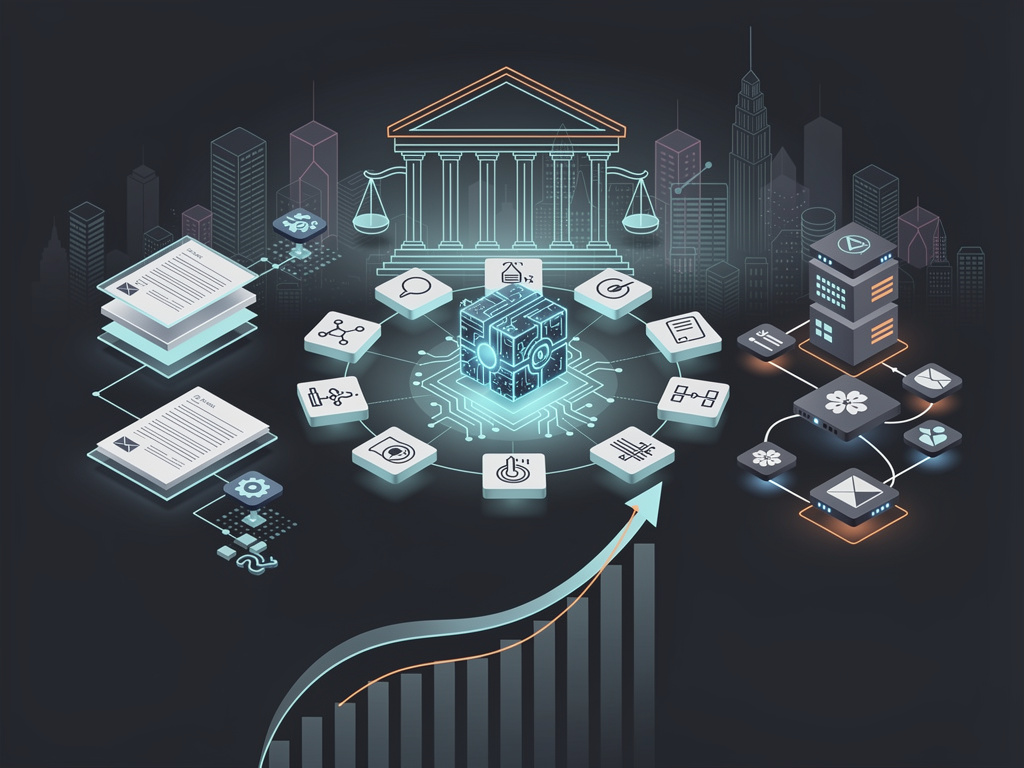
Anthropic just dropped a bundle of specialized tools that could redraw how law firms handle everyday tasks. The company formally launched Claude for Legal on May 12. It bundles 12 practice-specific plugins, more than 20 integrations with existing software, and tight connections inside Microsoft 365.
Mark Pike, Anthropic’s associate general counsel, has watched the demand build. Over 20,000 legal professionals signed up for the firm’s recent webinar on putting Claude to work. That turnout, Pike said, shows lawyers have moved past asking whether to adopt AI. They now ask how.
The new plugins target real pressure points. One acts as commercial counsel. It redlines contracts, triages nondisclosure agreements, and pulls from iManage. Another serves corporate counsel with M&A due diligence, board resolutions, and entity management. Regulatory counsel tracks incoming rules, compares them against internal policies, and flags gaps. Privacy counsel handles data subject requests and privacy agreement reviews. Litigation versions assist with deposition prep, chronology building, privilege logs, and brief drafting. Even a law student plugin offers case briefing, flashcards, and bar exam preparation.
These aren’t generic chatbots. They combine agentic workflows, directional templates, and direct links to document systems. Claude Opus 4.7, the model behind much of this, scored 90.9% on Harvey’s BigLaw Bench. That benchmark tests realistic legal tasks. The score stands as the highest yet for any Claude model, according to feedback shared with Pike from Harvey’s head of AI research.
But benchmarks tell only part of the story. Hallucinations still appear in court filings. Judges have sanctioned lawyers for citing nonexistent cases. Anthropic counters with grounding. The system pulls only from verified sources such as Westlaw, CourtListener, or a firm’s own iManage repository. Jay Madheswaran, CEO of Eve, put it plainly. In litigation an authoritative-sounding hallucination hurts more than silence. His team’s internal tests show Claude wins on grounding and citation faithfulness.
Integrations reach deep. Claude now connects through Model Context Protocol connectors to DocuSign, Thomson Reuters, Box, Everlaw, Ironclad, NetDocuments, Relativity, and more than a dozen others. It embeds directly in Word, Outlook, Excel, and PowerPoint. Context carries across those apps. A lawyer can draft a memo in Claude Cowork, shift to Word for line edits, then pull live research from Thomson Reuters without losing thread. Law.com reported that these connectors let firms combine Claude’s capabilities with their current stack rather than rip it out.
Freshfields has already deployed Claude to thousands of lawyers across 33 offices. Gerrit Beckhaus, partner and co-head of the firm’s innovation team, called the capabilities an essential part of its proprietary AI solutions. Usage jumped roughly 500% in the first six weeks. Quinn Emanuel built a litigation platform on Claude with minimal coding. Christopher D. Kercher, the partner who leads AI and data analytics there, described onboarding the model the way one would onboard a new case team member. He fed it chronology, key excerpts, and themes. The output, Kercher said, went far beyond what he could have produced alone.
Holland & Knight and Crosby Legal also use Claude on live matters. Several legal AI companies, including Harvey, Legora, Solve Intelligence, and Eve, build on Claude’s underlying models. This positions Anthropic as foundational infrastructure. Legal tech vendors that once sold direct access to large language models now layer additional features on top of Claude.
The shift carries consequences. When Anthropic first teased legal plugins earlier this year, shares of legal information providers tumbled. RELX and Wolters Kluwer each dropped more than 10% in two days. TechCrunch noted the broader heating up of AI legal services as Anthropic expands. The latest release deepens that pressure. Yet many firms appear ready. Pike observed that legal has become one of Claude Cowork’s top use cases, running three times more actively than other functions.
Anthropic frames the offering as meeting customers where they work. Plugins install with one click for paid users. Enterprise admins control enablement. Customization starts with an onboarding interview that tailors behavior to a firm’s playbooks and risk tolerances. Human oversight remains mandatory. Pike stressed that lawyers keep final decision rights.
The company also extended reach beyond Big Law. Partnerships with the Free Law Project and Justice Technology Association aim to improve access for underserved communities. Discounted nonprofit pricing and pro bono tools, such as real-time trial assistance via API, sit alongside the enterprise features. Sonja Ebron, CEO of Courtroom5, said most people discover their legal rights only when it is too late. Claude can meet them at the moment they search for answers.
Still, limits exist. Claude performs best on document-heavy tasks that reward long-context reasoning. It tracks defined terms across exhibits and schedules with notable accuracy. Complex negotiation, strategic judgment, and client counseling stay with humans. Pike acknowledged the legal sector’s historical resistance to new technology. Recent demand suggests that caution has given way to pragmatism.
Analysts see convergence ahead. Lawyers may begin work inside Claude or a Microsoft app, then export outputs to authoritative systems of record. Traditional legal tech vendors could evolve into specialists that add domain workflows on the Claude base layer. Open-source contributions from partners such as Harvey already flow into the ecosystem. Developers gain agentic building blocks that knowledge workers can now use without heavy coding.
Anthropic itself sits at a striking valuation above $900 billion. That figure nearly matches the size of the entire global legal market. The comparison underscores the stakes. Legal work, with its high volume of repeatable analysis and documentation, offers a proving ground for broader knowledge-work automation. The company’s February move into legal plugins already rattled software stocks. Tuesday’s expansion signals this push has momentum.
Big Law firms that move fastest stand to pull ahead on efficiency. Those slower to adapt risk watching competitors reduce hours spent on routine review and research. For solo practitioners and smaller teams, the lowered barrier to sophisticated tools could level the field. Yet success hinges on more than technology. Security, data privacy, and seamless fit with existing habits will decide adoption rates.
Claude for Legal does not replace lawyers. It amplifies certain parts of their practice. Redlining contracts. Building chronologies. Scanning regulations. Drafting first-pass briefs. These tasks consume hours. Offloading them with reliable grounding changes the math on billable work and capacity. Firms already report productivity gains. The question now becomes how far those gains extend and who captures the value.
Mark Pike believes the legal sector has crossed a threshold. Lawyers no longer debate AI’s place. They focus on implementation. With plugins that speak directly to practice areas, integrations that respect current toolkits, and a model tuned for document comprehension, Anthropic has handed them a practical starting point. How firms choose to run with it will shape the next chapter for legal work.


 WebProNews is an iEntry Publication