
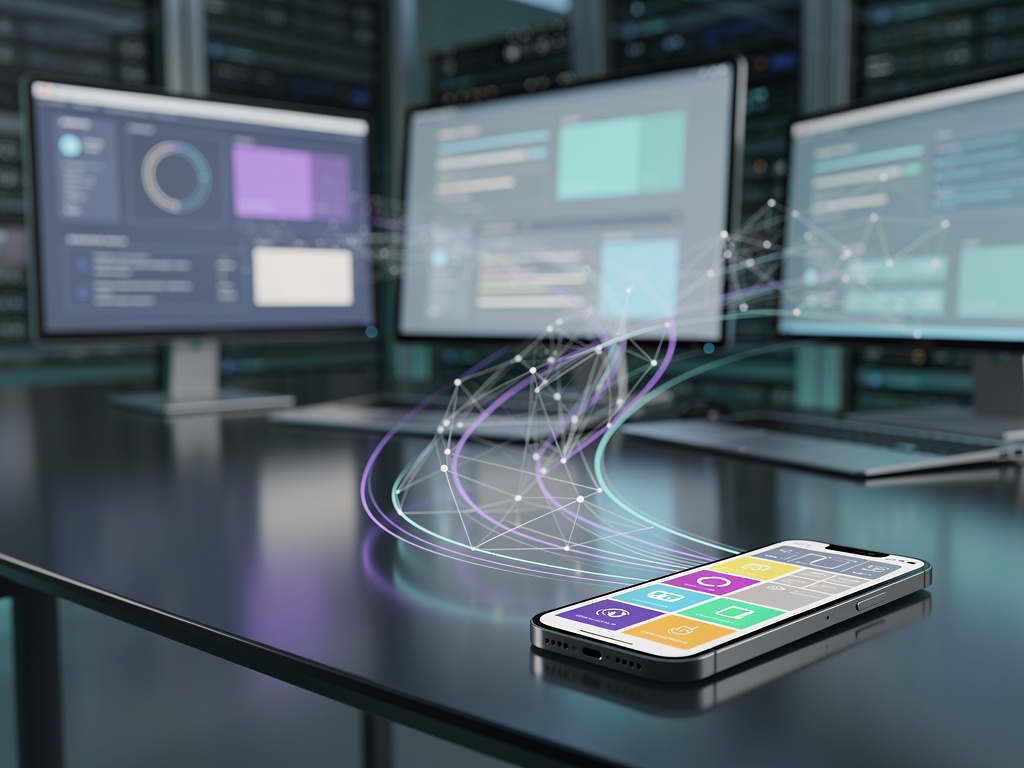
Anthropic just made every enterprise IT department’s job more complicated — and potentially more valuable. The AI company announced that its Claude assistant can now remotely operate a Mac from an iPhone, turning Apple’s mobile device into a command center for desktop-class computing. The feature, reported by MacRumors, lets users instruct Claude to perform complex tasks on their Mac — opening applications, moving files, running workflows — all through natural language commands issued from their phone.
This isn’t a parlor trick. It’s a direct assault on the $45 billion remote desktop and IT automation market.
The implications for companies operating in adjacent spaces are immediate and uncomfortable. Firms like TeamViewer, AnyDesk, and even Microsoft’s own Remote Desktop solutions now face a competitor that doesn’t just mirror a screen but actually understands what’s on it. Traditional remote access tools require users to manually navigate their desktops from a smaller display — a clunky experience that hasn’t fundamentally changed in two decades. Claude’s approach skips the visual relay entirely. You tell it what you want done, and it does it. The difference between remote viewing and remote agency is the difference between a security camera and a security guard.
For Anthropic, the timing is strategic. The company, valued at $61.5 billion after its latest funding round according to Reuters, has been searching for product differentiation that goes beyond chatbot benchmarks. OpenAI dominates consumer mindshare. Google’s Gemini has distribution advantages that are nearly impossible to replicate. So Anthropic is betting on computer use — the ability for AI to interact with software the way a human would, clicking buttons, reading screens, executing multi-step processes. This iPhone-to-Mac feature is the most consumer-visible expression of that bet yet.
And it puts Apple in an interesting position.
Apple has been conspicuously cautious about integrating third-party AI deeply into its operating systems. Its own Apple Intelligence features, rolled out through 2025 and into 2026, have focused on on-device processing and privacy-first design. But Claude remotely controlling a Mac raises questions Apple will eventually need to answer. How much system-level access should a third-party AI have? What happens when Claude accidentally deletes a file or sends an email the user didn’t intend? Liability frameworks for AI agents operating on personal computers don’t exist yet in any meaningful legal sense.
The business opportunity, though, is enormous. Consider the workflow. A sales executive sitting in an airport lounge pulls out her iPhone, tells Claude to open the CRM on her office Mac, pull last quarter’s pipeline data, format it into a slide deck, and email it to her team before a 3 p.m. meeting. No VPN configuration. No squinting at a remote desktop on a 6.7-inch screen. No calling IT. That’s not a marginal improvement. That’s a category of work that previously required either being physically present or tolerating significant friction.
Enterprise software companies should be paying close attention to the downstream effects. If AI agents can operate desktop applications on behalf of users, the value proposition of many SaaS tools shifts. Why build a mobile app for your enterprise software when Claude can just operate the desktop version remotely? This could slow mobile development investment across the B2B software industry — or accelerate it, if companies decide they need to build AI-agent-friendly interfaces to stay competitive.
The numbers suggest the market is ready for this kind of disruption. Gartner projected that by 2026, 30% of enterprises would have adopted some form of AI-augmented automation for routine computing tasks, up from less than 5% in 2024. Anthropic’s move collapses what many assumed would be a gradual enterprise rollout into something any individual with a Mac and an iPhone can try today.
But there are real risks to Anthropic’s bottom line here too. Computer use is computationally expensive. Every time Claude operates a Mac remotely, it’s processing screen captures, interpreting visual layouts, deciding on actions, and executing them — a chain of inference calls that burns through GPU cycles far faster than a simple text conversation. Anthropic hasn’t disclosed specific cost-per-task figures for computer use, but industry analysts at Bernstein estimated in a February 2026 note that agentic AI tasks cost roughly 8 to 15 times more in compute than equivalent chat-based interactions. Scaling this to millions of users without hemorrhaging money will require either aggressive pricing or dramatic efficiency gains in inference.
Pricing is where the competitive dynamics get sharp. Anthropic currently charges $20 per month for Claude Pro, the consumer subscription tier. Microsoft charges $23.99 per month for its Copilot Pro offering. If Anthropic bundles remote computer use into its existing subscription without a price increase, it creates immediate pressure on Microsoft to match the capability — or explain why its higher-priced product doesn’t offer it. If Anthropic charges extra, it tests consumer willingness to pay for a feature category that barely existed six months ago.
The security implications deserve scrutiny from investors. An AI agent that can control a computer remotely is, by definition, an attack surface. If a user’s Anthropic account is compromised, the attacker doesn’t just get access to chat history — they get a tool that can operate the victim’s Mac. Anthropic says it has implemented multiple authentication layers and user confirmation steps for sensitive actions, per the MacRumors report. But the history of cybersecurity is a history of authentication layers being circumvented. Enterprise adoption — where the real revenue is — will hinge on whether CISOs trust the architecture.
For the broader AI industry, this announcement signals an acceleration of the agentic AI thesis. The idea that AI systems will move from answering questions to performing tasks has been a central narrative in Silicon Valley for the past 18 months. OpenAI has its own computer use capabilities in development. Google has demonstrated similar features with Project Mariner. But Anthropic shipping a polished consumer-facing version that works across Apple’s two most popular device categories is a concrete milestone. Talk is cheap. Shipping is not.
The companies most exposed to disruption aren’t the obvious ones. Yes, remote desktop providers face pressure. But think further down the chain. Virtual assistant services — the human kind — represent a market worth roughly $25 billion globally. If Claude can reliably perform 40% of the tasks a human virtual assistant handles, the pricing pressure on that industry becomes severe. Executive assistant staffing agencies, freelance VA platforms, even certain BPO operations in the Philippines and India could see demand erosion faster than anticipated.
Not all of this will play out immediately. The technology is new, and early adopters will inevitably encounter limitations — tasks Claude can’t complete, misunderstood instructions, latency issues over poor network connections. Anthropic’s own documentation acknowledges that computer use remains in beta and may produce unexpected results. The gap between demo and daily driver is always wider than launch-day coverage suggests.
Still, the strategic direction is clear. AI companies are no longer competing on who can generate the best text or the most convincing image. They’re competing on who can do the most work. Anthropic just raised the stakes by turning every iPhone into a remote control for a Mac, with an AI agent at the helm. For investors, the question isn’t whether this category will matter. It’s which companies will capture the margin — and which will watch theirs evaporate.


 WebProNews is an iEntry Publication