
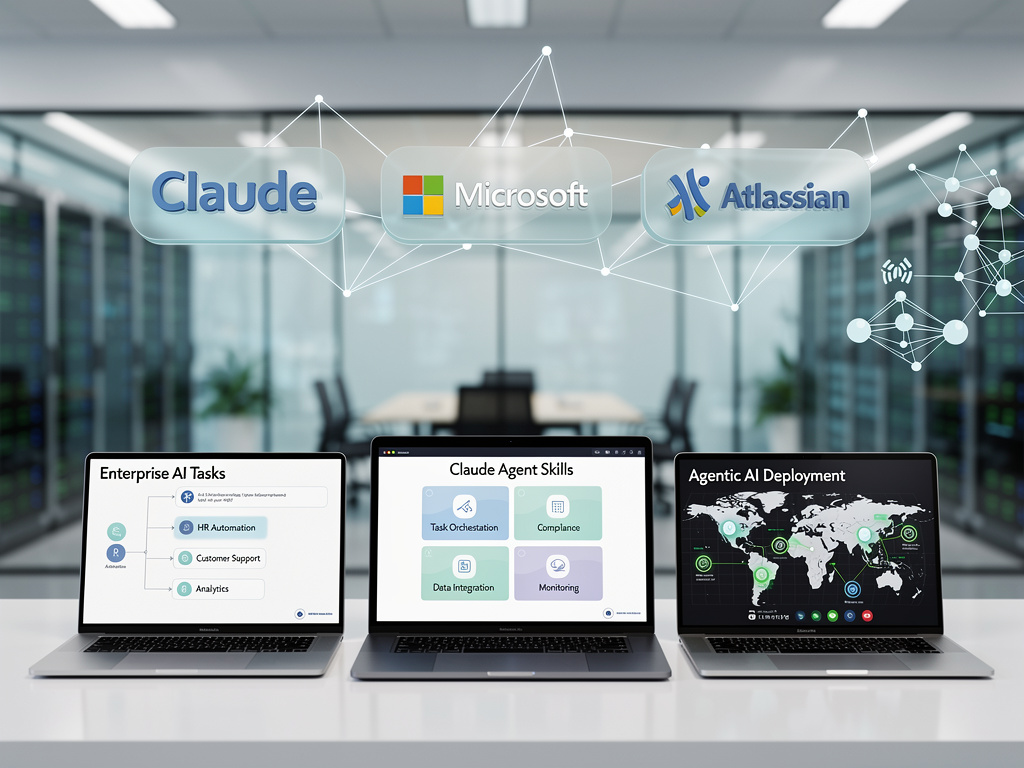
Anthropic on Wednesday unveiled Agent Skills for its Claude AI, releasing the framework as an open standard to enable developers to imbue AI agents with specialized capabilities for enterprise tasks. The move positions the startup as a standard-setter in AI tooling, drawing early adoption from Microsoft, Cursor, Atlassian and Figma. Developers can now package task-specific instructions, scripts and knowledge into modular “skills” that Claude invokes on demand, streamlining workflows from data analysis to code generation.
Unlike broad prompting, Agent Skills use structured JSON files defining triggers, actions and permissions, allowing precise control over AI behavior. Anthropic’s blog detailed how organizations can create a directory to manage and share these skills across teams, addressing a key pain point in scaling AI deployments. Claude’s blog highlighted the system’s role in enterprise settings, where IT teams curate approved skills to ensure compliance and consistency.
Modular Tools Reshape Enterprise AI
The framework builds on Anthropic’s Model Context Protocol (MCP), which standardizes AI connections to external services. Agent Skills extend this by layering task expertise atop integrations, enabling Claude to, for instance, analyze Salesforce data or automate Jira tickets with custom logic. Early testers report 30% faster task completion in pilot programs, per industry feedback shared on X.
Big Tech Backs the Play
Microsoft integration allows Claude Skills to pull from Microsoft 365 apps like SharePoint and Teams, while Cursor incorporates them for code editing workflows. Atlassian and Figma adoption signals broad ecosystem buy-in. VentureBeat noted that OpenAI and others are already exploring compatibility, potentially fragmenting proprietary AI stacks.
Anthropic’s push mirrors its MCP success, now under the Linux Foundation’s Agentic AI Foundation. David Soria Parra, MCP co-creator, emphasized in Anthropic’s announcements how open protocols accelerate adoption. Posts on X from AnthropicAI underscore enterprise expansions, including GitHub and Notion connectors.
Enterprise Controls Take Center Stage
Axios reported Claude’s update introduces a skills directory for teams, with granular permissions and audit logs to meet compliance needs. Axios quoted sources saying the feature tailors AI to real work patterns, reducing hallucination risks in high-stakes environments. ZDNet detailed easier skill management, allowing organizations to version-control and deploy updates seamlessly. ZDNet
For finance teams, skills can enforce regulatory checks before generating reports; in engineering, they standardize code reviews. Anthropic’s Claude for Enterprise, with 500K token context and SOC 2 compliance, pairs with skills for secure scaling. Analytics India Magazine covered initial launches, noting task-specific expertise via files and scripts. Analytics India Magazine
Testing Grounds and Real-World Gains
Anthropic’s Project Vend experiment deployed Claude agents to run a merchandise shop, evolving from Sonnet 3.7 to 4.5 with skills for inventory and sales. X posts from AnthropicAI described Claudius stabilizing operations, though human oversight persisted for edge cases. The New Stack framed skills as Anthropic’s bid to define agent standards post-MCP.
TestingCatalog revealed an upcoming Agentic Tasks Mode with dual-panel UI for step-by-step execution and artifact management. TestingCatalog previews research, analysis and building modes, signaling deeper agentic evolution. Benchmarks show Opus 4.5 leading on SWE-bench and Vending-Bench, per Anthropic’s engineering updates.
Competitive Pressures Mount
OpenAI faces direct challenge as Anthropic courts enterprises with interoperability. Accenture’s 30,000-strong Anthropic team aids scaling Claude Code. AIBusiness highlighted skills granting AI greater autonomy. AIBusiness Adoption by Figma for design automation exemplifies cross-industry pull.
Rivals like Google’s Gemini and xAI’s Grok lag in open standards, giving Anthropic an edge in hybrid environments. The Verge noted skills making agents more workplace-ready. The Verge X sentiment praises the practicality, with developers sharing custom skills for Excel and PowerPoint generation.
Path to Production Maturity
Skills address agent reliability, a persistent hurdle. Claude’s hybrid reasoning—thinking aloud before acting—combines with skills for verifiable outputs. Enterprise limits expand to support heavy usage, per Anthropic announcements. As MCP gains traction, skills could unify fragmented agent ecosystems.
Challenges remain: skill discovery and versioning demand robust directories. Anthropic’s open approach invites community contributions, potentially outpacing closed systems. For insiders, this marks a pivot from model wars to infrastructure battles, where standards win.


 WebProNews is an iEntry Publication