
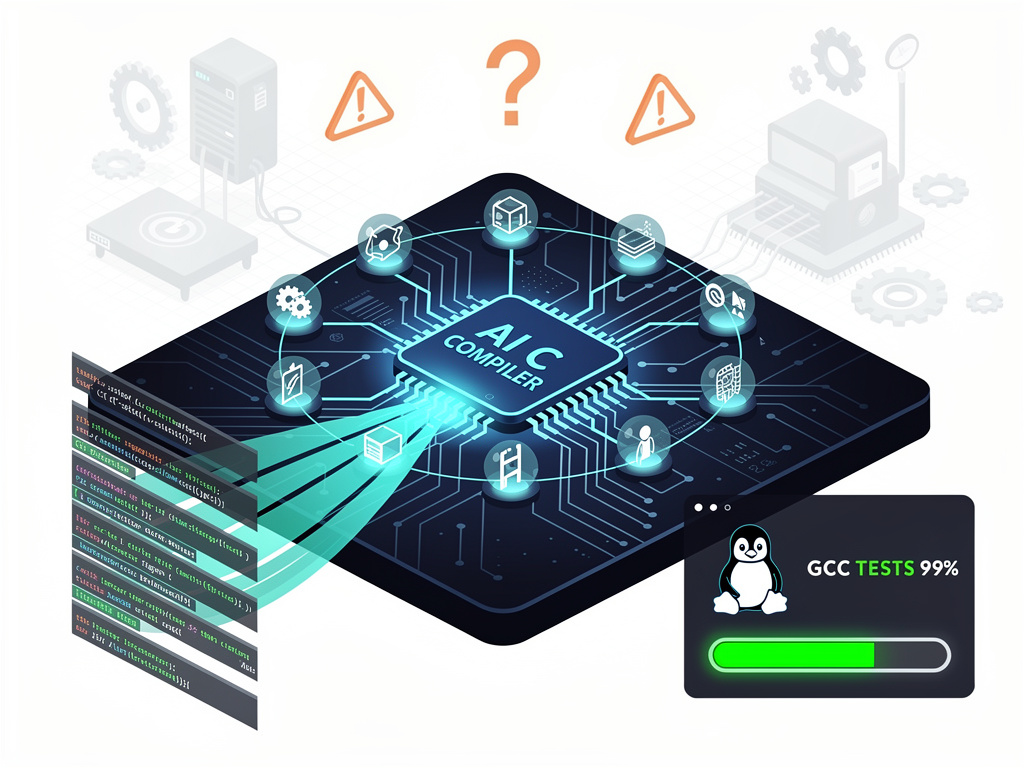
A single researcher, sixteen AI agents, two weeks, and roughly $20,000 in API costs. The result: a fully functional C compiler spanning approximately 100,000 lines of code, capable of compiling the Linux kernel and passing 99% of GCC’s own torture test suite. The project, conducted by Anthropic, has ignited one of the most polarizing debates in the software engineering world — not about whether AI can write code, but about what it means when AI can replicate one of the most complex pieces of software infrastructure ever built.
The compiler doesn’t just pass academic benchmarks. According to details shared widely on social media and technical forums, it successfully compiles major real-world projects including FFmpeg, Redis, PostgreSQL, QEMU, and even runs the iconic video game Doom. The feat was accomplished without a single line of human-written code, though the human involvement was far from trivial. As tech commentator Chris noted on X, the researchers said they “(mostly) walked away” — but that qualifier carries enormous weight.
The Human Didn’t Disappear — The Role Just Transformed
What makes the Anthropic compiler project so fascinating isn’t merely the output but the process. No human engineer sat down and wrote compiler logic, parsing routines, or code generation passes. Instead, the researcher orchestrating the project spent their time designing tests, building continuous integration pipelines when agents began breaking each other’s work, and creating workarounds when all sixteen agents simultaneously got stuck on the same bug. The human role, as Chris put it on X, “didn’t disappear. It shifted from writing code to engineering the environment that lets AI write code.”
This distinction is critical for understanding where AI-assisted software development is heading. The researcher functioned more like an architect and systems engineer than a traditional programmer. They defined specifications, created feedback loops, and ensured the AI agents could iterate productively. When the agents failed — and they did fail, repeatedly — the human intervened not by writing the fix but by restructuring the problem so the agents could find it themselves. This is a fundamentally new mode of software creation, one that challenges traditional notions of authorship, engineering skill, and the division of labor between humans and machines.
GCC’s 37-Year Journey and the Perils of False Equivalence
The comparison to GCC — the GNU Compiler Collection, one of the most important open-source projects in computing history — has drawn sharp criticism from industry veterans. GCC was first released in 1987 by Richard Stallman and has been continuously developed by thousands of engineers over nearly four decades. But as Steven Sinofsky, the former president of Microsoft’s Windows division, pointed out on X, “It didn’t take GCC 37 years to be built. In 1987 it fully worked for the language as it existed at the time. Over 37 years it evolved with the language, platforms, libraries, optimization and debugging technology, etc.” The implication is clear: comparing a fresh compiler built with knowledge of all existing solutions to the decades-long iterative development of GCC is intellectually dishonest, or at least deeply misleading.
GCC’s evolution tracks the evolution of computing itself — new processor architectures, new C and C++ language standards, sophisticated optimization passes that can mean the difference between software running in milliseconds versus seconds, and debugging capabilities that millions of developers rely on daily. The Anthropic compiler, by contrast, is a snapshot: a functional but limited artifact that proves AI can assemble known patterns into a working whole. That is genuinely impressive. But it is not the same thing as building GCC, and framing it as such risks obscuring the real achievements and real limitations of the technology.
The “Trained on Existing Code” Objection and Why It Matters
Perhaps the most common and pointed criticism of the project comes from those who note that the AI agents were trained on vast repositories of existing code — including, almost certainly, GCC’s own source code and decades of compiler theory textbooks. As Anton H noted on X, “As if those agents weren’t trained on the same code that they were asked to reproduce. LLMs are exceptionally good at repeating something that was already done, shuffling around pieces re-combining them in a new way, but never a completely new concept or true innovation.”
This objection goes to the heart of what large language models actually do. They are, at their core, next-token prediction engines — extraordinarily sophisticated pattern matchers that can recombine existing knowledge in useful ways. Satyam, another X commenter, reinforced this point: “It misses the point that the compiler the agents wrote is not new code. The logic, the tests everything already exists, and that’s a solid platform for LLM next token inference. The real challenge would be to write novel code on a completely new idea or a new language.” Software engineer Joe Hanink echoed the sentiment on X, noting that “having knowledge of the entire history of software, textbooks, patterns, best practices, and existing implementations seems like a huge head start, in the same way that generative AI art is highly imitative.”
Performance Gaps That Tell a Deeper Story
Beyond the philosophical debate about originality, there are concrete technical shortcomings that temper the enthusiasm. As pk highlighted on X, quoting from technical documentation about the project: “The generated code is not very efficient. Even with all optimizations enabled, it outputs less efficient code than GCC with all optimizations disabled.” In other words, the AI-built compiler’s best output is worse than GCC’s worst. For a demonstration project, this may be acceptable. For any production use case, it is a disqualifying limitation.
The performance issue was visually underscored by the Doom demonstration. Pop Catalin, a developer commenting on X, was blunt: “Looking at the framerate of Doom, this has to be the worst C compiler ever created. You could create a C interpreter that makes C code run faster than this.” He went further, warning of a broader trend: “If you thought that software developers were sloppy and hogging hardware resources needlessly up to now, just wait until Claude slop starts being put into production. We’re entering a new era of bad code, never seen or imagined before.” This concern — that AI-generated code will flood production systems with functional but deeply inefficient software — is gaining traction among senior engineers who worry about the long-term consequences of prioritizing speed of creation over quality of output.
$20,000 and Two Weeks: Cheap or Expensive?
The cost framing has also drawn scrutiny. Proponents point to $20,000 and two weeks as astonishingly cheap for a working C compiler. Critics see it differently. Lucas Baker wrote on X: “So it took 16 agents two weeks, amassing $20,000 in API charges, to reinvent a well-documented existing technology. And this is supposed to be a point in its favor?” The question of value depends entirely on what you’re measuring. If the goal is to demonstrate that AI can produce complex, functional software systems at a fraction of the traditional cost and timeline, the project succeeds. If the goal is to produce something novel, efficient, or production-ready, it falls short.
There is also the question of what the $20,000 figure actually represents. It covers API costs — the compute charges for running sixteen AI agents through millions of tokens of code generation, testing, and iteration. It does not account for the researcher’s time, the infrastructure used for continuous integration, or the years of training data and model development that made the agents capable in the first place. The true cost of the compiler, in a full accounting sense, is orders of magnitude higher. But this is also true of any software project that relies on existing tools, libraries, and knowledge — the question is where you draw the boundary.
The Veterans Weigh In: Is 100,000 Lines Even Impressive?
Allan MacGregor, a Canadian developer, questioned on X why the AI community is “so obsessed with lines of code” — a metric that experienced engineers have long dismissed as meaningless or even inversely correlated with quality. A more concise compiler that achieves the same functionality would arguably be superior. The 100,000-line figure, intended to convey scale and impressiveness, may instead signal bloat.
One of the most grounding responses came from jezza kezza on X, who recounted building a C compiler from the language specification in a third-year university class taught by Ken Thompson — one of the creators of Unix and the C language itself — in ten weeks, while juggling other coursework. “Nothing like 100k lines — I am a better coder than that,” the commenter wrote. “Total coding hours would have been less than 100. Stop waffling mate.” The anecdote is a reminder that building a basic C compiler is a well-understood academic exercise, and that the real engineering challenge lies not in producing a compiler that works but in producing one that works well — with the optimization, portability, and reliability that define production-grade tools.
Extrapolation, Exponentials, and the AI Optimist’s Wager
Chris, the original poster of the viral thread, pushed back against critics by invoking the trajectory of AI improvement. “You do understand three years ago it couldn’t even code a ball bouncing on the screen properly,” he wrote in response to Joe Hanink. “You simply need to extrapolate my friend.” He also dismissed concerns about linear scaling: “You know in AI things don’t scale linearly. It’s much faster. 17 agents can do it in one week.” The argument is essentially that even if today’s AI-built compiler is inferior to GCC, the rate of improvement suggests that parity — and eventually superiority — is inevitable.
This is the core tension in every debate about AI capabilities. Optimists see a technology on an exponential curve, where today’s limitations are tomorrow’s solved problems. Skeptics see a technology that excels at recombination and imitation but has not yet demonstrated the capacity for genuine innovation — the kind of conceptual leaps that created GCC, Unix, or the C language itself in the first place. As the X user A1GoKn8t succinctly put it, referring to GCC’s 37-year history: “That’s why it could build it in the first place.” The AI’s achievement is, in a very real sense, built on the shoulders of the very human engineers it is being compared to.
What the Compiler Project Actually Proves
Strip away the hype and the backlash, and the Anthropic compiler project reveals something genuinely important about the current state of AI-assisted software development. It demonstrates that AI agents, properly orchestrated by a skilled human, can produce large-scale, functional software systems that would have been unthinkable even a few years ago. It also demonstrates that the human role in such projects is not eliminated but fundamentally transformed — from writing code to designing the systems, tests, and feedback loops that enable AI to write code effectively.
At the same time, the project’s limitations are as instructive as its achievements. The compiler is slower than GCC at its worst settings. It was built by reassembling well-documented, extensively studied existing knowledge. It required constant human intervention to keep the agents on track. And it cost $20,000 in compute alone for a result that a skilled university student could approximate in a semester. The project is neither the death knell for software engineering nor a parlor trick. It is a data point — an important one — in the ongoing story of how AI is reshaping the craft of building software. The question is no longer whether AI can write code. It is whether the code AI writes will ever be good enough to matter in the ways that count.


 WebProNews is an iEntry Publication