
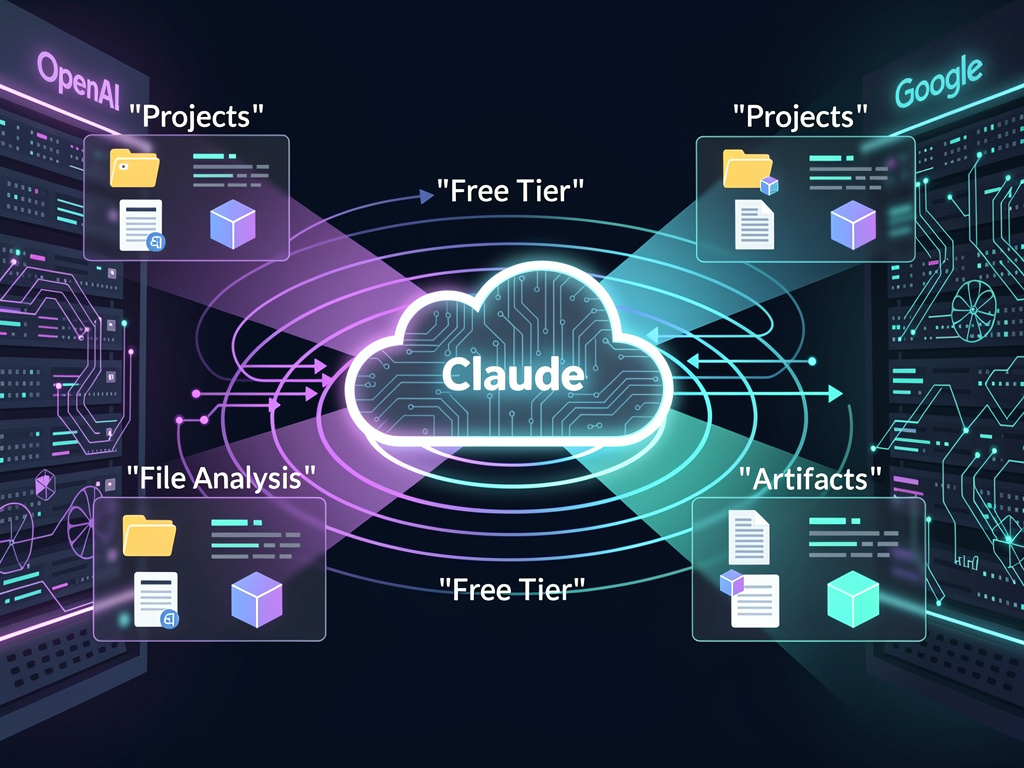
For months, the competitive dynamics among leading artificial intelligence companies have resembled a high-stakes poker game, with each player carefully calibrating how much capability to give away for free versus how much to reserve for paying customers. Now, Anthropic — the San Francisco–based AI safety startup valued at roughly $60 billion — is making a bold move by significantly expanding the features available to free-tier users of its Claude chatbot, a decision that could reshape how millions of people interact with frontier AI models.
The announcement, first reported by MacRumors, details a sweeping set of changes that give non-paying Claude users access to capabilities previously locked behind the company’s $20-per-month Pro subscription. The move comes at a time when Anthropic is locked in an increasingly fierce battle with OpenAI, Google DeepMind, and a surging roster of open-source competitors for market share, developer mindshare, and the loyalty of everyday consumers who are still deciding which AI assistant will become their default tool.
What Free Users Are Getting — and Why It Matters
According to the details shared by Anthropic, free-tier Claude users will now have access to a broader set of features including enhanced file upload and analysis capabilities, longer context windows for conversations, improved web search functionality, and the ability to create and share artifacts — Claude’s term for interactive, standalone outputs such as code snippets, documents, and data visualizations. Previously, many of these features were either entirely unavailable to free users or available only in a highly restricted form.
Perhaps most notably, free users will gain access to Claude’s Projects feature, which allows users to organize conversations and uploaded documents into persistent workspaces. This capability has been a key differentiator for Claude Pro subscribers who use the tool for professional research, writing, and software development. By opening it up, Anthropic is signaling that it views broad adoption — not just premium revenue — as a critical strategic objective in this phase of the AI industry’s evolution.
Anthropic’s Strategic Calculus: Growth Over Near-Term Revenue
The decision to expand free access is not without risk. Anthropic, like its competitors, faces enormous compute costs. Running frontier AI models at scale requires vast fleets of GPUs, and every free query represents a cost center rather than a revenue line. The company has raised more than $15 billion in funding to date, including a massive investment round led by Amazon, but it still operates at a significant loss as it races to build out infrastructure and improve its models.
So why give more away? Industry analysts point to a familiar playbook from the consumer technology era: prioritize user acquisition and engagement now, monetize later. The logic is that once users build workflows, habits, and data histories around a particular AI assistant, switching costs rise dramatically. Anthropic appears to be betting that a more generous free tier will pull users away from ChatGPT — which remains the dominant consumer AI product — and into Claude’s ecosystem before they become too entrenched elsewhere.
The Broader Competitive Context
Anthropic’s move does not exist in a vacuum. OpenAI has been pursuing its own aggressive expansion strategy, recently making GPT-4o available to free users and rolling out features like memory, custom GPTs, and enhanced voice capabilities across its tiers. Google has similarly expanded access to Gemini, integrating it deeply into Search, Gmail, and the broader Workspace suite, effectively making advanced AI features available to billions of users at no additional cost.
Meanwhile, open-source models from Meta (Llama), Mistral, and others have continued to improve at a startling pace, putting pressure on all proprietary AI companies to justify their value proposition. If a free, locally runnable model can handle 80% of use cases, the argument for paying $20 a month — or even signing up for a free account with a closed-source provider — becomes harder to make. Anthropic’s expanded free tier can be read, in part, as a response to this pressure from below.
Claude’s Differentiation: Safety, Style, and Substance
Anthropic has long positioned itself as the “safety-first” AI company, founded by former OpenAI researchers Dario and Daniela Amodei who left over disagreements about the pace and governance of AI development. Claude’s brand identity leans heavily on being more thoughtful, more nuanced, and less prone to hallucination than its competitors — qualities that have earned it a devoted following among writers, researchers, and developers who prize accuracy and tone.
The expansion of free features appears designed to let more users experience these differentiators firsthand. As MacRumors noted, the changes also include improvements to Claude’s ability to handle multi-step reasoning tasks and more complex document analysis — areas where the model has consistently benchmarked well against GPT-4o and Gemini Ultra. By removing the paywall from these capabilities, Anthropic is essentially saying: try it, and you’ll see the difference.
The Pro Tier Isn’t Going Away — It’s Moving Upmarket
Importantly, Anthropic is not simply cannibalizing its paid product. The company is simultaneously enhancing its Pro subscription with new features that push further into professional and enterprise territory. Pro users will continue to enjoy significantly higher usage limits, priority access during peak demand, early access to new model releases, and advanced features tailored for power users and teams.
This tiered approach mirrors strategies employed by companies like Spotify, Dropbox, and Slack, which have all used generous free tiers to build massive user bases while reserving premium functionality for paying customers. The key challenge is ensuring that the free tier is compelling enough to attract users without being so generous that it eliminates the incentive to upgrade. Based on the details available, Anthropic appears to be threading this needle carefully — giving free users a genuine taste of Claude’s capabilities while preserving meaningful differentiation for subscribers.
What This Means for the AI Industry’s Pricing Paradigm
Anthropic’s announcement may accelerate a broader trend toward more generous free offerings across the AI industry. If Claude’s expanded free tier succeeds in driving significant user growth, OpenAI and Google will face pressure to respond in kind, potentially triggering a race to the bottom on consumer AI pricing. This would be good news for users but could further strain the already precarious economics of running frontier AI models.
The venture capital community is watching closely. Investors have poured tens of billions of dollars into AI companies on the premise that these tools will eventually generate enormous revenue through subscriptions, API usage, and enterprise contracts. A prolonged period of aggressive free-tier expansion could delay the path to profitability for the entire sector, raising uncomfortable questions about whether the current investment thesis is sustainable.
The User Experience Question
Beyond the strategic and financial implications, there is also the question of whether more features necessarily means a better experience for free users. AI chatbots are already complex tools, and adding capabilities like Projects, advanced file analysis, and artifact creation could overwhelm casual users who simply want to ask a question and get an answer. Anthropic will need to invest in onboarding, interface design, and contextual guidance to ensure that its expanded free tier feels accessible rather than intimidating.
Early reactions on social media platforms including X have been largely positive, with users praising Anthropic for making Claude more accessible. Several developers and researchers noted that the Projects feature alone could make Claude the default choice for free-tier users who need more than a simple chat interface. Others expressed curiosity about whether the expanded free tier would come with increased rate limits or whether Anthropic would throttle usage to manage costs.
Anthropic’s Long Game in an Uncertain Market
Ultimately, Anthropic’s decision to open up more of Claude to free users reflects a company that is playing a long game. In an industry where the technology is evolving at a breathtaking pace and the competitive dynamics shift monthly, locking features behind a paywall risks ceding ground to rivals who are willing to be more generous. By lowering the barrier to entry, Anthropic is making a calculated bet that the best way to win the AI race is to let as many people as possible experience what Claude can do — and trust that the product will speak for itself.
Whether that bet pays off will depend on execution, on the continued improvement of Claude’s underlying models, and on whether Anthropic can convert free users into paying customers at a rate sufficient to justify its enormous capital expenditures. For now, though, the message to the market is clear: the era of AI companies hoarding their best features for premium subscribers may be drawing to a close, and the real competition is about to begin.


 WebProNews is an iEntry Publication