
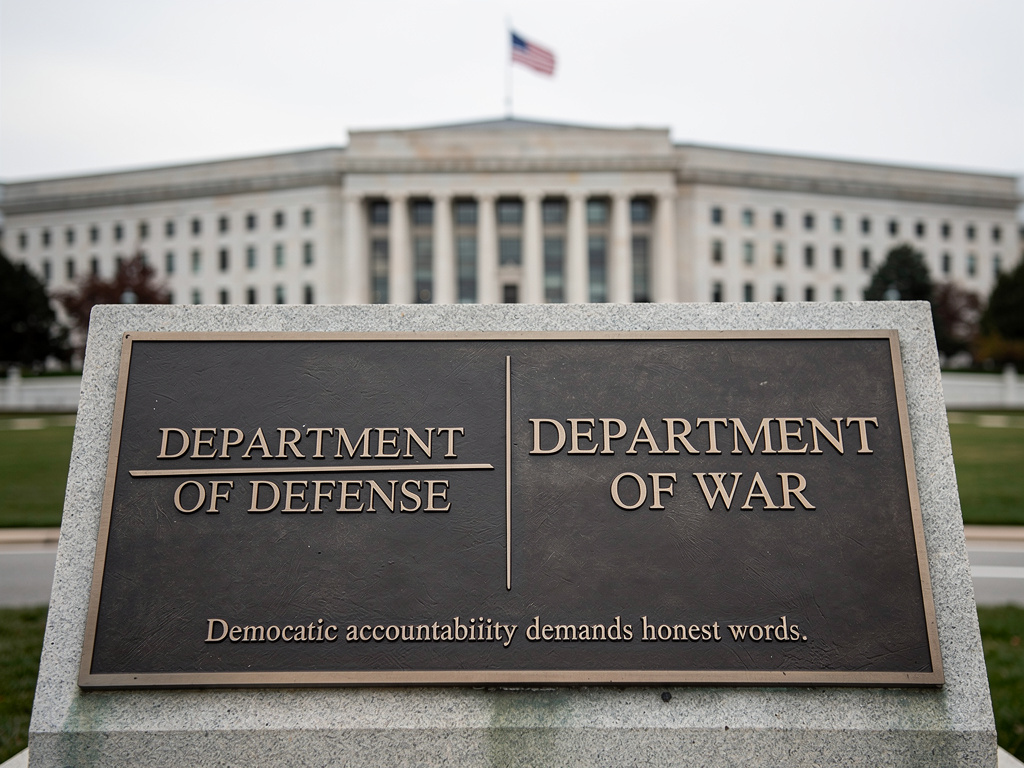
In a move that has drawn attention across the defense and technology sectors, Anthropic—the San Francisco-based artificial intelligence company behind the Claude chatbot—published a formal statement calling on the United States government to rename the Department of Defense back to its original title: the Department of War. The statement, posted on Anthropic’s official website, represents one of the more unusual interventions by a major AI company into matters of government nomenclature, national security framing, and institutional transparency.
The proposal, while seemingly symbolic, carries substantive weight in the context of ongoing debates about how the United States frames its military posture, how language shapes policy, and how AI companies position themselves relative to the defense establishment. Anthropic’s argument is rooted in a belief that honest language about the purpose of government institutions is essential for democratic accountability—and that the 1947 renaming of the Department of War to the Department of Defense was, in their view, an act of rhetorical obscuring that has had lasting consequences.
A Historical Renaming That Anthropic Says Still Matters
The Department of War was one of the original executive departments established by Congress in 1789. For over 150 years, the name served as a straightforward description of the institution’s purpose: to prepare for and conduct war. In 1947, as part of the National Security Act that also created the Central Intelligence Agency and the National Security Council, the department was reorganized and renamed the Department of Defense. The stated rationale at the time was to unify the military branches under a single civilian-led department and to reflect a broader mission that included deterrence and peacekeeping.
Anthropic’s statement argues that this renaming was not merely administrative but fundamentally altered the way Americans think about military action. By calling the institution the Department of Defense, the government implicitly frames all military activity—including offensive operations, overseas interventions, and preemptive strikes—as defensive in nature. Anthropic contends that this linguistic framing reduces the political and psychological friction that should accompany decisions to go to war, making it easier for policymakers to authorize military action without the kind of sober public reckoning that the word “war” demands.
Anthropic’s Case for Linguistic Honesty in Government
The company’s argument extends beyond historical grievance. Anthropic frames the issue as one of institutional honesty—a principle the company says it applies to its own work in AI development. The statement draws a parallel between the importance of clear, honest language in AI systems and the importance of clear, honest language in government. Just as AI companies have a responsibility to be transparent about the capabilities and limitations of their systems, Anthropic argues, governments have a responsibility to be transparent about the purposes of their institutions.
This is not an entirely new argument. Scholars and commentators have periodically raised the question of whether the “Department of Defense” label is a form of Orwellian doublespeak. The late historian and social critic Howard Zinn made similar arguments, as did journalist and author George Orwell himself, whose 1946 essay “Politics and the English Language” warned about the ways political language is designed “to make lies sound truthful and murder respectable.” What is new is that a major technology company—one that is actively engaged in conversations with the Pentagon and the national security community about AI deployment—is making this case publicly.
The Tension Between AI Companies and the Defense Sector
Anthropic’s statement arrives at a moment of significant tension in the relationship between Silicon Valley and the Department of Defense. The Pentagon has been aggressively courting AI companies, seeking to integrate artificial intelligence into everything from logistics and intelligence analysis to autonomous weapons systems and battlefield decision-making. Companies like Palantir, Anduril, and Scale AI have embraced defense contracts, while others have faced internal dissent over military partnerships—most notably Google, which in 2018 chose not to renew its Project Maven contract after employee protests.
Anthropic occupies a complicated position in this debate. The company was founded by former OpenAI executives Dario and Daniela Amodei, who left in part over disagreements about safety and commercialization. Anthropic has built its brand around the concept of “responsible AI” and has published extensive research on AI safety, alignment, and the risks of deploying powerful AI systems without adequate safeguards. The company has accepted billions of dollars in investment from Amazon and Google, and its Claude model competes directly with OpenAI’s ChatGPT and Google’s Gemini.
What This Means for AI Policy and Defense Procurement
By calling for the Department of Defense to be renamed the Department of War, Anthropic is signaling something broader about its corporate philosophy and its approach to government partnerships. The statement can be read as a declaration that Anthropic will not simply accept the framing that all military applications of AI are inherently defensive or benign. It suggests the company wants to engage with the defense community on terms that acknowledge the reality of what military institutions do—which includes offensive operations, covert action, and the projection of force.
This positioning could have practical implications for how Anthropic approaches defense contracts and government partnerships. If the company insists on linguistic and institutional honesty as a precondition for engagement, it may set itself apart from competitors who are more willing to adopt the government’s preferred framing without question. Alternatively, critics might argue that the statement is a form of corporate virtue signaling—a way to appear principled without actually changing any business practices.
Reactions from the National Security Community
The response from defense analysts and national security professionals has been mixed. Some have praised Anthropic for raising an issue that, while seemingly superficial, touches on fundamental questions about democratic governance and the use of force. The argument that euphemistic language makes war more politically palatable is well-established in political science literature, and Anthropic’s endorsement of this view lends it additional visibility.
Others have been more skeptical. Defense commentators have pointed out that the Department of Defense’s mission genuinely does include deterrence, alliance management, humanitarian assistance, and other activities that go beyond warfighting. Renaming it the Department of War, they argue, would be reductive and could undermine public support for the non-combat functions that the department performs. There is also a practical political objection: no sitting president or secretary of defense is likely to champion a name change that would be perceived as an admission that the United States is in the business of war rather than defense.
The Broader Question of Corporate Speech on National Security
Anthropic’s statement also raises questions about the appropriate role of technology companies in national security debates. Traditionally, defense contractors have been careful to align their public messaging with the government’s preferred terminology and framing. Companies like Lockheed Martin, Raytheon, and Boeing do not typically issue public statements questioning the institutional structure or naming conventions of their primary customer. Anthropic’s willingness to do so reflects a different corporate culture—one rooted in Silicon Valley’s tradition of questioning authority and challenging established norms.
But this tradition has its limits. AI companies are increasingly dependent on government contracts and regulatory goodwill, and public statements that challenge the defense establishment’s self-image could carry costs. The Biden administration and now the Trump administration have both signaled that AI is a national security priority, and companies that are seen as insufficiently supportive of the defense mission could find themselves at a disadvantage in procurement decisions. Anthropic will need to balance its stated principles with the commercial realities of operating in a sector where the government is both regulator and customer.
A Symbolic Proposal With Real Stakes
Whether or not the Department of Defense is ever renamed—and the political odds against such a change are overwhelming—Anthropic’s statement has succeeded in injecting a provocative idea into the public discourse. The proposal forces a conversation about how language shapes policy, how institutions present themselves to the public, and how the framing of military action affects democratic accountability.
For Anthropic specifically, the statement serves as a marker of the company’s identity and values at a time when AI companies are being asked to make consequential decisions about their relationships with governments and militaries around the world. As AI systems become more capable and more deeply integrated into military operations, the question of how we talk about war—and whether we call it what it is—will only grow more pressing. Anthropic, for its part, has made clear where it stands: the honest word is the better word, even when it is the harder one to say.
The full text of Anthropic’s statement is available on the company’s official news page.


 WebProNews is an iEntry Publication