
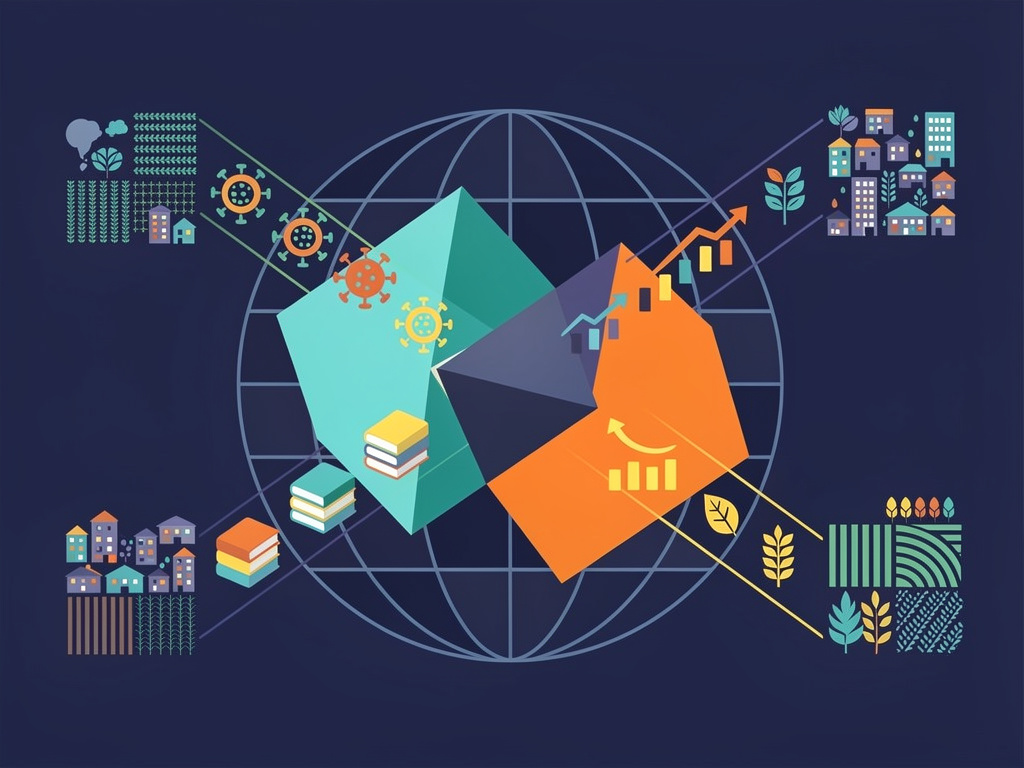
Four point six billion people. That is the staggering number without access to essential health services. On a Wednesday in May 2026, Anthropic and the Gates Foundation declared they would no longer treat that statistic as inevitable.
The two organizations formed a $200 million partnership. It spans four years. The money arrives as grants, Claude usage credits, and hands-on technical support. Focus areas include global health, life sciences, education, and economic mobility. Programs will roll out with partners across the United States and in countries around the world.
Anthropic’s Beneficial Deployments team leads the effort. It already supplies Claude credits and engineering help to nonprofits. The team also builds public goods such as health datasets and evaluation benchmarks. Nonprofits and schools receive discounted access to the model. This new commitment marks a sharp increase in that work.
The Gates Foundation supplies something Anthropic cannot buy. Decades of on-the-ground experience. A proven record of measuring results. Networks that reach health ministries, research institutes, and communities in places where markets rarely venture. Together the partners intend to apply Claude to concrete problems that have resisted conventional solutions.
Health commands the largest share of the funding. In low- and middle-income countries, the partnership targets faster development of vaccines and therapies. Governments will gain tools to analyze health data and reach quicker, better decisions. Connectors will let Claude talk directly to existing platforms. New benchmarks and evaluation frameworks will test performance on medical tasks.
Early work already shows the direction. Anthropic and the Institute for Disease Modeling plan to sharpen forecasts for deploying treatments against malaria and tuberculosis. Claude will help make those models more accessible and accurate. Researchers will use the model to spot patterns in scientific literature and datasets. They will screen candidates for drugs and vaccines against polio, HPV, and preeclampsia.
HPV alone kills about 350,000 people each year. Ninety percent of those deaths occur in low- and middle-income countries. The numbers explain why the partners chose to start there. Similar computational screening aims to compress the early stages of vaccine and therapy development. Frontline health workers and patients could soon receive AI assistance with diagnosis, treatment recommendations, and medical decisions. Health ministries may deploy the technology to optimize workforce placement, supply chains, and outbreak alerts.
But. Success hinges on more than raw capability. The partners must prove the tools work in clinics with unreliable electricity and limited internet. They must earn trust from doctors and nurses who have seen technology promises come and go. Privacy and safety cannot be afterthoughts when patient data is involved.
Education receives equal attention. The partners will co-develop tools for K-12 students in the United States, sub-Saharan Africa, and India. Public goods arrive first. Model benchmarks. Datasets. Knowledge graphs. They target math tutoring, college advising, and curriculum design. Releases begin later this year.
In American classrooms, Claude will power evidence-based tutoring and career guidance. In Africa and India, the Global AI for Learning Alliance will create apps that boost foundational literacy and numeracy. The gap between a child in rural Kenya and personalized instruction has never looked so narrow. Whether the technology actually closes it remains the open question.
Economic mobility efforts build on Anthropic’s earlier role as inaugural AI partner in NextLadder Ventures. That $1 billion initiative, launched in July 2025 by the Gates Foundation, Ballmer Group, Stand Together, Valhalla Foundation, and John Overdeck, backs both nonprofit and for-profit organizations. It mixes grants, equity, and revenue-based financing. The goal is to equip frontline workers such as social workers and public defenders with better tools. (Gates Foundation press release)
Anthropic committed roughly $1.5 million annually to NextLadder. It supplied Claude credits and expert time. Elizabeth Kelly, head of beneficial deployments at Anthropic, said at the time, “Core to our mission is helping AI benefit humanity. As the inaugural AI partner, we’re providing Claude credits and hours of time with our in-house Claude experts.” The new $200 million deal expands that philosophy on a global scale.
Agriculture forms another pillar. Nearly two billion smallholder farmers stand to gain from model improvements tuned to local crops, new datasets, and targeted benchmarks. All three will be released as public goods. In the United States, the partnership will create portable records of skills and certifications. Career guidance for workers entering or retraining in new fields. Tools that connect training data to actual employment outcomes so interventions can be measured and improved.
Mark Suzman, CEO of the Gates Foundation, has spoken repeatedly about AI’s potential to accelerate progress against poverty and disease. In the NextLadder announcement he noted that rapid advances in technology, especially artificial intelligence, create “incredible opportunities to help people live healthier, more prosperous lives.” The foundation’s separate $50 million deal with OpenAI for African health clinics, announced earlier in 2026, shows it is hedging across multiple AI providers. (Gates Foundation announcement on the Anthropic partnership)
Anthropic’s approach carries the company’s signature caution. It emphasizes publishing its thinking and decision-making as results come in. The firm plans to share impact data from supported programs. That transparency matters. Critics have watched large language models hallucinate medical advice and produce biased outputs. Real-world deployment at scale will test whether Claude avoids those traps when the stakes involve human lives and livelihoods.
So far the partnership has avoided grandiose claims. No one promises to end poverty or cure all disease. The language instead focuses on acceleration. On making existing efforts more effective. On reaching populations that markets ignore. The $200 million buys time and access to test those ideas rigorously.
Recent coverage highlights both promise and skepticism. A Reuters report noted the deal alongside the foundation’s earlier OpenAI agreement, framing it as part of a broader philanthropic push into AI for social good. Discussions on X revealed divided reactions. Some users praised the focus on neglected areas. Others questioned motives, citing Bill Gates’ past philanthropy controversies or broader concerns about AI companies seeking legitimacy through charitable work.
Yet the structure looks pragmatic. Anthropic gains real-world testing grounds, domain expertise, and distribution channels it could not build alone. The foundation gains powerful new computational tools without having to develop them internally. Both sides share the risk and the learning.
Over the next four years the partnership will generate data. Some programs will succeed. Others will stumble. The public goods released, from health benchmarks to agricultural datasets, could help researchers and organizations beyond the immediate grantees. That multiplier effect may ultimately matter more than any single application.
The timing feels deliberate. AI capabilities have advanced far enough to tackle specialized domains. Compute costs continue to fall. Governments and nonprofits increasingly accept that these models belong in their toolkit. What remains unproven is whether the technology can deliver consistent value in messy, under-resourced settings.
Anthropic and the Gates Foundation have placed a sizable bet that it can. Four hundred million dollars combined. Thousands of hours of expert time. Access to some of the world’s most challenging problems. The results will not arrive quietly. They will be measured, published, and scrutinized.
For an industry still debating AI’s societal role, this partnership offers a concrete experiment. Not theory. Not hype. Actual deployment against diseases that kill hundreds of thousands, against learning gaps that trap generations, against economic barriers that persist despite trillions spent. The world will be watching what Claude learns in return.


 WebProNews is an iEntry Publication