
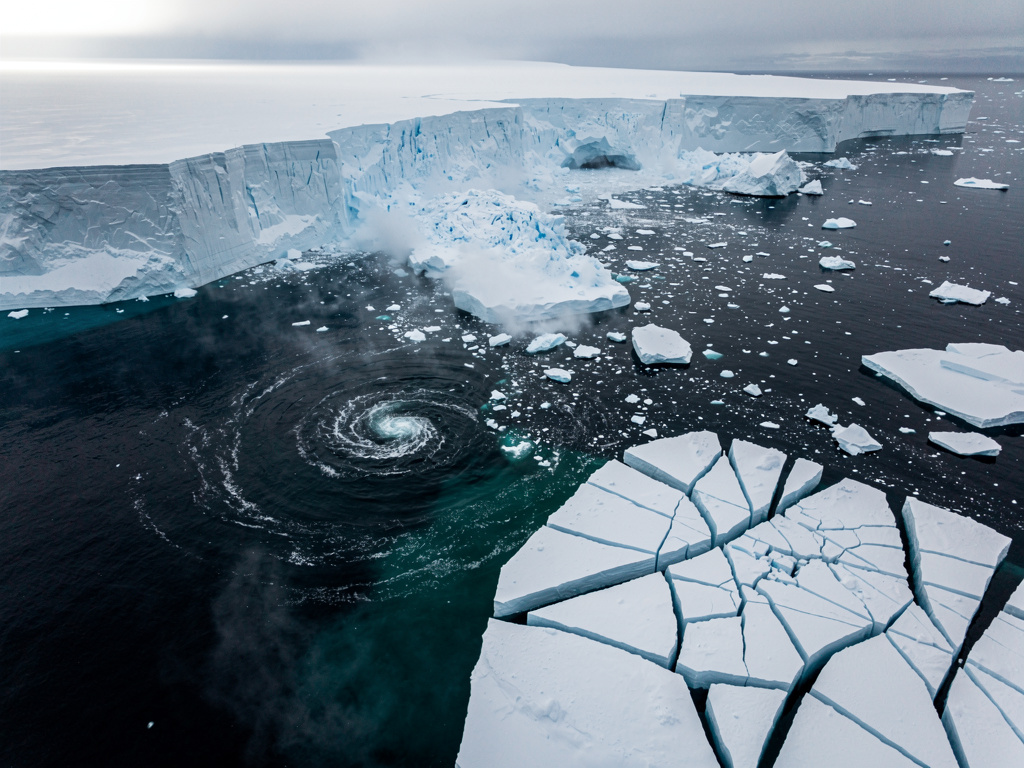
The Ticking Ice Bomb: Antarctica’s Doomsday Glacier on the Brink
In the frozen expanse of West Antarctica, a colossal sheet of ice known as the Thwaites Glacier holds the fate of global coastlines in its precarious balance. Dubbed the “Doomsday Glacier” for its potential to trigger catastrophic sea-level rise, this massive formation—roughly the size of Florida—has become a focal point for climate scientists worldwide. Recent expeditions and satellite data reveal a structure fracturing at an alarming rate, with warm ocean waters accelerating its retreat. As researchers race to understand its dynamics, the implications for billions living near shorelines grow increasingly dire.
The glacier’s instability stems from its unique position: it acts as a plug holding back the larger West Antarctic Ice Sheet. If Thwaites collapses entirely, it could contribute to a sea-level rise of up to two feet directly, and potentially unleash an additional 10 feet by destabilizing surrounding ice. This isn’t mere speculation; analyses from satellite imagery over the past two decades show cracks expanding rapidly, doubling in total length from about 100 miles to over 200 miles. Such fractures weaken the ice shelf, making it vulnerable to sudden disintegration.
Scientists have long monitored Thwaites, but the pace of change has surprised even the most seasoned experts. Warm tidal currents are permeating the ice at depths reaching 3.7 miles, causing vigorous melting from below. This process, combined with surface fractures, paints a picture of a glacier losing its grip on stabilizing points, such as underwater ridges that once anchored it firmly.
Accelerating Fractures and Underwater Assaults
A study highlighted in WIRED details how cracks in the Thwaites Glacier have proliferated over 20 years, suggesting an irreversible collapse may be imminent. The analysis, based on satellite data, indicates that these fissures are not just superficial but are compromising the glacier’s structural integrity. Researchers warn that this pattern could propagate to other vulnerable Antarctic ice shelves, amplifying the regional meltdown.
Complementing this, expeditions like the one chronicled by The New York Times are providing on-the-ground insights. Journalists accompanying scientists to the site report on efforts to gauge the dangers, with dispatches emphasizing the continent’s ice melting and its worldwide sea-level impacts. These journeys underscore the human element: teams braving extreme conditions to deploy sensors and collect samples that reveal the glacier’s hidden vulnerabilities.
Further evidence comes from GPS and satellite observations, as noted in a ScienceDaily release. The Thwaites Eastern Ice Shelf is slowly detaching from a key stabilizing point, with ice flow speeding up as fractures multiply. This acceleration is driven by warm water intrusions, creating what some describe as underwater “storms” that erode the base.
Mixed Signals from Recent Research
Yet, not all findings point to immediate doom. Some studies offer a sliver of reassurance amid the warnings. For instance, research discussed in another New York Times piece reveals nuanced conclusions about Thwaites’ melting rates. While certain aspects, like the expansion of warm-water eddies, heighten concerns, other data suggest that the glacier’s retreat might not accelerate as drastically in the short term as previously feared.
This balanced view is echoed in broader ecological discussions, such as those in Greenly, which unpacks the glacier’s significance and potential mitigation strategies. The article stresses that while Thwaites holds enough ice to raise oceans by 60 meters if the entire sheet it buttresses were to melt, current models indicate a more gradual process—though still alarmingly fast compared to historical norms.
Social media platforms like X reflect public sentiment, with posts highlighting fears of rapid collapse. Users share updates on fractures doubling since 2002 and massive eddies causing 20% of ice loss, often linking to scientific alerts. These discussions amplify the urgency, portraying Thwaites as a symbol of broader climate perils, though they sometimes veer into exaggeration without full context.
Expeditions Unveiling Hidden Dynamics
Ongoing expeditions are crucial for demystifying these processes. The New York Times’ live coverage of a sea journey to Antarctica’s fastest-thinning glaciers, accessible via their dedicated page, documents real-time observations. Scientists on board are studying how wind, waves, and ocean currents interact with the ice, revealing that elevated sea ice in regions like the Amundsen Sea might temporarily buttress Thwaites, reducing stress from warm water incursions.
Contrasting perspectives emerge from skeptics, as seen in posts on X from figures questioning the “doomsday” label. Some argue that volcanic activity beneath Antarctica contributes more to melting than emissions, citing studies that estimate Thwaites’ direct sea-level contribution at mere millimeters over centuries rather than feet. However, mainstream research counters this, emphasizing human-induced warming as the primary driver.
A recent study featured in Futurism paints a stark picture, warning of approaching catastrophic collapse based on crack growth rates. It aligns with findings that the glacier is melting half a mile annually due to warm water beneath, potentially leading to a two-foot rise by 2050 in worst-case scenarios.
Debating the Doomsday Moniker
The nickname “Doomsday Glacier” itself sparks debate among scientists. As explored in DNyuz, many researchers dislike the sensational term, arguing it oversimplifies complex dynamics. They point out that while Thwaites is indeed the fastest-melting glacier in Antarctica, its collapse timeline remains uncertain—ranging from decades to centuries depending on emission trajectories.
This sentiment is reinforced in coverage from The Good Men Project, which references CNN reports on underwater storms and glacial earthquakes weakening the structure. These phenomena, including seismic events that fracture the ice like sugar cubes, contribute to instability, yet they also highlight natural variability that complicates predictions.
Public discourse on X often amplifies these tensions, with users posting about the glacier’s size—80 miles across—and its potential to destabilize the West Antarctic Ice Sheet. Posts warn of sea levels rising several feet, drawing from studies showing vigorous melting at great depths, but they also include calls for action to slow the retreat through global emission reductions.
Technological Advances in Monitoring
Advancements in technology are transforming how we track Thwaites. Satellite imagery, combined with autonomous underwater vehicles, allows for unprecedented detail. For example, data from the past two decades, as analyzed in NewsBytes, shows fractures spreading over larger areas, raising fears of accelerated sea-level rise.
These tools are integral to international collaborations, such as the International Thwaites Glacier Collaboration, which deploys robots and sensors to map the glacier’s underside. Insights from these efforts reveal that warm water is not just lapping at the edges but infiltrating deep cavities, causing melt rates far exceeding earlier estimates.
Moreover, modeling improvements incorporate these real-time data points, offering scenarios that range from moderate retreat to full collapse. Industry insiders in climate modeling note that integrating factors like glacial earthquakes—vibrations that further weaken the ice—enhances forecast accuracy, though uncertainties persist due to the glacier’s remote location.
Global Implications and Mitigation Strategies
The broader ramifications extend beyond Antarctica. Coastal cities from Miami to Shanghai face heightened flood risks if Thwaites destabilizes. Economic analyses project trillions in adaptation costs, prompting calls for urgent emission cuts to curb ocean warming.
Strategies to mitigate include geoengineering proposals, though controversial, such as building underwater barriers to block warm currents. More feasibly, global policy shifts toward renewable energy could slow the warming driving Thwaites’ melt.
X posts frequently discuss these impacts, with users sharing visuals of cracking ice and projections of inundated coastlines, fostering a sense of collective urgency. Yet, they also highlight misinformation, like overstated collapse timelines, underscoring the need for verified scientific communication.
Voices from the Field and Future Outlook
Field researchers provide poignant narratives. Expeditions reveal a glacier “holding on by its fingernails,” with fractures resembling windshield cracks spreading across the surface. These observations, shared in real-time, humanize the science and emphasize the race against time.
Looking ahead, upcoming studies aim to refine models, incorporating new data from ongoing missions. While some findings reassure that total collapse isn’t immediate, the consensus leans toward accelerated risks if warming continues unchecked.
Ultimately, Thwaites serves as a sentinel for planetary health, urging a reevaluation of human impacts on polar regions. As cracks widen and waters warm, the glacier’s fate intertwines with our own, demanding informed action from policymakers and industries alike.


 WebProNews is an iEntry Publication