
Cosmic Furnace: An Ancient Galaxy Cluster Burning Hotter Than the Universe’s Rules Allow
In the vast expanse of the cosmos, where the echoes of the Big Bang still reverberate, astronomers have stumbled upon a structure that challenges the very foundations of our understanding of universal evolution. A galaxy cluster, observed as it existed just 1.4 billion years after the universe’s explosive birth, harbors gas heated to temperatures far exceeding what current models predict. This discovery, detailed in a recent study published in the journal Nature, suggests that the building blocks of the cosmos assembled with unexpected rapidity and intensity, potentially reshaping theories on how massive structures formed in the early universe.
The cluster in question, known as SPT2349-56, was first spotted through observations using advanced telescopes, including the Atacama Large Millimeter/submillimeter Array (ALMA) and the Chandra X-ray Observatory. Researchers, led by a team from the University of British Columbia, measured the intracluster medium—the hot gas permeating the space between galaxies— and found it blazing at over 100 million degrees Celsius. That’s at least five times hotter than theoretical expectations for such an early epoch, when the universe was merely 10% of its current age.
This anomaly isn’t just a quirky outlier; it implies that galaxy clusters, the largest gravitationally bound structures in the universe, might have matured far quicker than previously thought. Traditional cosmological models posit a gradual buildup, with gravity slowly pulling matter together over billions of years. Yet here, in this primordial soup, something accelerated the process dramatically.
Unveiling the Heat Source
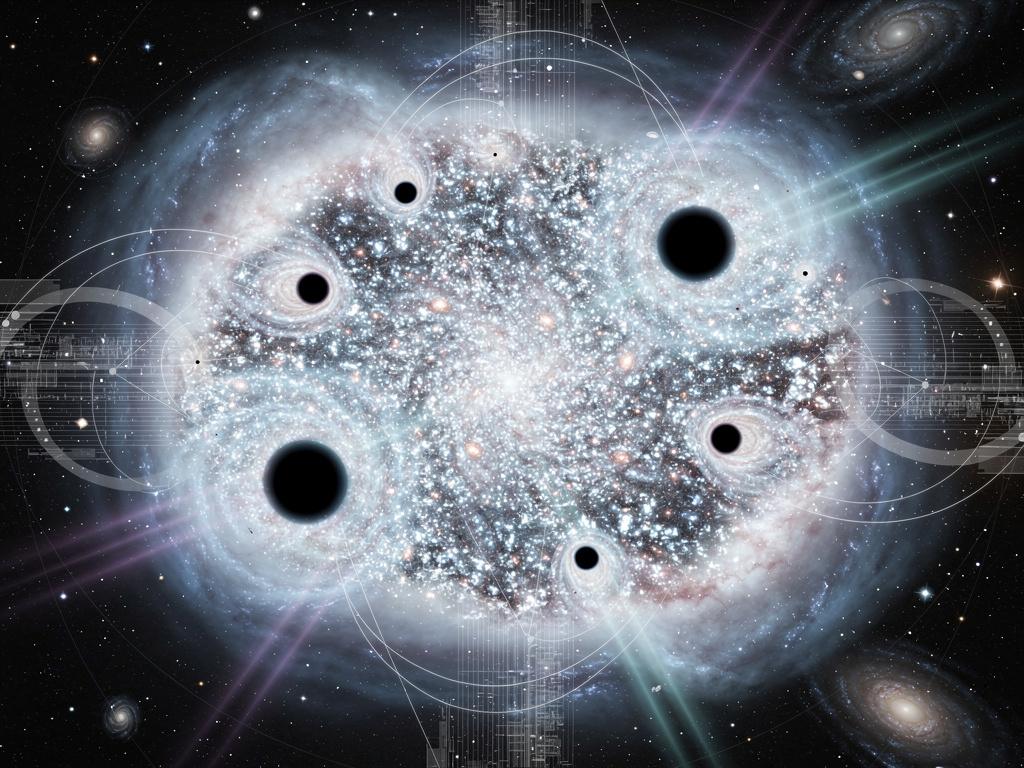
Delving deeper into the data, scientists attribute this extreme heat to the activity of supermassive black holes within the cluster. These cosmic behemoths, residing at the hearts of galaxies, are believed to be spewing out enormous amounts of energy through jets and winds, superheating the surrounding gas. The presence of not one, but three such active black holes in close proximity, is particularly striking. As reported in Futurism, this configuration was “not expected so early in the universe’s development,” forcing a reevaluation of black hole formation timelines.
The implications extend to the broader narrative of cosmic history. If black holes were ramping up activity this soon after the Big Bang, it could mean that the seeds of these monsters—possibly direct-collapse black holes or remnants from the first stars—formed and grew with astonishing efficiency. This challenges simulations that assume a more leisurely pace, where feedback mechanisms from stars and black holes take eons to heat cluster atmospheres to such degrees.
Moreover, the discovery aligns with observations from other early universe structures, but amplifies their mysteries. For instance, previous findings from the James Webb Space Telescope have revealed surprisingly massive galaxies in the universe’s infancy, hinting at accelerated growth. Now, with SPT2349-56, we see that clusters themselves were not lagging behind.
Theoretical Upheaval in Cosmology
Astronomers are now grappling with how to integrate this hot cluster into existing frameworks. As noted in a piece from Scientific American, the gas temperatures “put a new spin on how these cosmic behemoths evolved,” suggesting that energy injection from black holes played a pivotal role much earlier than anticipated. This could necessitate tweaks to the Lambda Cold Dark Matter model, the standard blueprint for universe formation, by incorporating more aggressive feedback loops.
Industry experts in astrophysics point out that such findings underscore the limitations of current simulations. High-performance computing models, while sophisticated, often rely on assumptions about dark matter distribution and baryonic physics that may not hold in the extreme conditions of the early universe. Revising these could lead to breakthroughs in understanding dark energy’s influence or even the role of exotic particles.
On social platforms like X, the buzz is palpable. Posts from astronomy enthusiasts and researchers highlight the excitement, with one noting the cluster’s heat as evidence of “turbocharged” black hole activity, echoing sentiments from recent academic discussions. This real-time discourse amplifies the discovery’s impact, as scientists share preliminary analyses and speculate on follow-up observations.
Technological Triumphs Behind the Find
The detection of SPT2349-56 owes much to cutting-edge instrumentation. The South Pole Telescope initially identified the cluster through its gravitational lensing effects on cosmic microwave background radiation, a relic from the Big Bang. Subsequent X-ray imaging from Chandra revealed the scorching gas, while ALMA provided insights into the molecular composition and dynamics.
This multi-wavelength approach is crucial for piecing together the puzzle. As detailed in coverage from Earth.com, the cluster’s gas is not only hot but also surprisingly mature, with chemical abundances indicating rapid stellar processing. Such maturity implies that star formation and supernova explosions contributed to the heating, complementing the black hole activity.
For industry insiders, this highlights the value of international collaborations. The team, spanning institutions from Canada to Chile, leveraged shared resources to achieve what single observatories could not. Future missions, like the proposed Lynx X-ray Observatory, could offer even finer resolution, potentially spotting more such anomalies.
Black Holes as Cosmic Accelerators
At the core of this enigma are the supermassive black holes, whose influence appears outsized for the era. Theories suggest these entities grew by accreting gas at near-Eddington limits, the maximum rate before radiation pressure halts inflow. In SPT2349-56, the trio of black holes may have formed a feedback symphony, where their outflows collided and amplified heating effects.
This scenario draws parallels to modern clusters like Perseus, where black hole jets regulate gas cooling. But observing it so early pushes back the timeline for such regulation, as explored in an article from Live Science. The question arises: Were these black holes primordial, born from the collapse of massive gas clouds, or did they merge from smaller seeds?
Simulations are being updated to test these ideas. Researchers at institutions like UBC are running models that incorporate enhanced black hole seeding mechanisms, potentially resolving discrepancies with observed cluster masses.
Broader Implications for Universal Structure
Beyond black holes, the discovery prompts questions about dark matter’s role. Galaxy clusters are dark matter-dominated, with invisible halos providing the gravitational glue. If clusters formed hot and fast, it might indicate clumpier dark matter distributions in the early universe, deviating from smooth, cold dark matter predictions.
This ties into ongoing debates in particle physics, where experiments like those at CERN seek to characterize dark matter candidates. A hotter, earlier cluster could favor models with self-interacting dark matter, which might clump more readily.
Public sentiment on X reflects a mix of awe and speculation, with users drawing connections to Webb’s recent finds of early star clusters, suggesting a universe that was “busy” from the start. Such discussions underscore the discovery’s resonance beyond academia.
Observational Challenges and Future Horizons
Observing such distant objects is fraught with difficulties. Redshift stretches light, making X-ray emissions faint and hard to detect. The team’s success relied on long exposure times and sophisticated data processing, filtering out foreground noise.
Looking ahead, next-generation telescopes promise more revelations. The Square Kilometre Array, set to come online soon, could map radio emissions from these black hole jets, providing velocity data to model their energy output.
As covered in Daily Mail, experts warn that this cluster might be the tip of the iceberg, with many more “impossible” structures awaiting discovery. If so, it could herald a paradigm shift in cosmology.
Rethinking the Big Bang’s Aftermath
The hot gas in SPT2349-56 also informs our view of the cosmic web, the filamentary structure connecting galaxies. Early heating might have influenced how matter flowed along these filaments, accelerating cluster assembly.
Comparative studies with other protoclusters, like those observed by Webb, show similar rapid evolutions. For instance, the Firefly Sparkle galaxy, noted in X posts from NASA accounts, features star clusters forming just 600 million years post-Big Bang, mirroring this theme of precocity.
Integrating these observations requires interdisciplinary effort, blending astrophysics with computational modeling to simulate alternative evolutionary paths.
The Human Element in Discovery
Behind the data are the scientists whose persistence uncovered this anomaly. Lead researcher Dazhi Zhou expressed initial doubt, as quoted in UBC Science, saying, “We didn’t expect to see such a hot cluster atmosphere so early.” This humility underscores the iterative nature of science.
Funding from agencies like NASA and the Canadian Space Agency supports such work, highlighting the economic stakes. Discoveries like this can drive technological innovations, from advanced detectors to AI-driven data analysis.
In the end, SPT2349-56 stands as a testament to the universe’s capacity to surprise, urging us to refine our models and peer deeper into the cosmic dawn. As more data pours in, the story of this ultra-hot cluster may well rewrite the opening chapters of cosmic history.


 WebProNews is an iEntry Publication