
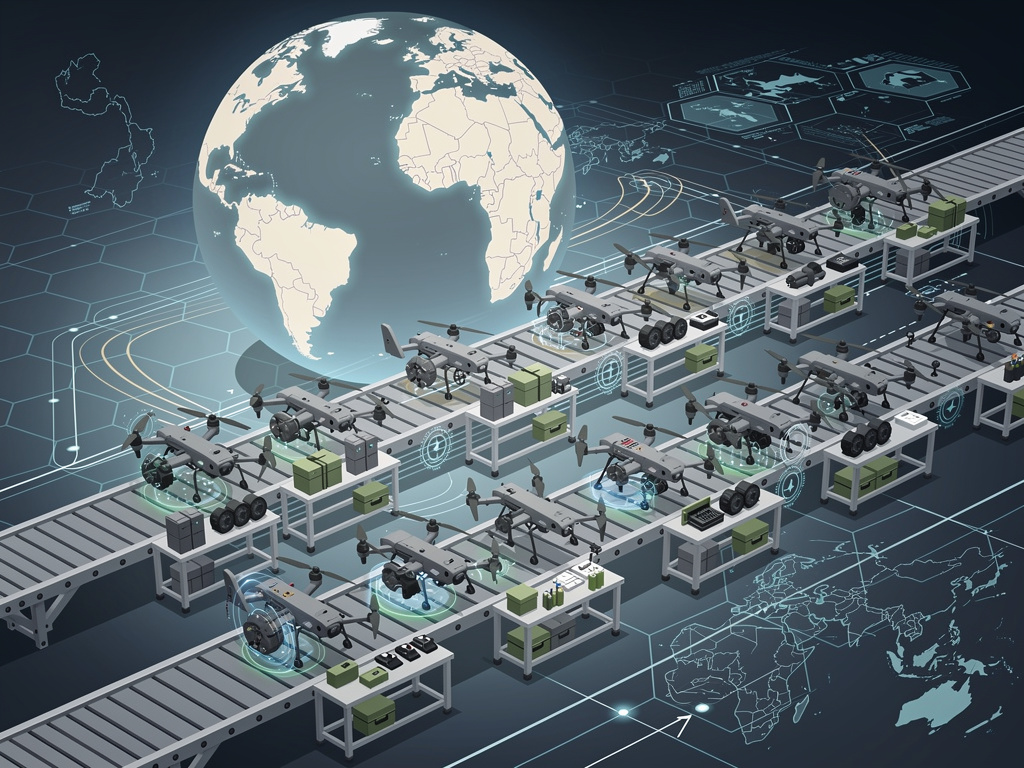
In a warehouse in Johannesburg, a company most defense analysts have never heard of is assembling drones at a pace that would have seemed absurd two years ago. Paramount Advanced Technologies, a subsidiary of South Africa’s Paramount Group, has announced plans to produce 30,000 unmanned aerial vehicles per year — a figure that places it in direct competition not with small African defense contractors but with some of the largest drone manufacturers on the planet.
The ambition is enormous. The model is borrowed straight from Silicon Valley.
According to TechRadar, Paramount Advanced Technologies is explicitly emulating Apple’s approach to hardware production — designing its drones in-house while outsourcing component manufacturing to specialized suppliers, then bringing everything together in tightly controlled final assembly lines. It’s the same playbook that turned Apple into the world’s most valuable company: own the design, the software, and the integration, but let others handle the screws and circuit boards. Paramount believes this model can work for military-grade UAVs just as well as it works for iPhones.
The company isn’t starting from zero. Paramount Group, its parent, has operated in the African defense sector for more than 30 years, building armored vehicles, aircraft, and naval systems. But drones are a different beast entirely — faster product cycles, software-defined capabilities, and a battlefield tempo set not by procurement committees but by the relentless innovation pressure coming out of Ukraine’s war with Russia.
That conflict has rewritten the rules of drone warfare. Ukrainian forces have demonstrated that cheap, mass-produced first-person-view drones can neutralize tanks, disrupt supply lines, and provide intelligence at a fraction of the cost of traditional military hardware. The lesson has not been lost on defense establishments worldwide: volume matters as much as sophistication. Possibly more.
Paramount’s CEO Ivor Ichikowitz has been vocal about this shift. He’s argued that Africa cannot afford to be a passive consumer of foreign military technology, and that the continent’s security challenges — from insurgencies in the Sahel to piracy along its coasts — demand locally produced, affordable drone capabilities. As reported by TechRadar, the company’s N-Raven drone is at the center of this strategy, designed as a modular platform that can be configured for reconnaissance, strike, or logistics missions depending on the payload and software package installed.
The Apple analogy runs deeper than just supply chain management. Paramount is also pursuing what might be called a platform strategy — building a base airframe that can be rapidly iterated and customized, much as Apple releases new iPhone variants on a regular cadence while maintaining backward compatibility with its broader hardware and software environment. The N-Raven’s modular architecture means Paramount doesn’t need to design a new drone for every mission type. It needs to design new modules. That’s a fundamentally different manufacturing proposition, and it’s one that lends itself to the kind of high-volume production the company is targeting.
Thirty thousand units a year. To put that number in context, Turkey’s Baykar — manufacturer of the TB2 Bayraktar that became famous in Ukraine and the Nagorno-Karabakh conflict — reportedly produces several hundred larger drones per year, though it has ramped up production of smaller systems. China’s DJI dominates the commercial drone market with millions of units annually, but those are consumer and commercial products, not military platforms. Paramount is staking out territory somewhere in between: military-grade capability at commercial-scale production volumes.
Whether the company can actually hit that number remains an open question. Scaling any manufacturing operation to tens of thousands of units requires not just factory floor capacity but reliable supply chains, quality control systems, trained labor, and — critically — customers willing to buy at that volume. Africa’s defense budgets are growing but remain modest by global standards. Paramount will almost certainly need to find export markets to sustain production at the levels it’s describing.
And there’s the geopolitical dimension. The global drone market is increasingly shaped by export controls, sanctions regimes, and strategic competition between the United States, China, Turkey, Iran, and Israel — the dominant players in military UAV exports. African nations have historically struggled to acquire advanced drone technology due to restrictions imposed by supplier countries. A homegrown African manufacturer could sidestep some of those barriers, offering governments on the continent a way to acquire drone capabilities without navigating the political strings that often come attached to Western or Chinese systems.
This is not a theoretical concern. Several African nations have turned to Turkish and Chinese drone suppliers in recent years precisely because those countries impose fewer conditions on sales than the United States or European nations. Nigeria, Ethiopia, and Morocco have all acquired Turkish TB2 drones. If Paramount can offer comparable capability with the added advantage of African manufacturing — and the political simplicity that implies — the market opportunity is real.
But capability is the key word. The N-Raven and Paramount’s broader drone lineup will need to prove themselves in operational conditions, not just trade show demonstrations. Ukraine’s drone war has shown that attrition rates for small UAVs are extraordinarily high. Drones get shot down, jammed, or simply crash. The ability to replace losses quickly — to treat drones as consumable munitions rather than precious assets — is what makes mass production strategically significant. Paramount’s 30,000-unit target only makes sense if the drones are cheap enough to lose and reliable enough to matter before they’re lost.
The manufacturing approach helps here. By using commercial off-the-shelf components where possible and reserving proprietary design work for the airframe, flight controller, and mission software, Paramount can keep unit costs down while maintaining control over the capabilities that differentiate its products from hobbyist-grade alternatives. It’s a strategy that mirrors not just Apple but also the approach taken by successful Ukrainian drone startups, which have built effective weapons systems by combining consumer electronics components with purpose-built software and warheads.
There’s a workforce angle too. Paramount has emphasized that its production model will create manufacturing jobs across South Africa and potentially other African countries, positioning the drone program as an industrial development initiative as much as a defense project. Ichikowitz has framed this as part of a broader argument about African technological sovereignty — the idea that the continent should be building its own advanced technology rather than importing it.
So where does this leave the global drone industry? Fragmented and accelerating. The barriers to entry in drone manufacturing have fallen dramatically over the past five years, driven by the commoditization of key components like electric motors, lithium batteries, GPS modules, and flight controllers. What used to require a major defense contractor’s resources can now be done by a startup with good engineers and access to Shenzhen’s supply chain. Paramount is betting that it can combine startup speed with the institutional credibility and distribution networks of an established defense company.
The risks are substantial. Production targets announced at trade shows don’t always survive contact with reality. Supply chain disruptions, regulatory hurdles, quality problems, and the sheer difficulty of scaling manufacturing in a developing economy could all slow Paramount’s plans. And competition won’t stand still — Turkish, Chinese, Iranian, and Israeli manufacturers are all expanding their own production capacities, and several Ukrainian companies are exploring export opportunities for the drone designs they’ve battle-tested over the past two years.
Still, the strategic logic is sound. Africa’s security environment is deteriorating in several regions, drone technology is becoming essential to modern military operations, and no African manufacturer currently produces UAVs at scale. That’s a gap. Paramount is trying to fill it.
Whether it succeeds will depend less on the elegance of its Apple-inspired business model and more on the unglamorous fundamentals: Can it build drones that work, at a price governments can afford, in quantities that matter? The next twelve to eighteen months should provide some answers. The factory floor in Johannesburg is where the rhetoric meets the rivets.


 WebProNews is an iEntry Publication