
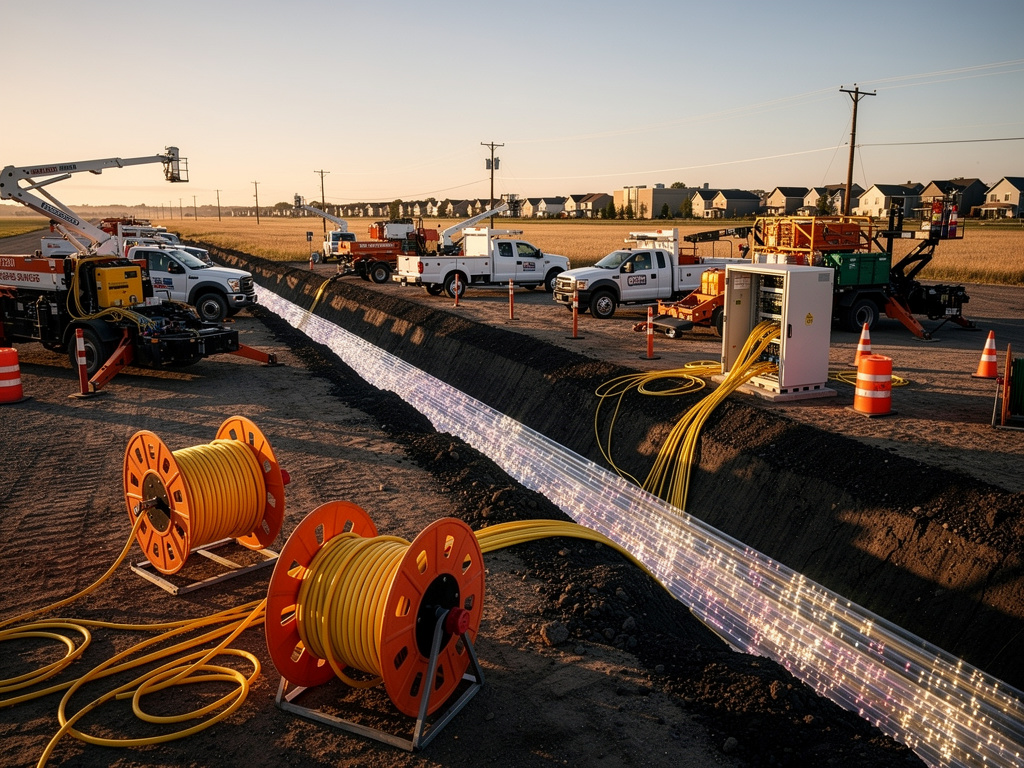
In the dusty stretches of Apache County, Arizona, Sammy Collins commands a 15,000-pound directional drilling machine, carving underground pathways for the fiber-optic cables that will bring high-speed internet to one of America’s most remote corners. The 36-year-old former Marine abandoned his desk job at an addiction treatment facility six months ago, joining a construction crew that has already promoted him twice and increased his pay by more than 22%.
Collins represents both the promise and the problem plaguing America’s ambitious push to blanket the nation in fiber-optic infrastructure. While his story illustrates the lucrative opportunities available to workers willing to master specialized skills—experienced drillers now command between the high $20s to mid-$40s per hour, nearly double Arizona’s median wage—his crew of 40 workers in Eagar, Arizona, is a drop in the bucket compared to the massive labor force required to meet surging demand.
The United States laid fiber cables at a record number of homes last year, propelled by billions in federal broadband grants and an insatiable appetite from technology companies building data centers to power artificial intelligence applications. Yet this infrastructure boom has collided headlong with a stark reality: there simply aren’t enough skilled workers to install the millions of miles of cable required. According to the Wall Street Journal, the shortage affects critical roles including drillers, foremen, splicers, and aerial linemen—specialized positions that require months of training, physical stamina, and in some cases, an artist’s precision.
“We just don’t have the people to do the work,” said Kyle Braude, a former rodeo rider who now manages fiber build projects for JKL Associates, a subsidiary of utility-construction contractor Push. His assessment echoes across an industry struggling to scale up operations despite unprecedented demand and generous federal funding designed to close the digital divide.
The Mathematics of a Mounting Crisis
The dimensions of the labor shortage are staggering. A 2024 report by the Fiber Broadband Association and the Power & Communication Contractors Association projects the industry will need to fill 58,000 new positions between 2025 and 2032. Simultaneously, approximately 120,000 current workers—predominantly older employees approaching retirement—are expected to exit the field during the same period. The combined effect creates a projected shortage of 178,000 workers, a deficit that contractors and industry analysts warn could delay both the nation’s AI ambitions and the goal of universal high-speed internet access.
This workforce gap carries profound implications beyond inconvenienced rural residents awaiting broadband service. The fiber-optic networks being installed today form the foundational infrastructure for emerging technologies including artificial intelligence, autonomous vehicles, telemedicine, and smart city applications. Without sufficient workers to build these networks, the timeline for deploying these transformative technologies could extend significantly, potentially ceding competitive advantages to international rivals investing heavily in digital infrastructure.
The shortage also threatens to undermine the $42.5 billion Broadband Equity, Access, and Deployment (BEAD) Program, the centerpiece of the federal government’s effort to bring high-speed internet to underserved areas. States have begun allocating these funds, but without adequate labor to execute projects, the money may flow more slowly than anticipated, or costs may escalate as contractors compete fiercely for limited skilled workers.
For workers who possess or acquire the necessary skills, however, the shortage has created a seller’s market. Telecommunications line installers and repairers earned a median annual wage of $70,500 for the year ending May 2024, according to Bureau of Labor Statistics data—a figure that excludes overtime pay, which can substantially increase total compensation. By comparison, the median wage across all U.S. occupations stood at $49,500, making fiber work significantly more lucrative than the national average, with no college degree required.
Wage Inflation Accelerates Across the Sector
Compensation for fiber workers has climbed steadily in recent years and shows no signs of plateauing. Push, one of the nation’s largest utility construction contractors, has raised hourly wages for fiber crews by 5% to 8% annually over the past several years, according to company president Chase Lapcinski. He anticipates wage growth will accelerate further in the near future as competition for qualified workers intensifies.
At Sellenriek Construction, based in Jonesburg, Missouri, entry-level fiber workers earned approximately $60,000 including overtime in the previous year. Chief Executive Steve Sellenriek reports that compensation typically jumps 25% to 30% within the first three years, with site superintendents reaching six-figure salaries. The company is experiencing an unprecedented rush of clients attempting to secure contracts early, before wages rise even higher—a clear indication that buyers anticipate continued upward pressure on labor costs.
The wage escalation extends to specialized roles that require particular expertise. Cesar Ruiz, president and CEO of Learning Alliance in Tampa, Florida, which operates a six-week to eight-week fiber installation boot camp, reports that 2025 graduates are starting at approximately $26 per hour plus overtime. That starting rate has increased roughly 13% over just two years, reflecting the urgency with which contractors are seeking to fill positions.
For skilled fiber splicers—technicians who perform the delicate work of joining hair-thin fiber-optic strands—compensation can reach even higher levels. Some splicers earn upward of $30 per splice on certain projects, allowing productive workers to generate substantial income. Mitch Grant, a 38-year-old fiber splicer with K&S Communications currently working in Springerville, Arizona, left cell tower work four years ago specifically because he recognized the earning potential in fiber splicing.
Precision Work in Harsh Conditions
Grant’s daily routine illustrates why fiber work commands premium wages. Kneeling over green utility pedestals in the small Arizona town, he performs meticulous work that demands both technical skill and patience. Each fiber-optic strand must be cleaved to create a perfectly clean edge, then fused using specialized equipment that joins the filaments at the molecular level. A slight misalignment or even a speck of oil from the technician’s hands can ruin the connection, requiring the work to be redone.
“When you first start doing it, it’s like, ‘How can you possibly do it?’ But then you get muscle memory,” Grant explained. The work often means spending entire days alone, accompanied only by music or audiobooks, as he methodically completes splice after splice. Local residents in Springerville, eager for the high-speed fiber internet service expected within two to four months through Commnet’s Ethos Broadband, frequently interrupt him to request updates on the project’s progress.
The physical demands of fiber installation work extend well beyond the technical precision required for splicing. Crews typically work more than 10 hours daily, outdoors in nearly all weather conditions. Projects often require workers to relocate for months at a time, living away from family and established communities. Aerial linemen must possess the strength and stamina to climb telephone poles in summer heat, working at heights while handling heavy equipment and materials.
Winter brings additional challenges in northern climates, where frozen ground makes drilling difficult or impossible, leading to seasonal slowdowns that can leave workers with reduced hours or temporary layoffs. This cyclical nature of the work, combined with the physical demands and frequent travel, contributes to turnover rates that exacerbate the industry’s workforce challenges.
Building Pathways Where None Existed
Unlike established skilled trades such as plumbing, electrical work, or auto repair—which benefit from decades-old apprenticeship programs, vocational school curricula, and clear career pathways—fiber-optic installation lacks a well-developed training infrastructure. This absence of traditional pipelines into the profession means the industry must create recruitment and training mechanisms largely from scratch, even as demand accelerates.
Learning Alliance’s boot camp represents one approach to rapidly developing qualified workers. Funded through military benefits and corporate donations, the program compresses essential skills into an intensive six-to-eight-week course. Graduates emerge with foundational knowledge sufficient to begin entry-level positions, where on-the-job experience builds competency over time. However, such programs remain relatively rare and small-scale compared to the workforce needs.
Push president Lapcinski has adopted a multipronged strategy to address the talent shortage. He hosts hands-on skill days for high school students in Wisconsin, providing teenagers with direct exposure to fiber installation work and the career opportunities it offers. The company has also broadened its recruitment to include farmers seeking more stable income, formerly incarcerated individuals looking for second chances, and white-collar workers who have grown weary of office environments—essentially anyone willing to learn and capable of handling the physical demands.
“AI isn’t going to replace this,” Lapcinski noted, highlighting the fundamentally hands-on nature of the work. “It will accelerate and support some of it, but it’s not going to go out and dig the hole.” His observation underscores a central irony of the current situation: the infrastructure required to enable artificial intelligence and advanced automation must be installed by human workers performing manual labor that resists automation.
Poaching Wars and Retention Challenges
Even when companies successfully recruit and train workers, retention presents an ongoing challenge. The combination of high demand and limited supply has created fierce competition among contractors, with workers frequently poached by competitors offering incrementally higher wages or better working conditions. For workers like Collins, who have already received two promotions in six months, opportunities to job-hop for better compensation are abundant.
This dynamic creates a vicious cycle for employers: investing in training workers who may depart for competitors before the company recoups its investment in their development. Some contractors have responded by offering retention bonuses, more predictable schedules, or clearer advancement pathways. Others have focused on improving working conditions, providing better equipment, or offering benefits packages that extend beyond base wages.
The poaching phenomenon also affects project timelines and budgets. When key workers depart mid-project, remaining crew members must absorb additional responsibilities, potentially slowing progress. Replacing departed workers requires time for recruitment and onboarding, during which productivity suffers. These disruptions ripple through project schedules, potentially triggering penalty clauses in contracts or delaying service activation for customers.
Industry observers note that the workforce challenges facing fiber installation mirror broader trends affecting skilled trades across the American economy. For decades, educational policy and cultural messaging have emphasized college education as the primary pathway to middle-class prosperity, devaluing vocational training and manual trades. The result is a generation of workers with bachelor’s degrees and student loan debt, but a shortage of electricians, plumbers, welders—and fiber technicians.
Federal Funding Meets Human Limitations
The timing of the workforce shortage is particularly problematic given the unprecedented federal investment in broadband infrastructure. The Infrastructure Investment and Jobs Act allocated $65 billion for broadband deployment, with the BEAD program representing the largest component. States have spent the past two years developing plans for allocating these funds, identifying underserved areas, and preparing to award contracts to internet service providers and construction firms.
However, money alone cannot conjure skilled workers into existence. As states begin releasing BEAD funds and projects move from planning to execution, the labor shortage threatens to become the binding constraint on deployment speed. Contractors may be forced to choose between taking on fewer projects than they have capacity to bid on, or accepting projects and risking delays due to insufficient staffing.
Some industry participants worry that the flood of federal money could actually worsen the labor shortage in the near term by triggering a simultaneous rush of projects competing for the same limited pool of workers. This could drive wages higher still—beneficial for workers, but potentially requiring project budgets to be revised upward or scopes to be reduced to fit within allocated funding.
The federal government has recognized the workforce dimension of broadband deployment, with some BEAD program guidance encouraging states to consider workforce development as part of their allocation strategies. However, training workers takes time—months or years to develop true proficiency in specialized roles like splicing—meaning that workforce development initiatives launched today will not fully address shortages until well into the deployment timeline.
The Road Ahead for America’s Digital Infrastructure
Despite the formidable challenges, the fiber-optic installation industry continues to attract workers drawn by competitive wages, job security, and the satisfaction of building critical infrastructure. For individuals without college degrees, particularly those in rural areas where high-paying opportunities are scarce, fiber work offers a genuine pathway to middle-class income and career advancement.
The industry’s workforce challenges also present opportunities for innovation in training, recruitment, and retention. Companies that develop effective programs for rapidly onboarding and developing workers may gain competitive advantages, while those that create positive workplace cultures and clear advancement pathways may succeed in retaining talent that competitors lose to poaching.
Technology may also play a role in addressing labor shortages, even if it cannot replace human workers entirely. Improved drilling equipment that is easier to operate, better splice preparation tools that reduce the skill required for quality connections, or project management software that optimizes crew deployment could all increase productivity, allowing existing workers to accomplish more.
For communities like Springerville, Arizona, where Mitch Grant splices fiber connections and residents eagerly await service activation, the workforce shortage translates into delayed access to opportunities that high-speed internet enables. Students who could benefit from online educational resources, entrepreneurs who could reach broader markets, and healthcare providers who could offer telemedicine services must wait while the industry works to build capacity.
The ultimate resolution of the fiber workforce shortage will likely require sustained effort across multiple fronts: expanded training programs, improved recruitment into the trades, better retention through competitive compensation and working conditions, and realistic timelines that account for human capital constraints. Until then, workers like Sammy Collins will remain in high demand, their specialized skills the limiting factor in America’s race to build the digital infrastructure of the future.
As Lapcinski’s observation suggests, the irony is inescapable: the artificial intelligence revolution depends on very human hands to install the fiber-optic cables that will carry its data. No algorithm can splice a fiber connection, no robot can yet navigate the complexities of drilling beneath varied terrain, and no software can replace the judgment of an experienced foreman coordinating a crew across miles of rural territory. For all the technological sophistication of the networks being built, their construction remains stubbornly, irreducibly human—and that human element has become the industry’s most precious and scarce resource.


 WebProNews is an iEntry Publication