
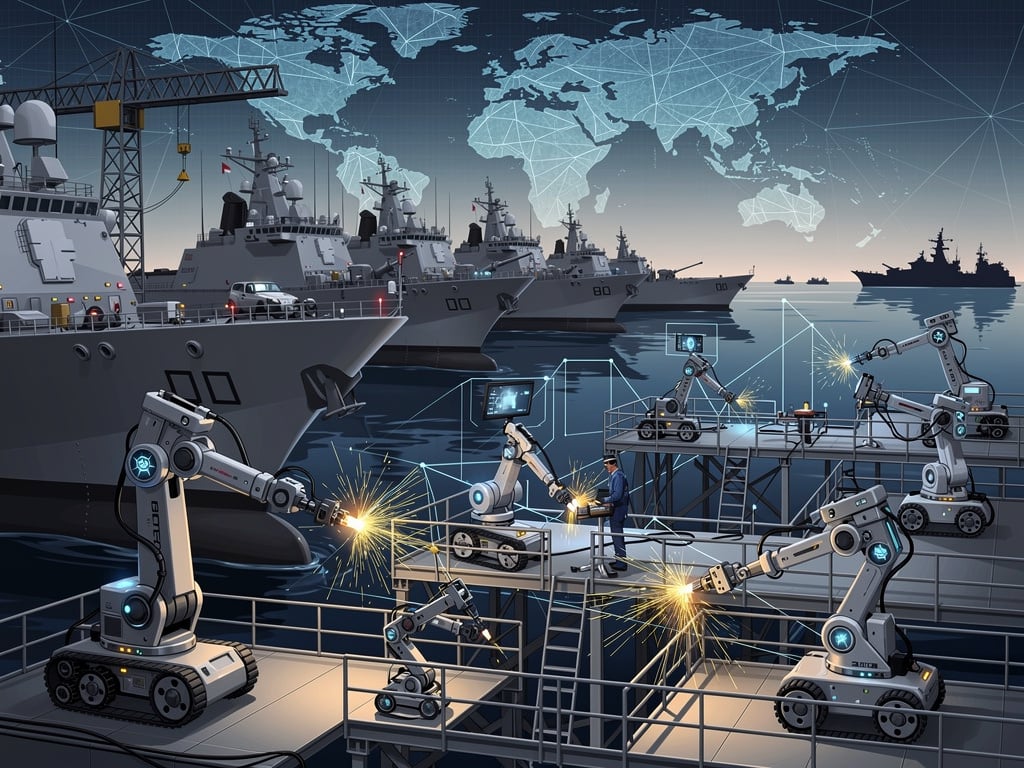
Huntington Ingalls Industries, the largest military shipbuilder in the United States, has entered a partnership with artificial intelligence firm GrayMatter Robotics to deploy autonomous systems across its shipyards. The deal is not a moonshot experiment. It’s a direct response to a labor shortage so severe that the Pentagon has flagged it as a national security risk.
The agreement, announced this week, will bring GrayMatter’s AI-powered robotic systems into HII’s Newport News Shipbuilding division in Virginia and its Ingalls Shipbuilding operation in Pascagoula, Mississippi. These two yards are responsible for building every nuclear-powered aircraft carrier and submarine in the U.S. Navy’s fleet, along with amphibious assault ships and destroyers. The stakes, in other words, could hardly be higher.
According to Yahoo Finance, the partnership will focus on automating surface preparation and coating tasks — grinding, sanding, blasting, and painting — that are physically demanding, hazardous, and increasingly difficult to staff. GrayMatter’s systems use machine learning and computer vision to adapt to complex, non-uniform surfaces in real time, a capability that distinguishes them from conventional industrial robots that follow pre-programmed paths.
This matters because shipbuilding is not like automotive manufacturing. Cars roll off assembly lines with standardized geometries. Ships don’t. Every hull section, every weld seam, every compartment presents unique contours. Traditional automation has struggled in this environment for decades. GrayMatter claims its AI can perceive and adjust to these variations autonomously, which — if it performs as advertised — would represent a significant capability gain for yards that have relied on manual labor for tasks that haven’t fundamentally changed since World War II.
The timing is anything but coincidental. The U.S. shipbuilding industrial base has been under extraordinary pressure. The Navy’s own assessments have repeatedly warned that the country’s shipyards lack the workforce to meet current construction and maintenance schedules, let alone the expanded fleet the Pentagon says it needs. HII alone has been trying to hire thousands of workers, competing for skilled tradespeople against commercial construction, energy, and manufacturing sectors that often offer comparable or better pay without the security clearance requirements.
A 2024 report from the Congressional Research Service documented persistent delays in submarine and carrier construction programs, attributing much of the slippage to workforce shortfalls and supplier bottlenecks. The Columbia-class ballistic missile submarine program, the Navy’s top acquisition priority, is already behind schedule. The Virginia-class attack submarine program has faced similar headwinds. And the Gerald R. Ford-class carrier program, while further along, has not been immune to labor-driven delays either.
GrayMatter Robotics, based in Los Angeles, was founded in 2019 by a team of roboticists from the University of Southern California. The company’s flagship product line — branded as Scan&Sand and Scan&Paint — uses proprietary AI to generate tool paths on the fly based on 3D surface scans. The robots don’t need CAD models or detailed programming for each new workpiece. They figure it out themselves.
That’s the pitch, anyway. And it’s attracted serious attention. GrayMatter has raised over $45 million in venture funding, with backing from investors including B Capital Group and Bow Capital. The company has deployed systems in aerospace, automotive, and general manufacturing settings, but the HII partnership marks its most prominent defense contract to date.
HII’s president and CEO, Chris Kastner, framed the partnership in blunt operational terms. Surface preparation and coating work accounts for a substantial portion of labor hours on any ship construction program. It’s grueling. Workers operate in confined spaces, wearing respirators, handling abrasive equipment for hours at a stretch. Injury rates are high. Retention is low. If robots can absorb a meaningful share of that work, it frees up human workers for higher-skill tasks — welding, fitting, electrical installation — where the talent gap is even more acute.
But there’s a deeper strategic calculus at play. The Department of Defense has been pushing hard for the defense industrial base to adopt advanced manufacturing technologies, including AI and robotics. The 2024 National Defense Industrial Strategy explicitly called for accelerating automation in shipyards, arsenals, and depots. The Pentagon’s Office of Strategic Capital and the Defense Innovation Unit have both been channeling funding toward companies developing dual-use manufacturing technologies. GrayMatter fits squarely in that category.
The Navy, for its part, has been investing directly in shipyard modernization through its Shipyard Infrastructure Optimization Program, or SIOP, a $21 billion initiative to overhaul the four public naval shipyards that handle maintenance and repair. But that program doesn’t cover the private yards — HII and General Dynamics’ Bath Iron Works and Electric Boat division — where new construction happens. Those companies have had to fund their own modernization efforts, sometimes with help from Navy contract incentives, sometimes on their own dime.
HII has been investing in digital shipbuilding for several years. The company has deployed digital twins, augmented reality tools for workers, and additive manufacturing in limited applications. The GrayMatter deal extends that effort into a domain — surface treatment — that has been stubbornly resistant to automation. Industry veterans will tell you that painting a ship is nothing like painting a car. The surfaces are enormous, irregular, and often in states of partial assembly. Environmental conditions vary. Coating specifications differ by zone, with different requirements for underwater hull sections, topside surfaces, and interior compartments.
GrayMatter’s AI reportedly handles this complexity by continuously scanning the work surface with lidar and cameras, building a real-time 3D model, and computing optimal tool pressure, angle, and speed for each pass. The system adapts if it encounters an unexpected weld bead, a rivet head, or a change in surface curvature. This kind of adaptive autonomy is what separates modern AI-driven robotics from the fixed-path industrial robots that have been common in manufacturing since the 1980s.
Still, skepticism is warranted. Shipyard environments are harsh. Salt air, humidity, dust, tight spaces, heavy overhead cranes moving massive steel sections — none of it is kind to sensitive electronics. Deploying robots in a lab or a clean aerospace facility is one thing. Deploying them in a working shipyard, where the floor plan changes weekly and the work surface might be a curved hull plate suspended thirty feet in the air, is something else entirely.
And then there’s the workforce question. Unions have historically viewed automation with suspicion, and shipyard workers are heavily unionized. HII’s Ingalls and Newport News divisions both have large bargaining units. The company has been careful to frame the GrayMatter partnership as augmenting the existing workforce rather than replacing it — a distinction that will be tested as the technology scales. If robots take over surface prep, what happens to the workers currently doing that job? HII says they’ll be retrained and redeployed to higher-value tasks. That’s a promise that sounds good in a press release. Delivering on it requires sustained investment in training programs and a genuine commitment to workforce development.
The broader context here is a defense industrial base that has been hollowed out over three decades of post-Cold War consolidation. The United States went from having dozens of active shipyards in the 1980s to a handful today. The supplier base has contracted in parallel. Skilled trades — pipefitters, welders, marine electricians — have aged out without adequate replacement pipelines. Community colleges and vocational programs that once fed workers into the yards saw enrollment decline for years as the cultural emphasis shifted toward four-year degrees.
That trend is slowly reversing. HII has invested in apprenticeship programs and partnerships with community colleges in Virginia and Mississippi. The Navy has funded workforce development initiatives through the Submarine Industrial Base Council and other bodies. But the gap between supply and demand remains wide. The Defense Department estimates the shipbuilding industrial base needs tens of thousands of additional workers over the next decade to meet planned fleet requirements.
So automation isn’t optional. It’s arithmetic. If you can’t hire enough people to do the work, you either find machines to do some of it or you accept that the ships won’t get built on time. The Navy has been accepting the latter outcome for years now, and the patience of Congress and the combatant commanders is wearing thin.
GrayMatter’s Ariessa Nair, the company’s co-founder and CEO, told reporters that the HII deployment will begin with pilot programs at both yards before scaling to broader production applications. The initial focus will be on flat and curved panel lines — the early stages of hull construction where large steel plates are prepared and coated before assembly. If those pilots succeed, the technology could eventually move into more complex areas: interior compartments, superstructure sections, and maintenance and repair work on ships already in service.
That last application — maintenance — could prove even more consequential than new construction. The Navy’s maintenance backlog is staggering. Ships routinely enter dry dock months late and emerge months behind schedule. Surface preparation and recoating are major components of any maintenance availability. If autonomous robots can compress the timeline for those tasks, the ripple effects across fleet readiness would be substantial.
Other defense shipbuilders are watching closely. General Dynamics’ Electric Boat division, which builds Virginia-class and Columbia-class submarines in Groton, Connecticut, and Quonset Point, Rhode Island, has its own automation initiatives underway but has been less public about specific partnerships. Austal USA, which builds littoral combat ships and is ramping up production of a new class of steel frigates in Mobile, Alabama, has also explored robotic welding and surface treatment technologies.
The international picture adds urgency. China’s shipbuilding capacity dwarfs that of the United States by virtually every measure — commercial tonnage, number of yards, workforce size. The People’s Liberation Army Navy has been commissioning warships at a pace the U.S. hasn’t matched since the Reagan-era buildup. While quality and capability comparisons are more nuanced than raw numbers suggest, the sheer volume of Chinese naval construction has alarmed American defense planners. If the U.S. can’t build ships faster with fewer people, the math doesn’t work.
AI-driven robotics won’t solve that problem alone. But it’s one of the few levers available that can deliver near-term productivity gains without requiring decades of workforce pipeline development. The HII-GrayMatter partnership is a bet that the technology is mature enough to perform in one of the most demanding manufacturing environments on Earth. If it works, expect every major defense manufacturer to follow. If it doesn’t, the shipbuilding crisis will only get worse.
The market seems cautiously optimistic. HII’s stock has been under pressure for much of 2024 and into 2025, weighed down by program delays and cost overruns that have squeezed margins. Investors have been looking for signs that the company can bend the productivity curve. A successful AI robotics deployment — one that demonstrably reduces labor hours and accelerates schedules — would be exactly the kind of catalyst the stock needs.
But Wall Street knows better than to price in promises. The proof will come in the quarterly earnings calls, in the shipyard performance metrics, and ultimately in whether the Navy’s ships start arriving closer to schedule. That’s the only test that matters. Everything else is just a press release.


 WebProNews is an iEntry Publication