
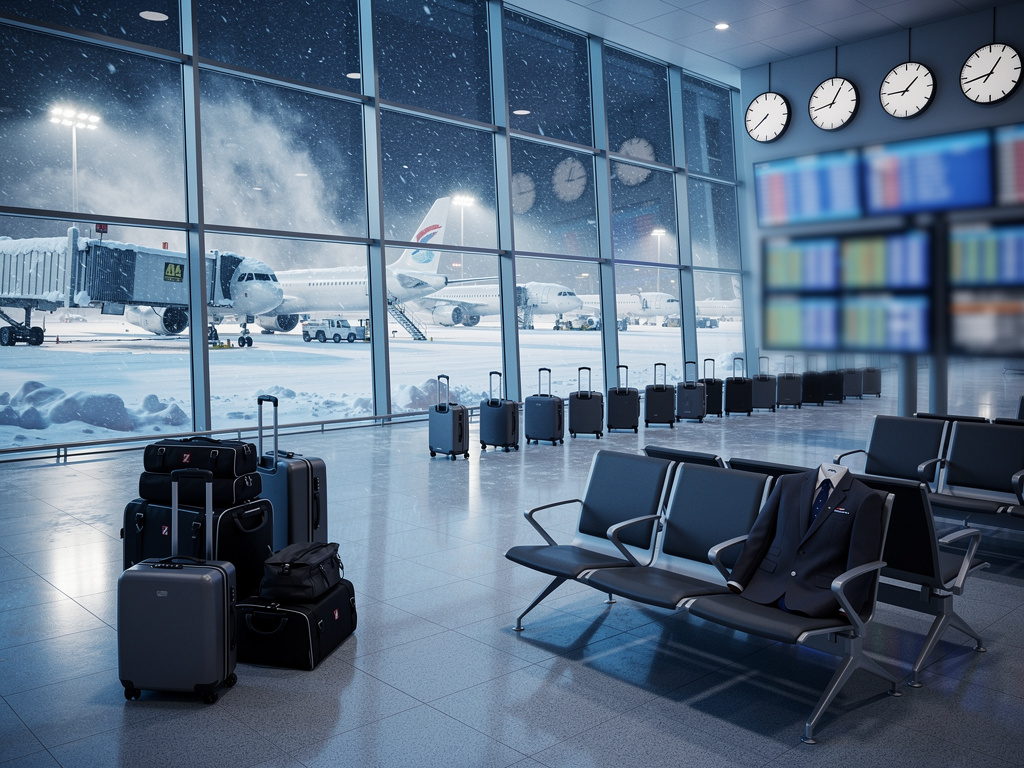
When Winter Storm Fern paralyzed air travel across the United States in early 2026, thousands of American Airlines flight attendants found themselves stranded in airports and hotel rooms—without pay. The incident has reignited a long-simmering debate about how airlines compensate their cabin crew during weather disruptions, exposing a compensation structure that labor advocates say leaves workers vulnerable during the very moments when their services are most needed.
According to Business Insider, American Airlines flight attendants are only paid for actual flight time, meaning the hours spent boarding passengers, sitting through delays, or waiting on standby during cancellations generate no income. During Winter Storm Fern, which caused widespread flight cancellations across the carrier’s network, this policy left crew members in a financial bind—expected to remain available for duty while earning nothing as flights were systematically grounded.
The storm, which brought heavy snow and ice to major hub cities including Dallas-Fort Worth and Charlotte, resulted in more than 3,000 flight cancellations across American’s network over a four-day period. Flight attendants reported spending upwards of 12 to 16 hours per day at airports or in crew hotels, maintaining their availability for flights that never materialized, all while their paychecks reflected zero hours worked.
The Peculiar Economics of Flight Attendant Compensation
The practice of paying flight attendants only for airborne hours—known in the industry as “door close to door open”—is a legacy compensation model that dates back to the early days of commercial aviation. While pilots are similarly compensated primarily for flight time, they typically receive higher hourly rates and additional pay for pre-flight duties. Flight attendants, by contrast, perform extensive work before and after flights—from conducting safety checks to assisting passengers with boarding and deplaning—for which they receive minimal or no compensation at many carriers.
At American Airlines, flight attendants earn a modest per diem allowance for time spent away from their home base, but this stipend is designed to cover meals and incidental expenses, not to serve as meaningful compensation for hours of work. The current contract, which was ratified in 2024 after contentious negotiations, provides flight attendants with approximately $2.20 per hour in per diem pay—a rate that hasn’t kept pace with inflation or the rising cost of food in airport terminals and crew hotels.
Winter Storm Fern’s Cascading Impact on Crew Schedules
The compensation crisis during Winter Storm Fern was compounded by the cascading nature of weather-related disruptions. Unlike passengers who can simply rebook or return home, flight attendants are bound by duty regulations that require them to remain available within a certain radius of the airport when on assignment. Many crew members found themselves stuck in cities far from home, unable to earn money yet prohibited from leaving to find alternative employment or return to their families.
Sarah Mitchell, a Dallas-based flight attendant with 12 years of service at American, told reporters that she spent three consecutive days at DFW Airport during the storm, reporting for duty each morning only to have her assigned flights cancelled. “I was there from 5 a.m. to 8 p.m. each day, in uniform, ready to work,” she explained. “But because the planes never left the ground, those three days show up as zero earnings on my paycheck. I still had to pay for parking, and the per diem barely covered one meal a day at airport prices.”
Union Response and Contract Negotiations
The Association of Professional Flight Attendants (APFA), which represents American’s 28,000 cabin crew members, has made compensation during irregular operations a priority in ongoing discussions with management. The union has proposed several modifications to the current pay structure, including minimum pay guarantees for scheduled shifts regardless of whether flights operate, and enhanced compensation rates during weather emergencies when crew members are required to remain on standby.
Julie Hedrick, APFA’s national president, issued a statement following the Winter Storm Fern disruptions calling the current compensation model “fundamentally unfair and unsustainable.” The union has pointed to recent contract improvements at other carriers as evidence that change is possible. Delta Air Lines, for instance, implemented boarding pay for flight attendants in 2022, compensating crew members for the time spent getting passengers settled before door closure—a move that added an estimated $40-50 million annually to the carrier’s labor costs but was credited with improving employee morale and retention.
Comparative Industry Practices and Competitive Pressures
The compensation dispute at American Airlines doesn’t exist in a vacuum. Across the industry, flight attendants have become increasingly vocal about pay structures that fail to account for the full scope of their responsibilities. United Airlines flight attendants, represented by the Association of Flight Attendants-CWA, have been in contract negotiations since 2021, with compensation during ground time emerging as a central sticking point. Similarly, Southwest Airlines crew members have pushed for improvements to their pay structure, though Southwest’s point-to-point route network and generally shorter ground times make the issue somewhat less acute than at traditional hub-and-spoke carriers.
The competitive dynamics of the airline industry complicate efforts to reform flight attendant compensation. Airlines operate on notoriously thin profit margins, with labor costs representing approximately 30-35% of total operating expenses at major carriers. Any significant increase in flight attendant compensation would need to be offset through higher fares, reduced service, or improved operational efficiency—none of which are easy sells in an industry where consumers have shown extreme price sensitivity and shareholders demand consistent returns.
Regulatory Framework and Legal Considerations
The legal framework governing flight attendant compensation adds another layer of complexity to the issue. Under the Railway Labor Act, which covers airline employees, the terms of compensation are determined through collective bargaining rather than by minimum wage laws or overtime regulations that apply to most other workers. This means that flight attendants’ pay structures are largely the product of negotiations between unions and management, with limited intervention from federal regulators.
However, some labor advocates have argued that the Federal Aviation Administration (FAA) should take a more active role in ensuring that compensation structures don’t create perverse incentives that could compromise safety. When flight attendants are unpaid during delays and cancellations, there’s a financial pressure to push for flights to operate even in marginal weather conditions—a dynamic that could theoretically conflict with safety priorities, though there’s no evidence this has been a factor in actual safety incidents.
The Broader Context of Aviation Labor Relations
The Winter Storm Fern compensation controversy comes at a particularly sensitive moment in aviation labor relations. The industry is still recovering from the pandemic-era disruptions that saw tens of thousands of workers furloughed or taking early retirement packages. As travel demand has rebounded, airlines have struggled to rebuild their workforces, leading to operational meltdowns during peak travel periods and severe weather events.
Flight attendants have found themselves with increased leverage in this tight labor market. The difficulty airlines face in recruiting and training new cabin crew—a process that can take several months and costs upwards of $5,000 per trainee—has made retention a critical priority. This dynamic has emboldened unions to push for more aggressive contract improvements, including reforms to compensation structures that have remained largely unchanged for decades.
Economic Implications and Operational Costs
Implementing minimum pay guarantees or compensation for ground time would represent a significant financial commitment for American Airlines. Industry analysts estimate that paying flight attendants for all scheduled duty time, rather than just flight time, could increase the carrier’s annual labor costs by $150-200 million—a substantial sum, but one that represents less than 1% of American’s total operating expenses, which exceeded $50 billion in 2025.
Proponents of compensation reform argue that the investment would pay dividends in reduced turnover, improved morale, and better customer service. Flight attendants who feel fairly compensated are more likely to go above and beyond for passengers, potentially improving customer satisfaction scores and brand loyalty—metrics that airlines increasingly recognize as drivers of long-term profitability in a commoditized industry.
Looking Ahead: Potential Paths Forward
As contract negotiations continue between American Airlines and the APFA, several potential compromise solutions have emerged. One proposal would establish minimum pay guarantees for scheduled duty periods, ensuring that flight attendants earn at least a baseline amount even when flights are cancelled. Another approach would create enhanced compensation rates during declared weather emergencies, recognizing the particular hardship crew members face when stranded away from home during irregular operations.
The resolution of this dispute will likely have implications beyond American Airlines. Other carriers are watching closely to see whether the APFA can secure meaningful improvements to the compensation structure, as any breakthrough could set a precedent for contract negotiations across the industry. For the thousands of flight attendants who found themselves working without pay during Winter Storm Fern, the stakes are deeply personal—a question of whether the airlines they serve will recognize the full value of their labor, both in the air and on the ground.


 WebProNews is an iEntry Publication