
Jim Farley didn’t mince words. The Ford CEO had imported a Xiaomi SU7 from Shanghai to Chicago. “I don’t want to give it up,” he confessed at the 2024 Aspen Ideas Festival. His candor revealed a quiet truth. The car impressed him. Its blend of software, performance and price left an imprint.
Tech reviewer Marques Brownlee captured a similar reaction in his video on the SU7 Max. He listed its strengths one by one. Great software. Great features. Great build quality. Great versatility. Great range. Great drive. “That’s pretty elite,” he said. His pauses stretched. His voice carried disbelief. For the first time in years, a mass-market vehicle from China had unsettled an American observer.
But most Americans will never sit behind its wheel. Tariffs, import rules and national-security reviews keep such vehicles at bay. A $10,000 BYD Seagull remains a rumor for U.S. buyers. European parking lots overflow with surplus BYD models. Satellite images document the glut. Americans watch from afar.
The Shift From Demand to Denial
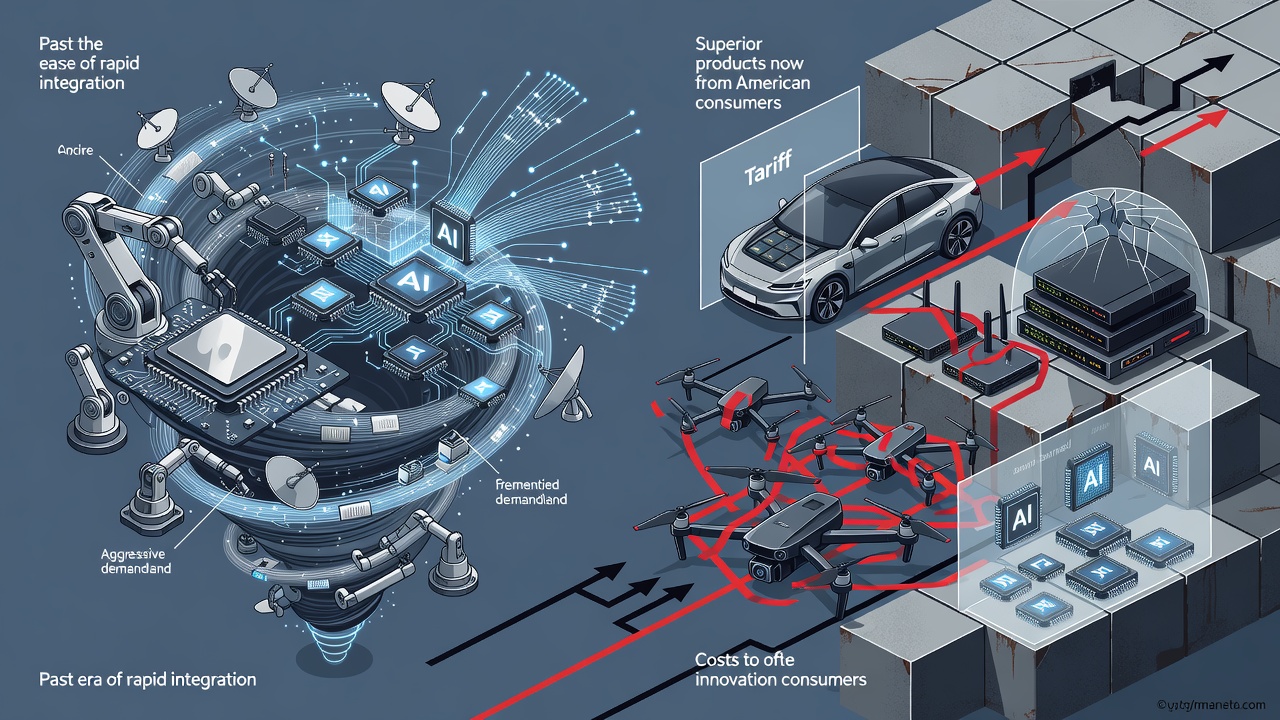
This pattern repeats across categories. The Federal Communications Commission banned new foreign-made routers in March, citing cybersecurity risks. It also imposed strict limits on unmanned aircraft systems, hitting Chinese suppliers hardest. Advanced batteries and solar components face steep tariffs and scrutiny. The result feels historic. For the first time in modern consumer technology history, Americans observe the rest of the world adopting better, cheaper and sometimes more advanced products in real time. Officials tell them they cannot have those products.
The PCMag opinion piece from June 27, 2026, lays out the inversion. Once the United States demanded the best technology available. Consumers expected it. Regulators cleared paths for superior imports when they delivered clear gains. Today the default leans toward prohibition. National security, domestic industry protection and supply-chain concerns dominate the conversation.
And the stakes stretch beyond consumer gadgets. Export controls on advanced semiconductors have tightened in waves since 2022. The Bureau of Industry and Security added dozens of Chinese entities to its lists in 2025. It issued guidance in June 2026 confirming that restrictions on AI chip shipments apply to subsidiaries of Chinese firms even when those subsidiaries operate outside China. Al Jazeera reported the move on June 1, 2026. The Department of Commerce acted to close perceived loopholes.
Earlier this year the Trump administration rescinded parts of the prior AI Diffusion Rule. It strengthened other controls. Guidance warned that use of Huawei’s Ascend AI chips anywhere in the world could violate U.S. rules if those chips were developed in breach of existing restrictions. Penalties include fines, imprisonment and loss of export privileges. Chinese firms responded by accelerating domestic alternatives. Huawei’s Mate 60 Pro, launched years ago with a 7-nanometer domestically produced processor, proved the point. SMIC manufactured the chip. The device competed despite sanctions.
Critics argue the strategy backfires. Brookings Institution fellow Mark MacCarthy examined the dynamics in a June 17, 2026, analysis. “The ball game’s over—the U.S. is out of the AI chip market in China,” he wrote. Chinese tech giants now face pressure to reduce dependence on Nvidia. Some develop their own silicon. Others turn to Huawei despite competitive tensions. The controls, once aimed at slowing Beijing, have spurred parallel innovation that erodes American market share.
Yet the policy retains defenders. They point to genuine risks. Advanced AI models trained on massive compute clusters could underpin military applications. Semiconductor manufacturing equipment represents a chokepoint. Congress received regular briefings on these threats. Bipartisan consensus holds that certain transfers demand scrutiny. The question is where to draw the line.
Consider electric vehicles again. Elon Musk warned in a 2024 earnings call that Chinese makers would “demolish” rivals absent trade barriers. He later distanced himself from the tariffs that followed. “Neither Tesla nor I asked for these tariffs,” Musk said. The Biden administration raised levies on Chinese EVs to 100 percent. The Trump team kept many in place. Ford scaled back its own EV efforts. It pivoted toward battery storage for data centers. Farley’s praise for the Xiaomi stayed private. Public policy moved in the opposite direction.
Aptera, a California startup, offers another case. Its three-wheeled, solar-assisted vehicle promises extreme efficiency. Up to 40 miles per day from sunlight under ideal conditions. Enthusiasts placed deposits. The design echoed themes Musk once championed. Yet Aptera struggles with funding and scaling. Mass production stalls. Meanwhile, Chinese firms ship affordable EVs by the hundreds of thousands. Vertical integration gives them cost advantages built over decades.
But the restrictions don’t stop at hardware. Data centers powering American AI face their own constraints. xAI’s Colossus project in Memphis drew scrutiny over unpermitted gas turbines and emissions. Environmental groups documented potential nitrogen oxide output reaching thousands of tons annually. Local air quality already suffered. The tension highlights a broader contradiction. Policymakers push AI supremacy. They limit the very energy and components needed to achieve it at competitive prices.
Recent developments add layers. A Reuters report from March 5, 2026, revealed officials debating new rules for AI chip exports. One proposal would require foreign buyers of large volumes to invest in U.S. data centers or provide security guarantees. The idea marks a shift. Earlier exemptions for allies narrow. The goal remains keeping advanced compute inside secure perimeters. Allies chafe. Domestic firms worry about lost sales.
So the United States finds itself in an odd position. It leads in frontier AI research. Private investment pours in. Yet consumers encounter fewer choices in finished products. Tariffs raise sticker prices. Reviews of foreign flagships circulate online like forbidden fruit. Drones from DJI remain popular among hobbyists and professionals until stocks run dry. Replacement options cost more and deliver less capability.
Industry voices express unease. The Semiconductor Industry Association criticized aspects of earlier global licensing regimes. It warned that overly broad rules burden U.S. exporters without fully solving the security problem. Chinese firms adapt. They stockpile, redesign and train talent at scale. Talent flows both ways, but visa restrictions and campus scrutiny complicate American recruitment.
History offers contrast. In the 1980s and 1990s, Japanese cars flooded the market. Detroit complained. Washington negotiated voluntary restraints. Yet consumers gained reliable, fuel-efficient options. The competition forced American improvements. Today the rhetoric centers on existential threats. Competition with China receives framing closer to Cold War containment than market adjustment.
And the containment carries costs. Higher prices for renewables slow adoption. Limited drone access hampers agriculture, inspection and emergency response. Router bans create uncertainty for small businesses seeking affordable networking gear. Each restriction solves one perceived vulnerability. It creates others in innovation velocity and consumer welfare.
Recent X discussions reflect the frustration. AI leaders warn that heavy regulation risks driving talent and capital elsewhere. One executive noted the danger of “regulatory capture” closing off open-source progress. Another pointed to self-imposed U.S. limits on models while Chinese labs ship powerful open-weight systems without equivalent guardrails. Momentum, they fear, shifts.
Policy makers counter that leadership demands discipline. The CHIPS Act poured billions into domestic fabs. Export controls aim to preserve the technological lead those fabs support. Intel, TSMC’s Arizona plants and GlobalFoundries expand. Success will take years. In the interim, gaps appear. Huawei ships competitive phones. BYD captures global EV market share. American buyers pay premiums for domestic alternatives that lag in certain metrics.
The inversion feels complete in some domains. China now embodies the competitive dynamism Americans once celebrated. Its firms iterate rapidly. Supply chains integrate from mine to motor. The United States, by contrast, layers rule upon rule. National security, environmental review, union priorities, shareholder returns. Each valid in isolation. Together they slow execution.
Ford’s pivot from passenger EVs to grid storage captures the moment. Chinese competition proved too intense. Battery prices fell faster abroad. American labor and regulatory costs stayed high. The outcome wasn’t inevitable. It followed deliberate policy choices. Those choices prioritized certain forms of security over market access.
Observers wonder whether the balance can shift. Musk’s influence in Washington grew after substantial campaign support. His companies benefit from some protections yet face pressure to deliver on autonomous and affordable visions. The Cybercab robotaxi concept promises transformation. Yet ownership of high-quality EVs at low prices could accelerate the transition he once described as essential for humanity.
Critics see a closed system. Scarcity justifies high margins. Security pretexts protect incumbents. Innovation suffers when engineers cannot study the best existing artifacts. Students learn from teardowns and open teardowns. When the best examples stay offshore, the feedback loop weakens.
Recent congressional reports and think-tank papers document the pattern. The Information Technology and Innovation Foundation argued in January 2026 that past efforts to limit big tech had been misguided. It called for renewed focus on accelerating American strengths rather than defensive blocks alone. Others urge smarter alliances. Share more technology with trusted partners. Tighten only against clear adversaries. Calibrate the controls.
The path forward remains contested. Short-term political incentives favor tough stances on China. Public concern over data privacy, intellectual-property theft and military modernization runs deep. Yet long-term technological primacy requires more than denial. It demands superior products, faster iteration and broader adoption at home.
Americans once insisted on the best. They imported it, copied it, improved it and exported the results. That posture built global dominance. The current posture of selective bans carries risks. It may protect sensitive edges. It also risks ceding volume markets, talent pipelines and iterative learning to competitors who face fewer self-imposed limits.
The Xiaomi sits in a Chicago garage. Its owner, a prominent American executive, doesn’t want to surrender it. Most citizens lack that option. They read the reviews. They watch the videos. They calculate the price difference. And they wonder how long the prohibition can last before the gap in lived experience grows too wide to ignore.


 WebProNews is an iEntry Publication