
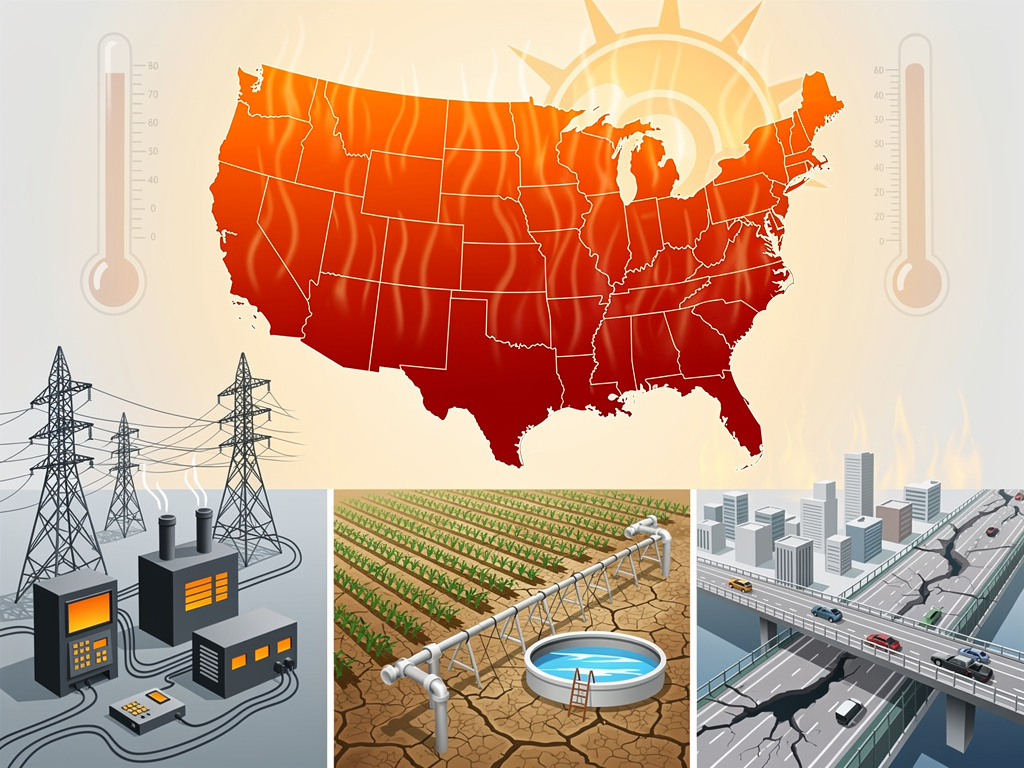
The thermometer didn’t lie. March 2025 was the warmest March ever recorded across the contiguous United States, a record stretching back 132 years to 1893. The average temperature hit 48.6°F, a full 5.9°F above the 20th-century average, according to data released by the National Oceanic and Atmospheric Administration. Every single one of the Lower 48 states recorded above-average temperatures. Not most. All of them.
That’s not a statistical curiosity. It’s a signal.
As Fortune reported, the record-shattering month wasn’t driven by a freak weather event in one region pulling the national average upward. The warmth was remarkably broad-based, blanketing the country from the Pacific Northwest to the Gulf Coast, from the Northern Plains to New England. NOAA’s data showed that large swaths of the central and eastern United States experienced temperatures that ranked among their top five warmest Marches on record, while several states in the Upper Midwest and Great Lakes region posted their warmest March ever.
The timing matters. March sits at the hinge between winter and spring, and when it runs this hot, the downstream consequences for agriculture, water supply, wildfire risk, and energy demand compound quickly. Snow that should have lingered in mountain watersheds melted early. Soil moisture levels that farmers count on shifted ahead of schedule. And the growing season, already creeping earlier year by year, lurched forward again.
NOAA’s monthly climate report confirmed that the March record didn’t emerge in isolation. The preceding twelve months had been peppered with above-average temperature readings across much of the country, part of a persistent warming trend that climate scientists have tracked with increasing precision. The agency noted that the rate of warming in the U.S. has accelerated since the 1980s, with the most recent decade consistently producing months that would have been statistical outliers just a generation ago.
But here’s what has industry watchers and risk analysts paying closer attention: the outlook for summer 2025.
NOAA’s Climate Prediction Center has issued seasonal forecasts indicating elevated probabilities of above-normal temperatures across much of the United States through the summer months. The forecast maps are stark — nearly the entire country shaded in orange and red, signaling that the odds favor continued warmth well above historical baselines. For energy grid operators, agricultural commodity traders, and insurance underwriters, these aren’t abstract projections. They’re planning inputs with real financial weight.
The electric utility sector is already stress-testing summer scenarios. The record March warmth pushed spring cooling demand higher than normal in southern states, and grid operators in Texas, California, and the Southeast have flagged the potential for tight reserve margins if summer temperatures track the upper end of forecast ranges. The North American Electric Reliability Corporation warned earlier this year that several regional grids face elevated risk of supply shortfalls during extreme heat events, particularly if drought conditions reduce hydroelectric output simultaneously.
Drought is the other shoe waiting to drop. According to the U.S. Drought Monitor, portions of the Southern Plains, Southwest, and parts of the Southeast entered April with abnormally dry or moderate drought conditions. The warm March accelerated evapotranspiration — the process by which heat pulls moisture from soil and vegetation — tightening water budgets in regions that were already running deficits. For winter wheat producers in Kansas and Oklahoma, the combination of early warmth and insufficient rainfall has created anxiety about yields that won’t be resolved for weeks.
Commodity markets have noticed. Spring wheat and corn futures have shown intermittent volatility tied to weather forecasts, and crop insurance actuaries are recalibrating risk models that increasingly treat extreme warmth as a baseline rather than a tail event. The USDA’s World Agricultural Supply and Demand Estimates, closely watched by grain traders, will incorporate evolving weather conditions into yield projections as the season progresses.
The broader climate context frames the March record in sharper relief. Globally, 2024 was confirmed as the warmest year in the modern instrumental record, with global average surface temperatures exceeding 1.5°C above pre-industrial levels for the first time over a full calendar year, according to data from NASA’s Goddard Institute for Space Studies and the European Union’s Copernicus Climate Change Service. While a single year above 1.5°C doesn’t mean the Paris Agreement threshold has been permanently breached — that benchmark refers to long-term averages — it underscored how rapidly the planet is accumulating heat.
The United States, despite its continental size and climatic diversity, has not been exempt from the trend. NOAA’s data shows that the average temperature in the contiguous U.S. has risen by approximately 1.8°F since the beginning of the 20th century, with the bulk of that increase occurring since 1970. The five warmest years on record for the Lower 48 have all occurred since 2012.
Some of the March warmth can be attributed to synoptic weather patterns — the specific arrangement of jet stream ridges and troughs that steered warm air masses northward for extended periods. But attributing the record solely to natural variability misses the point, according to climate scientists. The background warming from greenhouse gas accumulation raises the floor from which weather events operate. A warm pattern that might have produced a mildly above-average March in 1990 now produces a record-breaker because it’s riding atop a higher baseline temperature.
As Fortune noted, this dynamic is what makes the seasonal outlook so consequential. If the same atmospheric patterns that delivered March’s extraordinary warmth reassert themselves during summer — when solar heating is at its peak and heat waves carry direct public health risks — the results could be severe. The Centers for Disease Control and Prevention has identified extreme heat as the leading cause of weather-related mortality in the United States, and emergency departments in Sun Belt cities have reported rising heat-related admissions in recent summers.
The insurance industry is watching with particular intensity. Reinsurers like Munich Re and Swiss Re have published analyses showing that U.S. weather-related losses have trended sharply upward over the past two decades, driven not only by hurricanes and severe convective storms but increasingly by heat and drought impacts on agriculture, infrastructure, and public health. The March temperature record adds another data point to actuarial models that are already under strain.
Real estate and infrastructure planners face their own reckoning. Cities across the South and Southwest are investing in heat mitigation strategies — expanded tree canopy programs, cool roof mandates, redesigned public spaces — but the pace of adaptation often lags the pace of warming. Phoenix, which logged a record 31 consecutive days above 110°F last summer, has become a case study in urban heat management. The city’s Office of Heat Response and Mitigation, one of the first of its kind in the nation, has been scaling up cooling center capacity and public outreach, but officials acknowledge that infrastructure built for a cooler climate era requires fundamental redesign.
And then there’s the water question. The Colorado River Basin, which supplies water to 40 million people across seven states, remains in a long-term deficit despite recent improvements in reservoir levels from above-average snowpack in some years. Early snowmelt driven by warm March temperatures reduces the efficiency of the runoff — more water evaporates before it reaches reservoirs, and peak flows arrive before irrigation demand peaks, creating timing mismatches that reservoir operators struggle to manage. The Bureau of Reclamation’s spring runoff forecasts, critical for setting water allocation tiers, are directly influenced by temperature trends like those recorded in March.
So what comes next?
NOAA’s seasonal outlook suggests the country should prepare for a summer that runs hot. The agency’s temperature probability maps for June through August 2025 show above-normal temperatures favored across virtually the entire contiguous U.S., with the highest probabilities concentrated in the South, Southwest, and Central Plains. Precipitation outlooks are more mixed, with some areas — particularly the Northern Plains and Upper Midwest — showing equal chances of above- or below-normal rainfall, while the Southwest faces elevated drought risk.
For corporate risk managers, the message is straightforward: heat is no longer a seasonal nuisance. It’s a structural risk factor that affects supply chains, workforce productivity, energy costs, and asset values. Companies with significant outdoor labor forces — construction, agriculture, logistics — are facing tightening OSHA scrutiny on heat illness prevention, and the federal government has proposed new workplace heat standards that could impose compliance costs across multiple sectors.
The March record, in isolation, is a number on a chart. In context, it’s the latest confirmation that the American climate has shifted measurably from the conditions that shaped the country’s infrastructure, agricultural systems, and economic assumptions over the past century. The 132-year record didn’t fall by a whisker. It fell decisively. And the forecast says there’s more where that came from.


 WebProNews is an iEntry Publication