
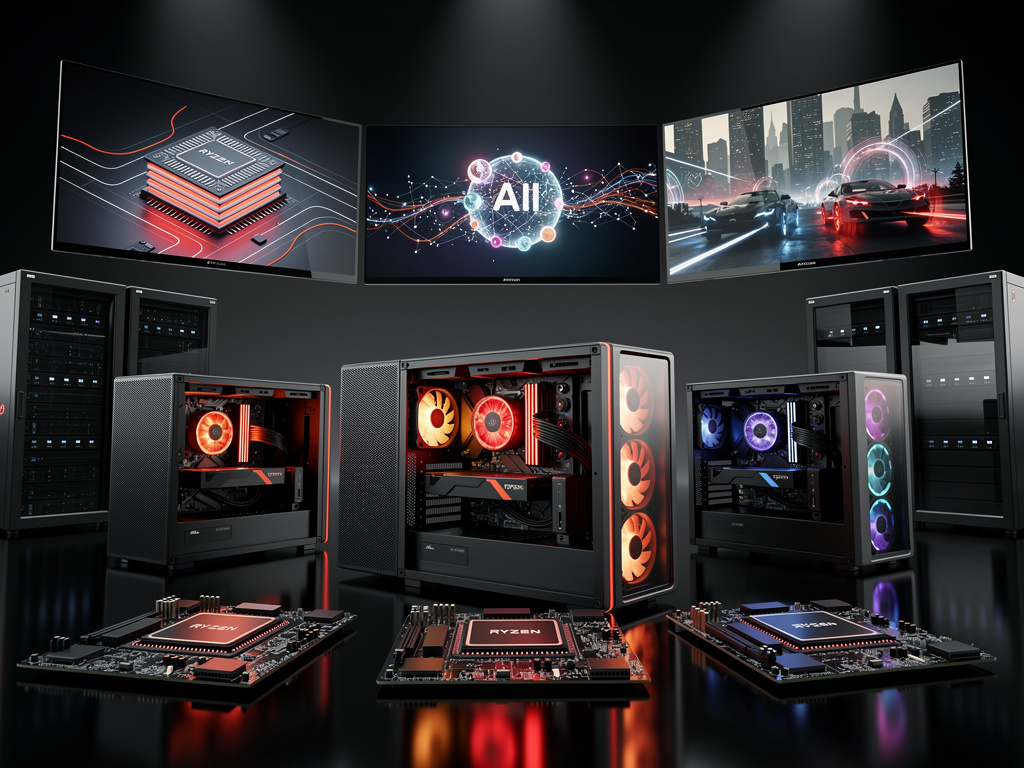
AMD’s Cautious Gambit at CES 2026: Refining AI and Gaming Without the Fireworks
As the tech world gears up for the Consumer Electronics Show in Las Vegas next month, Advanced Micro Devices Inc. is positioning itself for a measured yet potentially impactful presence. Unlike the splashy reveals of past years, AMD’s approach this time appears focused on incremental advancements in artificial intelligence and computing hardware, aiming to solidify its foothold in key markets without overpromising on revolutionary leaps. Dr. Lisa Su, the company’s chair and chief executive, is set to deliver the opening keynote on January 5, a slot that underscores AMD’s growing influence in the sector. Her address is expected to outline the firm’s vision for AI integration across various domains, from data centers to everyday consumer devices.
This strategy comes at a pivotal moment for AMD, which has been navigating intense competition from rivals like Nvidia Corp. and Intel Corp. In recent quarters, AMD has made strides in the AI chip market, but it faces pressure to demonstrate sustained momentum. Sources familiar with the company’s plans suggest that while no groundbreaking new architectures like a next-generation GPU or a surprise Zen 6 processor are on the docket, AMD will highlight updates that could resonate with enterprise users and gamers alike. For instance, the firm is likely to emphasize enhancements to its Ryzen lineup, building on the success of its 3D V-Cache technology that has captured a significant share of the high-performance CPU market.
The keynote’s timing, at 6:30 p.m. PT in the Palazzo Ballroom at The Venetian, aligns with CES’s evolution into a premier venue for computing announcements. AMD’s participation includes not just the speech but also an extensive demo area running from January 6 to 9, showcasing AI-enabled PCs, gaming hardware, and edge computing solutions. This setup allows attendees to interact with the technology, potentially driving partnerships and sales in the coming year.
Spotlight on Ryzen Refresh and AI Integration
One of the most anticipated elements is the probable unveiling of the Ryzen 7 9850X3D processor, an update to AMD’s popular gaming CPU series. According to leaks and confirmations from AMD’s own driver pages, this chip promises improved performance through enhanced 3D V-Cache, which stacks additional memory directly on the processor die to reduce latency in demanding applications like video games. Industry observers note that this could extend AMD’s dominance in the gaming segment, where its current Ryzen 7 7800X3D has been a bestseller. Rumors also swirl around a potential Ryzen 9 9950X3D2 variant with dual 3D V-Cache, though official confirmation remains pending.
Beyond gaming, AMD’s CES showcase is poised to delve into its broader AI strategy. Dr. Su’s talk is expected to cover advancements in cloud and enterprise AI, including updates to the Instinct lineup of accelerators. Recent announcements, such as the Instinct MI350 series highlighted at AMD’s Advancing AI 2025 event, indicate a push toward more efficient AI processing. This ties into collaborations with major PC makers like Dell Technologies Inc., Asus, and Lenovo Group Ltd., which are set to integrate AMD’s Ryzen AI series into next-generation laptops and desktops. These partnerships aim to bring AI capabilities to mainstream users, from enhanced video editing to real-time language translation.
On the software front, AMD is rolling out updates like FSR Redstone, its frame generation technology now supporting over 200 games and promising up to three times the performance boost on Radeon RX 9000 GPUs. This move addresses criticisms of AMD’s lag in AI-driven upscaling compared to Nvidia’s DLSS, potentially narrowing the gap in the competitive graphics market.
Navigating Competitive Pressures and Market Expectations
AMD’s restrained approach at CES 2026 contrasts with the bolder moves from competitors. Intel, for example, has teased its Panther Lake CPUs, while Nvidia is rumored to discuss its RTX 50 series. Yet, AMD’s focus on reliability over hype could pay dividends, especially amid supply chain constraints and economic uncertainties. Posts on X (formerly Twitter) from tech enthusiasts and analysts reflect a mix of excitement and skepticism, with some speculating on unconfirmed products like a “Strix Halo” APU or even early Zen 6 details, though these remain in the realm of rumor.
Drawing from recent coverage, Digital Trends highlights how AMD might “play safe” but still warrant attention through targeted launches. The article points to the Ryzen 9000G desktop APUs, featuring Zen 5 architecture and RDNA 3.5 graphics, as likely reveals that could appeal to budget-conscious builders seeking integrated solutions for the AM5 socket.
Moreover, AMD’s emphasis on edge AI—processing data closer to the source rather than in distant clouds—positions it well for emerging applications in autonomous vehicles and smart manufacturing. This aligns with broader industry trends toward decentralized computing, where efficiency and low latency are paramount.
Enterprise Ambitions and Supercomputing Prowess
Shifting to the enterprise side, AMD is leveraging CES to reinforce its data center credentials. The company’s EPYC processors have gained traction in servers, and updates at the show could include new configurations optimized for AI workloads. A notable example is AMD’s role in powering the High-Performance Computing Center Stuttgart’s “Herder” supercomputer, which will incorporate over 1,400 next-generation accelerators. This project underscores AMD’s capability in high-stakes environments, competing directly with Nvidia’s dominance in AI training.
Insights from VideoCardz.com suggest that AMD’s demo area will feature hands-on experiences with these technologies, including software ecosystems that integrate AI across hardware stacks. Such demonstrations could attract IT decision-makers looking for scalable solutions amid rising energy costs for data centers.
Additionally, partnerships announced at CES might extend to robotics and wearables, areas where AI chips like AMD’s Ryzen AI Max series could enable more intelligent devices. For instance, collaborations with Lenovo for business PCs indicate a push into professional markets, where reliability trumps raw power.
Gaming Hardware Evolutions and Software Synergies
In the consumer gaming realm, AMD’s CES plans include showcasing refreshed Radeon GPUs, though a full RDNA 4 generation launch seems unlikely until later in 2026. Instead, expect refinements to existing lines, such as the RX 9000 series, with improved ray tracing and AI-enhanced features. The aforementioned FSR Redstone update, detailed in Wccftech, represents a significant step, offering frame generation in over 40 titles and broad compatibility that could sway gamers away from Nvidia’s ecosystem.
X posts from users like tech investors and hardware enthusiasts amplify the buzz, with discussions around potential “Halo X3D” APUs that combine CPU and GPU prowess for laptops. While speculative, these align with AMD’s roadmap for 2026, which includes up to 24-core Ryzen 10000 series for desktops and 96-core Threadripper variants for workstations.
This integrated approach—melding hardware with software like AMD’s AI toolkit—aims to create a cohesive ecosystem, much like Apple’s walled garden but open to broader adoption.
Broader Implications for AI Adoption
Looking ahead, AMD’s CES narrative will likely tie into global AI proliferation. Dr. Su has emphasized how computing advancements accelerate progress in fields like healthcare and transportation. For example, edge AI solutions could enhance real-time diagnostics in medical devices or optimize traffic systems.
Coverage from TechTimes notes that AMD’s keynote fits into a lineup including Samsung and Intel, signaling a collective industry focus on AI chips and robotics. This convergence highlights AMD’s role in democratizing AI, making it accessible beyond tech giants.
Furthermore, AMD’s strategy mitigates risks from supply chain disruptions, such as those affecting TSMC’s advanced nodes. By focusing on mature technologies like 4nm processes for refreshes, the company avoids the pitfalls of aggressive scaling.
Strategic Positioning Amid Uncertainties
AMD’s CES 2026 playbook also reflects lessons from past events. After a three-year hiatus from keynoting, Dr. Su’s return, as announced by the Consumer Technology Association, positions her as a thought leader in AI’s transformative potential.
Reddit threads on communities like r/Amd_Intel_Nvidia echo this sentiment, with users debating the merits of AMD’s “bold plans” for next-gen Ryzen. While some express disappointment over the lack of flagship GPU reveals, others praise the focus on practical innovations.
In enterprise terms, AMD’s push into supercomputing, as seen in the Herder project, could lead to more government and research contracts, bolstering revenue streams.
Future Roadmaps and Investor Sentiment
Peering into 2026, AMD’s rumored products—like Zen 6 on 3nm nodes and UDNA GPUs—suggest a robust pipeline, even if CES serves as a teaser rather than a full reveal. X discussions from analysts predict a $5 trillion market opportunity, driven by AI demand.
Engadget previews CES as a hub for AI breakthroughs, with AMD’s contributions potentially including brighter screens and robotics integrations via partners like Asus, which has confirmed new ROG motherboards and laptops.
This ecosystem-building approach could insulate AMD from market volatility, appealing to investors seeking steady growth.
Balancing Innovation with Pragmatism
Ultimately, AMD’s CES 2026 strategy embodies a balance between ambition and caution. By prioritizing refinements over revolutions, the company aims to build trust and expand market share. Dr. Su’s keynote may not feature fireworks, but it could lay groundwork for sustained dominance in AI and computing.
As partners like Lenovo and Dell roll out AMD-powered devices, the real test will come post-show, in adoption rates and performance benchmarks. For industry insiders, this event signals AMD’s maturation into a versatile player, ready to tackle diverse challenges in an ever-evolving tech arena.
With inputs from various sources, including posts on X reflecting community speculation, AMD’s path forward appears calculated to capitalize on current strengths while eyeing future horizons.


 WebProNews is an iEntry Publication