
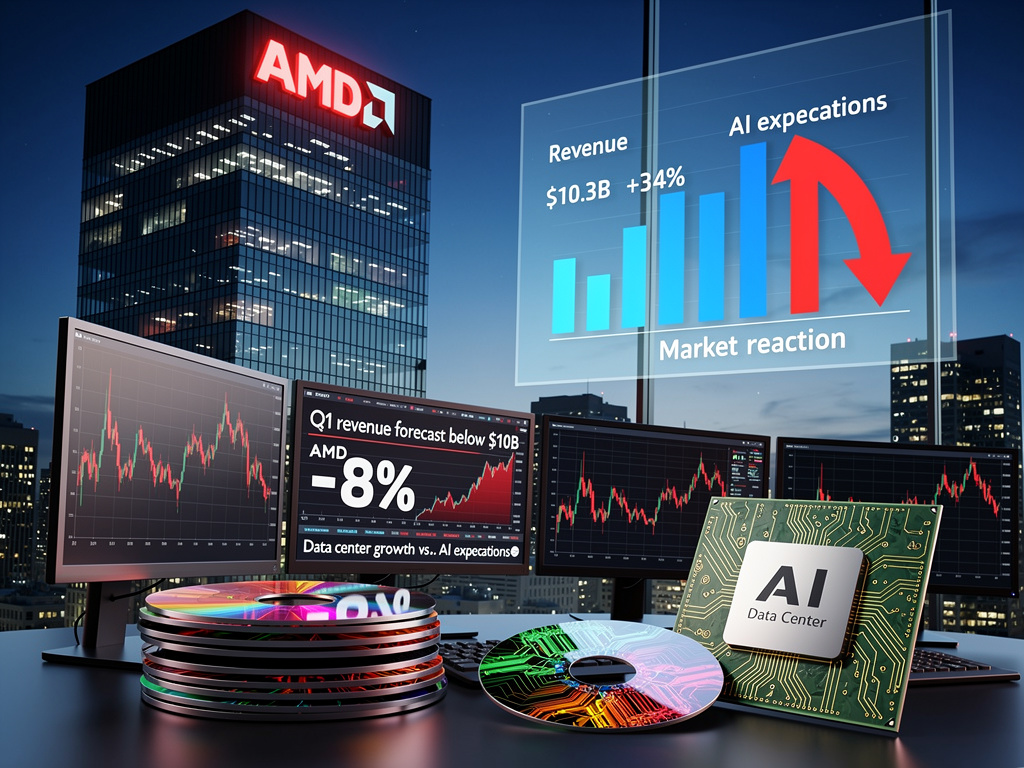
Advanced Micro Devices delivered what many companies would consider stellar fourth-quarter results—revenue surging 34% year-over-year to $10.3 billion, with its critical Data Center segment jumping 39% to $5.4 billion. Yet within hours of the announcement, the semiconductor giant’s stock plummeted more than 8% in after-hours trading, underscoring a harsh reality facing chipmakers in the artificial intelligence era: exceptional growth no longer guarantees investor satisfaction when expectations have reached stratospheric heights.
The market’s negative reaction centered squarely on AMD’s first-quarter revenue forecast of $9.8 billion, falling short of the $10 billion threshold that analysts had anticipated. According to Bloomberg, this guidance disappointed investors who have been seeking a bigger payoff from the company’s aggressive push into AI accelerators and data center processors. The disconnect between AMD’s actual performance and market expectations reveals the intense pressure facing semiconductor companies to not merely participate in the AI revolution, but to dominate it.
Data Center Dominance Fails to Satisfy Market Appetite
AMD’s Data Center segment, which CEO Lisa Su has positioned as the company’s primary growth engine, demonstrated remarkable momentum throughout 2025. The division’s $5.4 billion in fourth-quarter revenue represented its strongest performance to date, driven by robust demand for both EPYC server processors and Instinct AI accelerators. According to the company’s official earnings release, AMD shipped more than $3.5 billion worth of data center GPU products throughout the year, marking a significant milestone in its competition with NVIDIA’s dominant position in AI training and inference.
The company’s full-year 2025 results painted an equally impressive picture, with total revenue reaching $38.8 billion, up 31% from the previous year. Operating income more than doubled to $5.3 billion, while diluted earnings per share climbed 89% to $2.53. These figures would typically trigger celebrations in most corporate boardrooms, yet they proved insufficient to maintain investor confidence in an environment where AI-related semiconductor stocks have been priced for perfection.
The NVIDIA Shadow Looms Large
AMD’s challenge extends beyond its own execution—the company operates perpetually in the shadow of NVIDIA, whose dominance in AI accelerators has made it one of the world’s most valuable companies. While AMD has made significant inroads with its Instinct MI300 series, capturing design wins at major cloud providers and enterprises, the competitive gap remains substantial. Industry observers note that AMD’s AI accelerator revenue, while growing rapidly, still represents a fraction of NVIDIA’s corresponding business.
CNBC reported that investors had been hoping for guidance suggesting AMD could sustain double-digit billion-dollar quarterly revenues throughout 2026, a benchmark that would signal the company’s arrival as a true AI powerhouse. The $9.8 billion first-quarter forecast, while still representing healthy growth, suggested a potential plateau that concerned growth-focused investors. This reaction highlights how quickly market sentiment can shift when companies fail to exceed increasingly aggressive expectations.
Client and Gaming Segments Show Mixed Signals
Beyond the data center, AMD’s other business segments presented a more nuanced picture. The Client segment, encompassing processors for personal computers and laptops, benefited from the ongoing refresh cycle driven by AI-enhanced PCs and the transition to new Ryzen architectures. However, the Gaming segment faced headwinds as console demand moderated following years of pandemic-driven growth and supply chain normalization.
According to Morningstar, data center demand still looks quite strong despite the market’s negative reaction, with analysts noting that AMD’s diversified product portfolio positions it well for sustained growth across multiple end markets. The research firm emphasized that AMD’s ability to gain share in both CPU and GPU markets simultaneously represents a significant competitive advantage, even if the pace of that share gain hasn’t accelerated as rapidly as some investors hoped.
Social Media Sentiment Reflects Investor Frustration
The immediate aftermath of AMD’s earnings release sparked intense discussion across financial social media platforms. Ryan Shrout, a technology analyst, noted on X that while the results were objectively strong, the market had priced in perfection, leaving little room for anything less than extraordinary guidance. This sentiment was echoed by numerous market observers who pointed out the disconnect between fundamental performance and stock price reaction.
Another market commentator, posting as @stocksavvyshay, highlighted on X that AMD’s valuation had expanded significantly over the past year based on AI expectations, making the stock vulnerable to any perceived slowdown in momentum. The rapid sell-off demonstrated how quickly sentiment can reverse when growth stocks fail to meet elevated expectations, regardless of their absolute performance levels.
Competitive Dynamics Intensify Across Multiple Fronts
AMD faces intensifying competition not only from NVIDIA in AI accelerators but also from Intel in traditional server processors and emerging custom silicon from cloud providers. Amazon, Google, and Microsoft have all invested heavily in developing proprietary chips for specific workloads, potentially reducing their reliance on merchant silicon providers like AMD. This trend toward vertical integration among hyperscalers represents a long-term strategic challenge that could limit AMD’s addressable market in its most important segment.
The company’s response has been to emphasize the breadth of its product portfolio and its ability to provide optimized solutions across diverse workloads. AMD has invested billions in research and development to maintain competitive products across CPUs, GPUs, and adaptive computing solutions. However, maintaining this multi-front competitive position requires sustained investment and flawless execution, raising questions about whether AMD can continue delivering the growth rates that have characterized its recent performance.
Manufacturing Strategy and Supply Chain Considerations
Unlike Intel, which manufactures many of its own chips, AMD relies on Taiwan Semiconductor Manufacturing Company (TSMC) for production of its most advanced processors. This fabless model has generally served AMD well, providing access to leading-edge manufacturing technology without the capital intensity of operating fabs. However, it also creates dependencies and potential supply constraints, particularly as TSMC juggles capacity allocation among multiple major customers including Apple, NVIDIA, and Qualcomm.
AMD has secured significant wafer capacity at TSMC for its current and next-generation products, but the company’s ability to scale production to meet potential demand surges remains a point of investor concern. The semiconductor industry’s cyclical nature, combined with geopolitical tensions surrounding Taiwan, adds layers of risk that investors must consider when evaluating AMD’s long-term prospects. These factors contribute to the volatility observed in the stock’s reaction to quarterly results.
Looking Ahead: The Path to Sustained Leadership
Despite the market’s negative immediate reaction, AMD’s fundamental position in the semiconductor industry remains strong. The company has successfully transformed itself from a perennial underdog to a formidable competitor across multiple chip categories. Its data center business continues growing at rates that would be the envy of most technology companies, and its product roadmap includes several potentially significant launches throughout 2026.
The key question facing AMD is whether it can accelerate its AI accelerator business sufficiently to satisfy investors who have priced in aggressive market share gains from NVIDIA. The company’s MI300 series has gained traction, but converting design wins into sustained revenue streams requires time and continued execution. AMD must also navigate the challenge of maintaining its momentum in traditional server CPUs while simultaneously investing heavily in the AI accelerator market where margins and growth potential appear more attractive.
The fourth-quarter earnings report and subsequent market reaction encapsulate the challenges facing successful growth companies in highly competitive markets. AMD delivered results that objectively demonstrated strong execution and market position gains, yet found itself punished by investors who had expected even more. This dynamic reflects broader trends in technology investing, where companies must not only perform well but exceed increasingly ambitious expectations to maintain investor support. For AMD, the path forward requires balancing near-term execution with long-term strategic positioning, all while competing against well-funded rivals in markets characterized by rapid technological change and evolving customer requirements.
As the dust settles from this earnings announcement, AMD faces the task of proving that its current growth trajectory can accelerate rather than moderate. The company’s success in this endeavor will likely determine whether the stock’s post-earnings decline represents a buying opportunity or a justified repricing of expectations. What remains clear is that in the high-stakes world of AI-focused semiconductor investing, strong performance alone no longer guarantees market approval—companies must consistently exceed expectations while demonstrating a clear path to market leadership.


 WebProNews is an iEntry Publication