
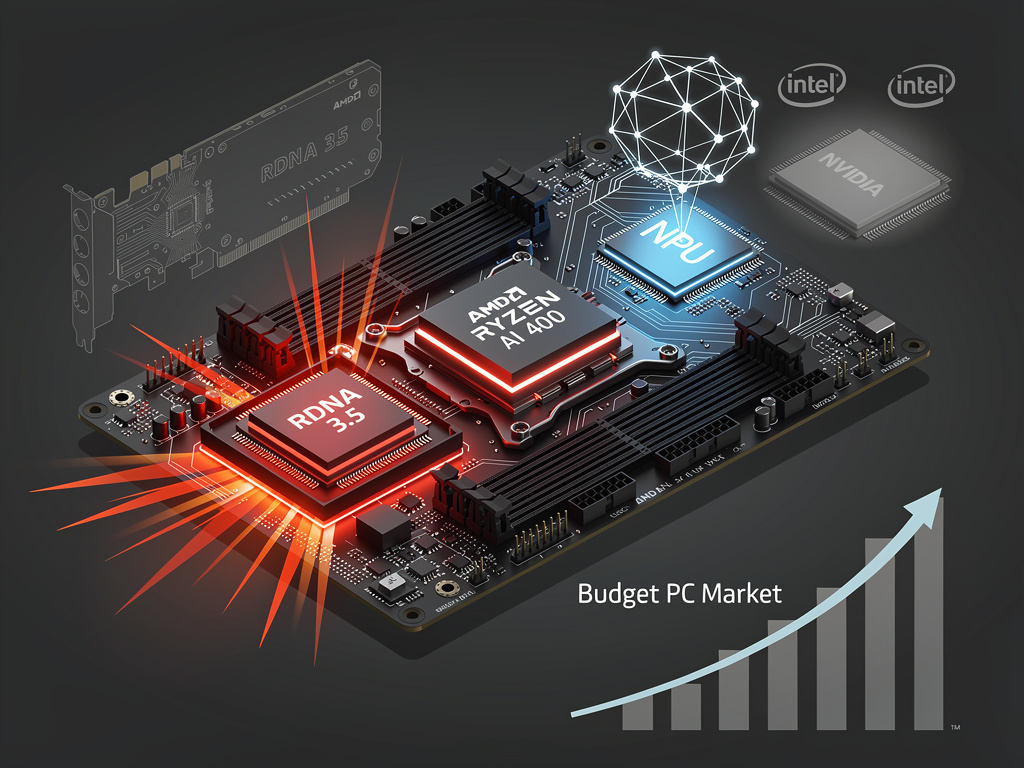
Advanced Micro Devices (AMD) is poised to fundamentally alter the economics of the desktop PC market by bringing its high-performance mobile architecture to the Socket AM5 platform. According to a report by Ars Technica, the semiconductor giant is preparing to launch the "Ryzen AI 400" series for desktop computers. This strategic move introduces the company’s most advanced integrated graphics and Neural Processing Unit (NPU) technology to a segment traditionally dominated by power-hungry discrete graphics cards and processor-only units.
The transition marks a significant departure from AMD’s previous desktop strategy, which largely kept its high-performance "APU" (Accelerated Processing Unit) line a generation behind its flagship CPUs. The Ryzen AI 400 series, anticipated to arrive in 2026, appears to unify the company’s architecture strategies, offering desktop users the same efficiency and graphical throughput previously reserved for premium laptops. This development challenges the long-standing necessity of entry-level graphics cards for general-purpose computing and light gaming.
Integration of RDNA 3.5 Graphics Architecture Threatens the Sub-$200 Discrete GPU Market
The core value proposition of the Ryzen AI 400 series lies in its graphical capabilities. As detailed in the Ars Technica report, these chips will feature the RDNA 3.5 graphics architecture. This is an optimization of the current RDNA 3 engine found in the Radeon RX 7000 series, specifically tuned for performance-per-watt efficiency. For desktop users, this translates to onboard graphics capable of handling 1080p gaming at acceptable frame rates without requiring a dedicated add-in card.
Industry observers note that this performance tier has historically been the domain of Nvidia’s GTX and RTX xx50 series, as well as AMD’s own lower-end Radeon cards. By integrating this level of performance directly into the central processor, AMD effectively raises the floor for what a "basic" computer can do. A recent analysis by Tom’s Hardware regarding the preceding mobile architecture suggests that RDNA 3.5 can outperform popular entry-level discrete GPUs in specific workloads, rendering the budget graphics card market obsolete for a large swath of consumers.
This integration also simplifies the supply chain for system integrators. OEMs such as HP, Dell, and Lenovo can manufacture capable multimedia desktops with fewer components, reducing failure points and assembly costs. For the consumer, it means a smaller physical footprint and lower energy bills, as the integrated solution consumes significantly less power than a CPU paired with a discrete GPU.
The Strategic Pivot Toward Localized AI Workloads on Desktop Platforms
Beyond graphics, the inclusion of a powerful NPU is the second pillar of AMD’s strategy. The "Ryzen AI" branding explicitly highlights the onboard XDNA 2 neural engine. While cloud-based Artificial Intelligence powers tools like ChatGPT, Microsoft and other software vendors are aggressively pushing for local AI processing to reduce latency and enhance privacy. The Ryzen AI 400 series is designed to meet and exceed the requirements for Microsoft’s Copilot+ PC initiative on the desktop side.
Currently, desktop users who wish to run local Large Language Models (LLMs) or generative image workflows must rely on expensive discrete graphics cards with ample VRAM. The Ryzen AI 400 series aims to democratize this capability. As reported by The Verge during the initial rollout of the architecture’s mobile counterparts, AMD’s XDNA 2 architecture boasts up to 50 TOPS (trillion operations per second) of AI performance. Bringing this throughput to the AM5 desktop socket allows developers to target a unified hardware standard for AI applications across both mobile and desktop form factors.
This hardware standardization is critical for software adoption. If millions of desktop PCs suddenly possess capable NPUs, software developers are more likely to optimize their applications for local inference. This creates a virtuous cycle where hardware availability drives software innovation, further cementing AMD’s position in the client computing sector against Intel, which is also ramping up its NPU integration with its Core Ultra desktop processors.
Technical Specifications and the Shift in Manufacturing Priorities
The underlying technology of the Ryzen AI 400 series utilizes a monolithic or advanced packaging design different from the chiplet-based approach of the high-end Ryzen 9000 series. By placing the CPU cores, GPU cores, and NPU on a single die (or tightly coupled tiles), AMD reduces latency between these components. This design choice is instrumental in achieving the memory bandwidth efficiency required for RDNA 3.5 graphics to perform adequately using system RAM.
According to technical specifications discussed in AnandTech, the memory controller on these APUs is likely optimized for high-speed DDR5 memory, which acts as the video memory for the integrated graphics. The performance of the Ryzen AI 400 series will heavily depend on the speed of the system memory installed by the user. This dependency creates a new dynamic in the DIY market, where builders might prioritize faster RAM over entry-level video cards to unlock the chip’s full potential.
Furthermore, the move to bring these chips to Socket AM5 ensures longevity for the platform. AMD has promised support for the AM5 socket through "2027+", and the introduction of the Ryzen AI 400 series fulfills the promise of a diverse processor portfolio compatible with a single motherboard standard. Users with existing B650 or X670 motherboards will likely only need a BIOS update to install these new processors, offering a straightforward upgrade path for older systems needing a graphics or AI boost.
Competitive Pressure on Intel and the Changing Desktop Market Dynamics
AMD’s aggressive push into high-performance APUs places substantial pressure on Intel. While Intel has integrated graphics in almost all its desktop chips, they have historically served as display adapters rather than gaming engines. Intel’s upcoming Arrow Lake and Panther Lake architectures promise improvements, but AMD’s RDNA architecture currently holds a performance-per-watt advantage in integrated scenarios.
The Ars Technica article highlights that AMD is not merely competing on raw CPU speed but on platform versatility. By offering a "good enough" gaming and AI solution in a single package, AMD targets the high-volume mid-range market where price sensitivity is acute. This is particularly relevant for internet cafes, corporate offices, and budget-conscious gamers in emerging markets where the cost of a discrete GPU is prohibitive.
Moreover, this strategy insulates AMD somewhat from the volatility of the discrete GPU market, which is often swayed by cryptocurrency mining booms or supply chain shortages. An integrated solution ensures that if a CPU is available, the graphics capability is also available. This reliability is attractive to corporate IT departments looking to deploy thousands of capable workstations without managing separate GPU inventory.
Future Implications for the Socket AM5 Platform and PC Gaming
Looking ahead, the release of the Ryzen AI 400 series on AM5 signals a broader trend where the distinction between "CPU" and "GPU" continues to erode. As manufacturing processes shrink and packaging technologies like TSMC’s CoWoS (Chip-on-Wafer-on-Substrate) become more accessible, we can expect future iterations to rival mid-range discrete graphics cards (such as the RTX 4060 class) directly on the processor package.
This evolution poses existential questions for the discrete graphics card market. If an APU can handle 1080p and even 1440p gaming with the help of upscaling technologies like FSR (FidelityFX Super Resolution), the market for discrete cards may eventually shrink to only serve high-end enthusiasts and professional workstations. AMD’s Ryzen AI 400 is not just a new product; it is a preview of a future where the motherboard is less cluttered, power supplies are smaller, and the computer is more integrated than ever before.


 WebProNews is an iEntry Publication