
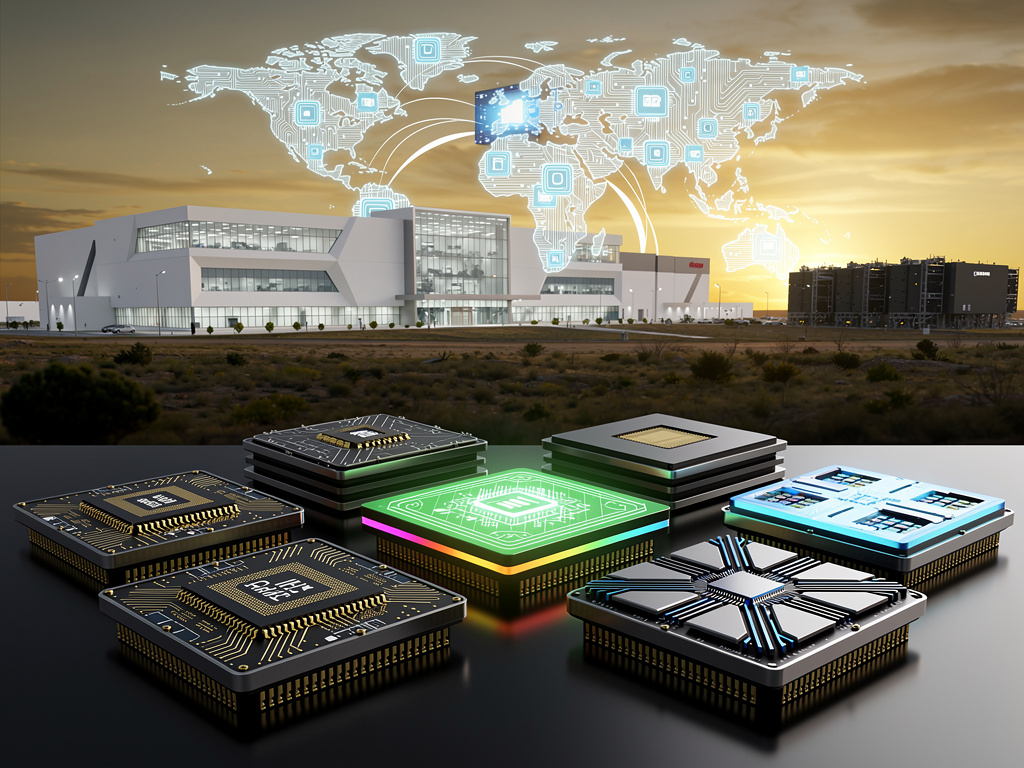
In the high-stakes world of semiconductor manufacturing, a new alliance is emerging that could reshape the production of artificial intelligence hardware. Advanced Micro Devices Inc. and Alphabet Inc.’s Google are in advanced discussions with Samsung Electronics Co. to produce cutting-edge AI chips at the South Korean giant’s facility in Taylor, Texas. This move comes amid escalating global demand for advanced processors capable of powering the next wave of AI applications, from data centers to autonomous systems. Sources indicate that the talks focus on utilizing Samsung’s planned 2-nanometer process technology, a node that promises significant leaps in efficiency and performance over current standards.
The Taylor fab, part of Samsung’s ambitious expansion in the U.S., represents a strategic pivot for the company as it seeks to challenge Taiwan Semiconductor Manufacturing Co.’s dominance in the foundry business. Samsung has already committed billions to the site, bolstered by U.S. government incentives under the CHIPS and Science Act. Recent reports highlight how this facility could become a hub for North American tech firms wary of geopolitical risks associated with overseas production. For AMD and Google, partnering with Samsung in Texas offers a way to diversify supply chains while tapping into domestic manufacturing capabilities.
Details from industry insiders suggest that the negotiations involve not just chip fabrication but also collaborative R&D on AI-specific architectures. Google’s Tensor Processing Units (TPUs), which are custom-designed for machine learning tasks, could be among the first products manufactured here. Similarly, AMD’s Instinct accelerators, already pivotal in AI training and inference, might benefit from Samsung’s advanced nodes to compete more aggressively with Nvidia Corp.’s offerings.
Shifting Alliances in Chip Production
This potential deal arrives at a time when TSMC, the world’s leading contract chipmaker, has imposed restrictions on exporting its most advanced technologies outside Taiwan. Known informally as the “N-2” rule, this policy limits the deployment of 2nm and finer processes to non-Taiwanese facilities, prompting clients like AMD and Google to explore alternatives. According to a report from TipRanks, both companies are actively evaluating Samsung’s Texas operations to circumvent these constraints and ensure timely access to next-gen silicon.
Samsung’s Taylor plant, set to begin mass production of 2nm chips as early as 2026, is equipped with state-of-the-art tools that some experts claim surpass those in TSMC’s U.S. facilities. Elon Musk, CEO of Tesla Inc. and xAI, has publicly praised the site’s capabilities on social media platform X, noting its edge in 3nm-era equipment, though he clarified it might not directly impact Tesla’s own AI chip needs. Posts on X from users like Jukan, a noted tech analyst, echo this sentiment, suggesting Samsung is positioning itself as a viable partner for U.S.-based Big Tech amid Taiwan’s export hesitations.
The economic implications for Texas are substantial. Samsung’s initial $17 billion investment in the Taylor fab, announced in 2021, has already created thousands of jobs, with further expansions backed by up to $6.4 billion in federal funding. Texas Governor Greg Abbott has touted the state as the top destination for semiconductor investments, highlighting partnerships that bring high-tech manufacturing to American soil. This influx not only bolsters local economies but also aligns with national security goals to reduce reliance on Asian supply chains vulnerable to disruptions.
Geopolitical Pressures and Supply Chain Diversification
Beyond economics, the AMD-Google-Samsung talks underscore broader geopolitical tensions in the tech sector. U.S. restrictions on exporting advanced chipmaking equipment to China have accelerated the push for “friendshoring,” where production is shifted to allied nations or domestically. Samsung, as a South Korean firm with significant U.S. operations, fits this model perfectly. A piece from SamMobile details how Google might entrust Samsung with fabricating its most powerful TPUs, potentially shaking up the AI hardware hierarchy by providing an alternative to TSMC’s stranglehold.
Industry observers point out that Samsung’s foundry business has faced challenges in recent years, with profitability lagging behind rivals. A report from CNN Business in July 2025 noted a tumble in Samsung’s profits as it struggled to catch up in the AI chip race, dominated by TSMC’s contracts with major players like Apple Inc. and Nvidia. However, securing orders from AMD and Google could mark a turnaround, especially as demand for AI chips surges. Estimates from market analysts project the global AI semiconductor market to exceed $100 billion by 2030, driven by applications in cloud computing and edge devices.
For Google, this partnership aligns with its aggressive AI strategy. The company has invested heavily in custom silicon to optimize its vast data centers, where TPUs handle everything from search algorithms to generative AI models like Gemini. By manufacturing in Texas, Google could reduce latency in supply chains and comply with U.S. data sovereignty requirements. AMD, meanwhile, is leveraging its Radeon and Instinct lines to capture more of the AI accelerator market, where partnerships with foundries like Samsung could enable faster iterations on designs tailored for high-performance computing.
Technological Edge and Manufacturing Challenges
Delving deeper into the technology, Samsung’s 2nm process is expected to employ gate-all-around (GAA) transistors, a step beyond the FinFET architecture used in current 3nm and 5nm nodes. This innovation promises up to 25% better power efficiency, crucial for AI chips that consume enormous energy in data centers. According to insights from Tom’s Hardware, while Musk’s comments highlighted Samsung’s tool advantages, the real test will be yield rates and scalability for complex AI designs.
Challenges remain, however. Samsung has historically trailed TSMC in yield optimization for advanced nodes, leading to higher defect rates and costs. Posts on X from users like Intel Pro Max Ultra express skepticism, arguing that Samsung’s relationships with clients often hinge on reciprocal business, such as purchasing components, which may not fully materialize with AMD and Google. Nonetheless, positive consultations reported by Sammy Fans indicate progress, with potential deals focusing on inferencing chips optimized for real-time AI tasks.
The Taylor fab’s location also offers logistical benefits, situated near major tech hubs and supported by Texas’ robust infrastructure. Samsung’s prior deals, such as a multiyear agreement with Tesla for AI semiconductors worth $16.5 billion, demonstrate its growing prowess in the U.S. market. X posts from figures like Chamath Palihapitiya emphasize Tesla’s role in bridging physical and software AI, a model that AMD and Google might emulate through Samsung’s facilities.
Market Implications and Future Prospects
As these discussions advance, the ripple effects could extend to competitors. Nvidia, which relies heavily on TSMC, might face increased pressure if Samsung’s Texas output proves competitive in price and performance. A report from SmBom projects Samsung securing 2nm orders amid rising global demand, potentially elevating its foundry market share from the current low teens to over 20% by the end of the decade.
For AMD, this partnership could accelerate its roadmap for AI products, including next-gen GPUs that integrate seamlessly with Samsung’s high-bandwidth memory (HBM). Google, with its cloud dominance, stands to gain by offering more efficient AI services to enterprise clients. Industry sentiment on X, including from Ally, highlights the longstanding AMD-Samsung collaboration in areas like mobile graphics and 5G, suggesting this AI chip deal is a natural evolution.
Broader industry trends point to a consolidation of U.S.-centric manufacturing. With federal subsidies flowing to projects like Samsung’s, the Taylor fab could become a cornerstone for AI innovation. Reports from Dataconomy attribute the shift to Taiwan’s export laws, driving companies toward Samsung as a reliable alternative.
Strategic Investments and Long-Term Vision
Samsung’s Texas expansion isn’t isolated; it’s part of a $40 billion commitment announced in meetings with Texas officials. Governor Abbott’s office has celebrated these investments, which include research clusters fostering innovation in semiconductors. X posts from the Texas Tribune recall the Biden administration’s $6.4 billion funding agreement, underscoring bipartisan support for domestic chip production.
Looking ahead, success in these talks could position Samsung as a key player in the AI ecosystem, attracting more clients disillusioned with TSMC’s policies. A piece from TrendForce suggests TSMC’s decisions are inadvertently steering clients like AMD and Google toward Samsung, potentially reshaping alliances in the sector.
For industry insiders, this development signals a maturing U.S. semiconductor presence, where collaborations like this could mitigate risks from global trade frictions. As AI demands evolve, the Taylor fab’s role in producing efficient, powerful chips will be pivotal, ensuring that American firms maintain a competitive edge in a rapidly advancing field.
Evolving Partnerships and Innovation Horizons
The ongoing negotiations also highlight Samsung’s efforts to innovate beyond traditional foundry services. Collaborations with AMD on substrates and memory supply, as noted in X discussions, could extend to joint development of AI-optimized architectures. Google’s trust in Samsung for TPU manufacturing, per reports, might lead to breakthroughs in inferencing efficiency, reducing energy footprints in large-scale deployments.
Critics, however, warn of potential hurdles, including intellectual property concerns and integration challenges with existing ecosystems. Yet, the momentum is building, with Samsung’s profit recovery tied to these high-profile wins. As one X post from Profit Loader succinctly put it, this taps into the core of AI chip evolution.
Ultimately, this alliance reflects a broader push toward resilient, localized production in critical technologies. With AMD and Google at the forefront, Samsung’s Texas fab could emerge as a linchpin in the quest for AI supremacy, blending innovation with strategic foresight.


 WebProNews is an iEntry Publication