
Decoding Steam’s December 2025 Snapshot: Hardware Shifts and Gamer Realities
In the ever-evolving world of PC gaming, Valve’s Steam platform continues to serve as a vital barometer for hardware trends and user behaviors. The latest monthly hardware and software survey for December 2025, released just as the year wrapped up, paints a revealing picture of the equipment powering millions of gaming sessions. Drawing from data collected anonymously from Steam users who opt in, this survey highlights subtle yet significant shifts in processor preferences, graphics card dominance, and operating system adoption. As the platform boasts over 132 million monthly active users according to insights from Coop Board Games, understanding these metrics is crucial for developers, hardware manufacturers, and investors eyeing the multibillion-dollar gaming sector.
The survey underscores a notable pivot in CPU market share, with AMD continuing its ascent against Intel. For December, AMD’s processors claimed 38.42% of the surveyed systems, marking a gain of 0.77% from the previous month. This uptick reflects broader industry dynamics, where AMD’s Ryzen series, particularly those with 3D V-Cache technology, have gained favor among gamers seeking high frame rates in demanding titles. Intel, while still holding a majority at 61.56%, saw a corresponding decline, signaling potential challenges in reclaiming ground amid competitive pricing and performance battles.
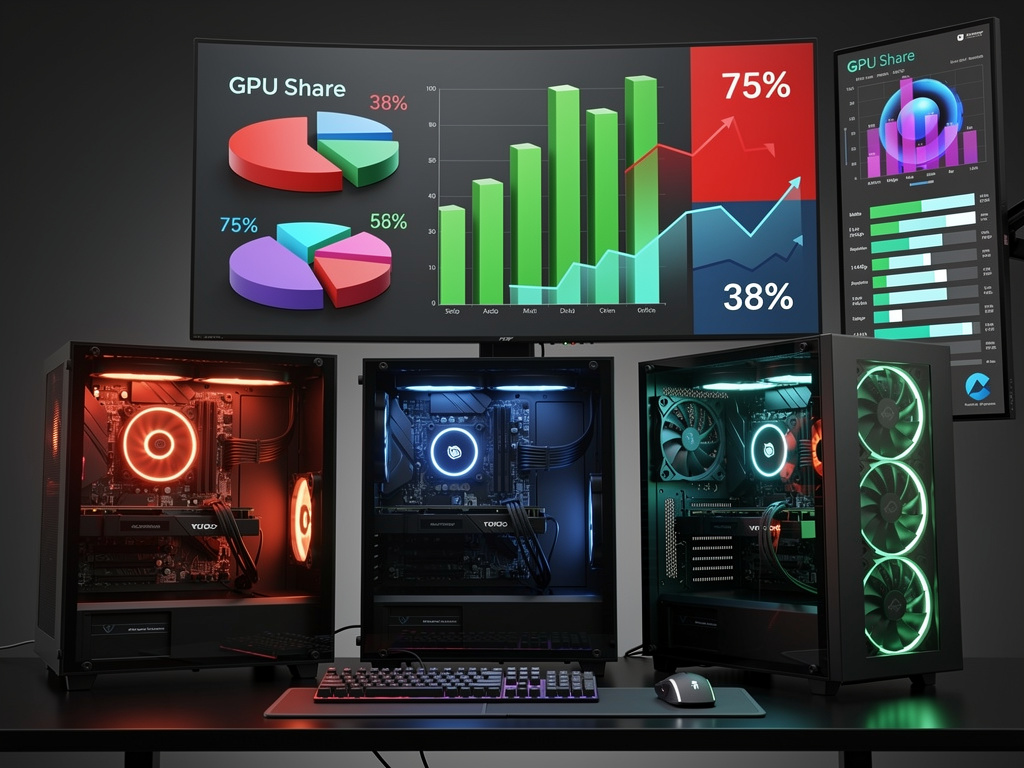
Beyond CPUs, the graphics card arena remains firmly under Nvidia’s grip, with the green team commanding 75.76% of the market. AMD trails at 14.92%, and Intel’s integrated graphics hold a modest 8.96%. This distribution isn’t surprising given Nvidia’s stronghold in ray tracing and AI-enhanced features like DLSS, which have become staples in modern games. However, the survey also reveals intriguing details about specific models: the RTX 3060 retains its crown as the most popular GPU at 5.88%, a testament to its value proposition during the cryptocurrency mining boom and subsequent availability in budget builds.
Rising Resolutions and Display Dynamics
Resolution preferences offer another layer of insight, showing a gradual migration toward higher-definition screens. Full HD (1920×1080) still dominates at 55.98%, but it’s down slightly from previous months, as per data cross-referenced with posts on X highlighting year-over-year changes. Quad HD (2560×1440) follows at 19.75%, indicating a growing appetite for sharper visuals without the steep hardware demands of 4K. Interestingly, ultrawide formats like 3440×1440 are inching up to 2.51%, suggesting niche adoption among productivity-focused gamers who double their setups for work.
This shift in display choices correlates with broader hardware upgrades. For instance, the prevalence of 8GB VRAM configurations at 34.91% aligns with mid-range cards like the RTX 3060 and 4060, which are well-suited for 1080p and 1440p gaming. Yet, as games push boundaries with more complex textures and effects, there’s a budding demand for higher VRAM capacities—evident in the slow but steady rise of 12GB and 16GB options. Industry observers note that this could pressure manufacturers to prioritize memory in future designs, especially as titles like those benchmarked by GameGPU demonstrate the limitations of lower-spec cards at ultra settings.
Operating system trends further illuminate user habits. Windows 11 has surged to 54.96%, overtaking Windows 10’s 41.34% with a notable monthly increase. This adoption rate, accelerated by Microsoft’s end-of-support announcements for Windows 10, suggests gamers are finally embracing the newer OS for its gaming optimizations like DirectStorage and Auto HDR. Linux, while a minor player at 1.99%, shows resilience, particularly among enthusiasts using distributions tailored for gaming, as detailed in coverage from Phoronix.
Processor Cores and Clock Speeds in Focus
Diving deeper into CPU specifics, the survey reveals a preference for hexa-core processors, which account for 30.97% of systems—a figure that underscores the sweet spot for gaming workloads balancing cost and performance. Octa-core chips follow closely, reflecting the popularity of mid-to-high-end Ryzen and Core i7 models. Clock speeds peaking between 2.3GHz and 2.69GHz at 22.23% indicate that while raw speed matters, efficiency and multi-threading capabilities are increasingly prioritized in modern game engines.
These hardware statistics don’t exist in isolation; they mirror broader market forces. For example, the Steam Deck and other handhelds contribute to AMD’s gains, as noted in X posts from hardware analysts pointing out AMD’s dominance in portable gaming devices. This portable segment, often overlooked in traditional PC surveys, is reshaping perceptions of what constitutes a “gaming rig,” with devices like the Steam Deck OLED influencing overall trends despite their lower specs compared to desktops.
Revenue and user growth metrics from 2025 reinforce the platform’s health. Steam shattered concurrent user records, hitting 41.66 million in October, as reported by Player Counter. This surge aligns with blockbuster releases and seasonal sales, driving not just playtime but also hardware upgrades as users prepare for demanding new titles.
Top Games and Play Patterns Revealed
Shifting focus to software, the survey indirectly informs on gaming trends through hardware correlations. Best-selling games of 2025, as unveiled by Valve and covered in TechRaptor, show a mix of indie hits competing with AAA behemoths, with revenue charts updated through December highlighting sustained interest in live-service games that benefit from mid-range hardware.
Interestingly, only two games from 2025 made the most-played list, according to analysis in The Gamer, underscoring the longevity of evergreen titles like Counter-Strike 2 and Dota 2. This pattern suggests gamers are sticking with familiar favorites, possibly due to economic factors or satisfaction with existing libraries, rather than chasing every new release.
Hardware preferences also tie into emerging trends like cloud gaming. X discussions emphasize that most Steam users operate on setups that don’t exceed console capabilities, with average rigs featuring RTX 3060s and 1080p displays—far from the high-end beasts touted by enthusiasts. This reality pushes developers toward optimizations that cater to the masses, potentially boosting accessibility via services like GeForce Now.
Market Share Battles and Future Implications
AMD’s CPU gains are particularly pronounced in the context of its X3D lineup, which has been praised for gaming performance. Intel’s response, or lack thereof, in addressing platform costs has led to market share erosion, as echoed in X posts from tech communities. This competition benefits consumers, fostering innovation in areas like power efficiency and integrated graphics.
On the GPU front, Nvidia’s lead is bolstered by its ecosystem, but AMD’s Radeon series is making inroads in value segments. The survey’s VRAM data points to a future where 16GB becomes the norm, especially as 4K adoption grows to 4.21%. Publications like TechSpot note that indie games’ success on Steam is leveling the playing field, allowing smaller studios to thrive without relying on cutting-edge hardware.
Looking at regional variations, while the global survey aggregates data, localized trends—such as higher Linux usage in certain areas—hint at diverse gaming ecosystems. For instance, China’s influence on Steam’s user base, with its massive player count, skews toward budget hardware, influencing overall statistics.
Insider Tactics and Development Strategies
For game developers, these insights are gold. Tactics outlined in Digiexe suggest targeting the prevalent 6-core CPUs and 8GB VRAM GPUs to maximize reach. Revenue trends show that microtransactions in free-to-play games continue to dominate, with 2025 seeing unprecedented earnings from such models.
Hardware manufacturers can leverage this data for product roadmaps. Nvidia’s RTX 50-series, like the 5070 climbing survey ranks as per recent X buzz, indicates rapid adoption of next-gen tech. Conversely, the persistence of older cards like the GTX 1060 in lower percentiles reminds us of the long tail in PC gaming upgrades.
User sentiment on X reveals a disconnect between aspirational builds and reality: while forums buzz with 4090 setups, the survey confirms mid-tier dominance. This gap informs marketing strategies, emphasizing affordability over extravagance.
Economic Factors Shaping Hardware Choices
Economic pressures play a role, with inflation and component costs influencing upgrade cycles. The survey’s stability in RAM configurations—16GB at a leading share—suggests gamers are content with current standards, delaying jumps to 32GB despite recommendations for content creation.
Portable gaming’s rise, evidenced by AMD’s portable wins, is diversifying the field. Devices like the Steam Deck, representing a significant portion of surveyed handhelds, are pulling users away from traditional desktops, as one X post quipped about the “midrange alliance” of average setups.
As we peer into 2026, these trends forecast continued fragmentation. With VR and AR on the horizon, hardware surveys like Steam’s will be pivotal in tracking adoption. Developers ignoring the mid-range risk alienating their core audience, while hardware firms must innovate to capture emerging segments.
Strategic Takeaways for Industry Players
Investors should note Steam’s revenue growth, detailed in Venue Labs, which positions Valve as a powerhouse amid console competition. Insider tactics include leveraging Steam’s data for targeted advertising and game optimization.
The survey also spotlights accessibility issues, with lower-spec dominance calling for better scaling in game design. As SQ Magazine explores, peak player counts correlate with hardware inclusivity.
Ultimately, December 2025’s data encapsulates a year of consolidation and subtle shifts, setting the stage for evolutionary changes in PC gaming’s hardware foundation.


 WebProNews is an iEntry Publication