
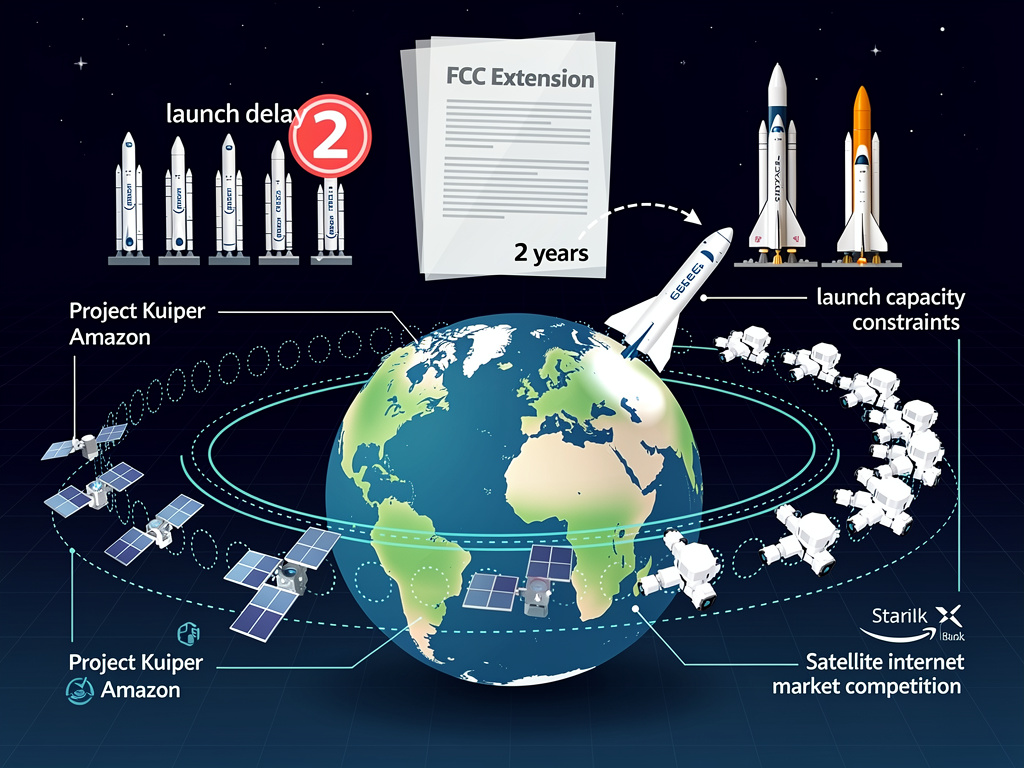
Amazon has formally requested a two-year extension from the Federal Communications Commission to deploy half of its planned 3,232-satellite constellation for Project Kuiper, its ambitious answer to SpaceX’s Starlink internet service. The Seattle-based e-commerce giant cited an industrywide shortage of launch vehicles as the primary obstacle preventing it from meeting the original July 2026 deadline, now seeking until July 30, 2028, to fulfill the regulatory requirement.
The request, filed with the FCC in late January, marks a significant setback for Amazon’s space ambitions and underscores the mounting challenges facing companies attempting to build large-scale satellite networks. According to GeekWire, Amazon acknowledged that securing sufficient launch capacity has proven far more difficult than initially anticipated, despite the company’s substantial financial resources and industry connections. The delay could have far-reaching implications for Amazon’s ability to compete in the rapidly evolving satellite internet market, where SpaceX has already established a commanding lead with more than 5,000 operational Starlink satellites.
The extension request comes at a critical juncture for the commercial space industry, which is experiencing unprecedented demand for orbital launch services. Bloomberg reported that Amazon has invested billions of dollars in Project Kuiper but faces a fundamental bottleneck in the supply chain: there simply aren’t enough rockets available to meet the company’s aggressive deployment timeline. This shortage affects not only Amazon but numerous other satellite operators, government agencies, and commercial entities competing for limited launch slots.
The Rocket Shortage Dilemma
The global launch vehicle shortage stems from multiple factors converging simultaneously. Traditional aerospace manufacturers have struggled to scale production of existing rocket systems, while newer entrants to the market face technical challenges and development delays. PCMag noted that Amazon had originally secured contracts with multiple launch providers, including United Launch Alliance, Blue Origin, and Arianespace, but production delays and technical setbacks have impacted the availability of these vehicles. The situation has become so acute that even well-funded projects with firm launch contracts are experiencing significant schedule slippage.
Ironically, Amazon has been forced to turn to its primary competitor in the satellite internet business for assistance. CNBC revealed that Amazon has purchased additional launch slots from SpaceX, the company owned by Elon Musk that operates the rival Starlink service. This arrangement highlights the paradoxical nature of the current space industry, where competitors must cooperate due to limited infrastructure, even as they battle for market share in providing global broadband internet access. SpaceX’s Falcon 9 rocket has become the workhorse of the commercial space industry, conducting more launches annually than all other providers combined.
Regulatory Requirements and Market Implications
The FCC’s deployment deadlines are not arbitrary bureaucratic requirements but serve important regulatory purposes. They ensure that companies granted valuable spectrum licenses actually use them rather than warehousing orbital slots for future use. Under current regulations, Amazon must deploy half of its authorized constellation by July 2026 and the complete network by July 2029. The company’s extension request would push the halfway milestone to July 2028, compressing the timeline for completing the full constellation to just 12 months.
According to Benzinga, industry analysts view Amazon’s request as reasonable given the documented launch capacity constraints, though some competitors may oppose the extension as giving Amazon unfair flexibility. The FCC must balance several competing interests: encouraging new entrants to promote competition in satellite internet services, ensuring efficient use of orbital resources, and recognizing legitimate operational challenges facing licensees. The Commission’s decision could set important precedents for how it handles similar requests from other satellite operators facing deployment challenges.
The Broader Space Economy Context
Amazon’s difficulties reflect broader trends in the commercialization of space, where ambitious plans frequently encounter practical constraints. The satellite internet market alone is projected to generate tens of billions of dollars in annual revenue within the next decade, attracting massive investments from both established technology companies and specialized startups. MoneyWeek has documented how the space economy has evolved from a government-dominated domain to a vibrant commercial sector, with private companies now leading innovation in launch services, satellite manufacturing, and space-based applications.
The current rocket shortage represents a temporary mismatch between supply and demand that the market is working to correct. Multiple companies are developing new launch vehicles specifically designed to meet the needs of satellite constellation operators. Blue Origin, Amazon founder Jeff Bezos’s rocket company, is developing the New Glenn heavy-lift launcher, which could eventually provide Amazon with dedicated launch capacity. However, New Glenn has experienced its own development delays, contributing to Amazon’s current predicament. Similarly, United Launch Alliance’s Vulcan rocket and Arianespace’s Ariane 6 have faced extended development timelines, leaving customers scrambling for alternatives.
Project Kuiper’s Technical Ambitions
Project Kuiper represents one of the most ambitious satellite programs ever undertaken by a commercial entity. The system is designed to provide high-speed, low-latency broadband internet access to underserved communities worldwide, leveraging Amazon’s extensive logistics expertise and global infrastructure. Tech in Asia reported that Amazon has already invested more than $10 billion in the project, including satellite manufacturing facilities, ground station networks, and customer terminal development. The company has emphasized that Project Kuiper is not merely an internet service but a strategic platform that could support Amazon’s cloud computing, logistics, and e-commerce operations.
Each Kuiper satellite incorporates advanced technologies including phased-array antennas, optical inter-satellite links, and autonomous collision avoidance systems. The satellites are manufactured at Amazon’s production facility in Kirkland, Washington, where the company has established assembly line processes designed to produce satellites at unprecedented rates once launch capacity becomes available. Amazon has stated that it can manufacture satellites faster than it can launch them, making launch vehicle availability the critical path for the program’s success.
Competitive Dynamics with Starlink
SpaceX’s Starlink service has established a substantial first-mover advantage in the satellite internet market, with more than two million subscribers across dozens of countries. The service has demonstrated the viability of low Earth orbit satellite constellations for providing broadband internet, particularly in rural and remote areas where traditional terrestrial infrastructure is economically impractical. Starlink’s success has validated the business model that Amazon hopes to replicate, but it has also raised the competitive bar significantly. By the time Amazon begins commercial service, Starlink will likely have several additional years of operational experience, customer relationships, and technical refinements.
The delay in Amazon’s deployment schedule could allow SpaceX to further consolidate its market position, potentially making it more difficult for Project Kuiper to attract customers and partners. However, Amazon’s vast resources, existing customer relationships through its e-commerce platform, and integration with Amazon Web Services could provide competitive advantages that pure-play satellite operators lack. The company has indicated that it plans to bundle Kuiper service with other Amazon offerings, potentially creating unique value propositions for both consumer and enterprise customers.
Launch Provider Diversification Strategy
Amazon’s original launch strategy involved diversifying across multiple providers to reduce dependency on any single rocket system. The company announced contracts worth billions of dollars with United Launch Alliance, Arianespace, and Blue Origin, representing what was then the largest commercial launch procurement in history. This approach was designed to provide redundancy and ensure schedule reliability, but the industrywide shortage has affected multiple providers simultaneously, undermining the diversification strategy’s effectiveness.
The addition of SpaceX launches to Amazon’s manifest, while pragmatic, creates an awkward situation where Amazon is funding its primary competitor’s launch operations. SpaceX uses revenue from commercial launch services to subsidize Starlink development and deployment, meaning Amazon’s payments indirectly support its rival’s competitive position. Nevertheless, SpaceX’s Falcon 9 rocket has proven so reliable and cost-effective that few alternatives exist for companies needing frequent, high-cadence launches. This dynamic illustrates the complex interdependencies emerging in the commercial space sector, where cooperation and competition coexist in ways rarely seen in other industries.
Manufacturing and Supply Chain Challenges
Beyond launch vehicle availability, satellite constellation operators face challenges throughout the supply chain. Critical components including radiation-hardened processors, solar arrays, and specialized communications equipment often have long lead times and limited production capacity. Amazon has attempted to vertically integrate much of its satellite production to maintain control over quality and schedule, but even with internal manufacturing, the company depends on external suppliers for numerous subsystems and components.
The semiconductor shortage that affected numerous industries in recent years has had lingering effects on satellite production, as space-qualified chips require specialized manufacturing processes and extensive testing. Additionally, the sudden surge in demand for satellite components as multiple constellation projects ramped up simultaneously has strained supplier capacity. These factors have contributed to the overall timeline pressures facing Project Kuiper, though Amazon has emphasized that launch availability remains the primary constraint on its deployment schedule.
Regulatory Precedents and FCC Decision-Making
The FCC has granted deadline extensions to satellite operators in the past, though each case is evaluated based on specific circumstances and the applicant’s demonstrated progress toward deployment goals. The Commission must consider whether granting an extension serves the public interest, whether the applicant has made good-faith efforts to meet the original deadline, and whether the extension would unfairly disadvantage other licensees or applicants. Amazon’s filing reportedly includes detailed documentation of its launch procurement efforts, manufacturing progress, and the industrywide factors contributing to launch vehicle shortages.
Other satellite operators are likely monitoring Amazon’s request closely, as the FCC’s decision could affect their own planning and potential future extension requests. If the Commission grants Amazon’s request, it may establish a precedent that launch vehicle availability constitutes a valid justification for deadline relief. Conversely, if the FCC denies the request or imposes conditions, it could signal a stricter approach to enforcement of deployment milestones, potentially affecting how companies plan and execute future satellite programs.
Future Outlook for Satellite Internet Competition
Despite the current setbacks, Amazon remains committed to Project Kuiper as a long-term strategic initiative. The company has continued hiring for the program, expanding its ground infrastructure, and developing customer terminals designed to compete with Starlink’s offerings on both performance and price. Amazon executives have emphasized that the satellite internet market is large enough to support multiple providers, particularly as demand grows for connectivity in aviation, maritime, enterprise, and government sectors beyond residential consumer service.
The eventual deployment of Project Kuiper will introduce meaningful competition to the satellite internet market, potentially benefiting consumers through lower prices and improved service options. However, the extended timeline gives SpaceX additional time to refine its technology, expand its customer base, and potentially achieve profitability in its Starlink division. The competitive dynamics between these two well-funded rivals will likely shape the satellite internet industry for decades to come, with implications extending beyond connectivity services to cloud computing, Internet of Things applications, and other space-based capabilities. As the rocket shortage gradually eases with new launch vehicles entering service, Amazon will face the challenge of rapidly accelerating its deployment to make up for lost time while maintaining the quality and reliability that customers expect from the company’s services.


 WebProNews is an iEntry Publication