
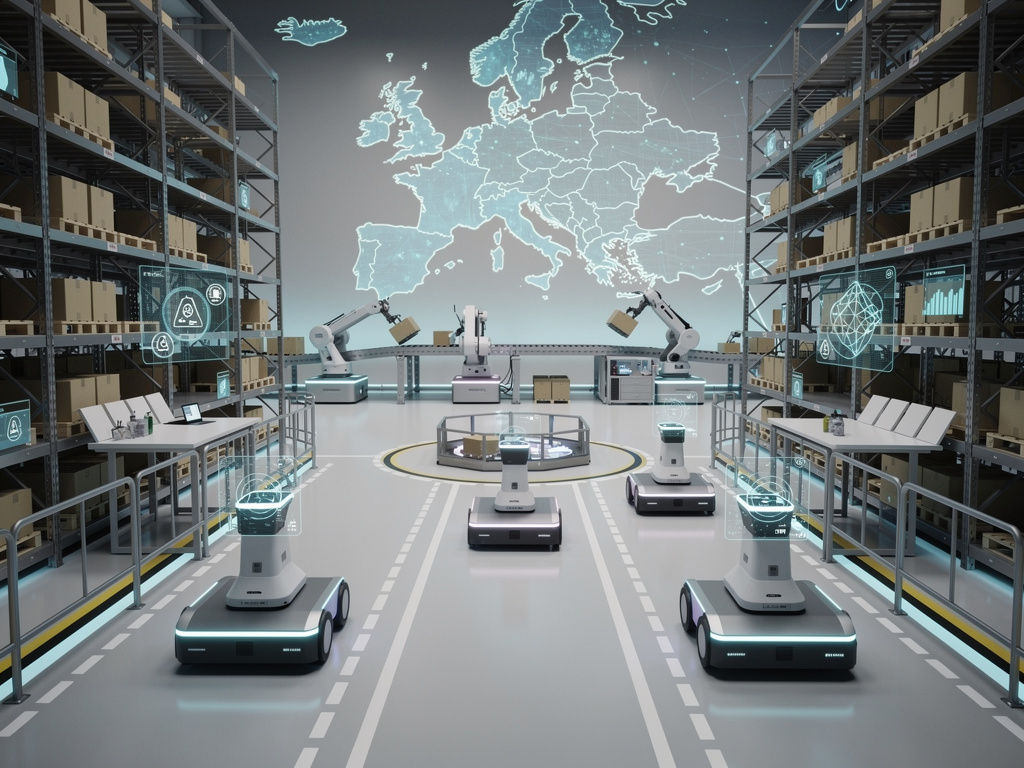
Amazon has rolled out an upgraded version of its Proteus robot. This latest model accepts plain-language instructions from workers. The change marks another step in the company’s long push to blend robots and humans on the same warehouse floor.
The announcement came Thursday at an event in Dartford, east of London. There, executives showed how employees could now speak directly to the machine. Scott Dresser, vice president at Amazon Robotics, put it simply. “You tell it what needs to be done. It figures out the priority, the route, the timing.” Reuters reported the details.
Proteus still looks like an oversized Roomba. Its job remains hauling heavy carts loaded with packages. Yet the new intelligence lets it roam far beyond the loading docks where earlier versions stayed confined. It can now handle containers arriving at the facility, shift them between stations, and support staff across the building. The upgrade relies on advances in AI that let the robot interpret conversational prompts instead of rigid software commands.
This evolution builds on years of quiet progress. When Amazon first introduced Proteus in 2022, the company called it its first fully autonomous mobile robot. Engadget covered the debut. Back then the focus was safety and navigation around people without fences or guides. The robot used computer vision, LiDAR and proprietary perception systems to move carts weighing up to nearly 400 kilograms while avoiding collisions.
But that original version operated only in specific outbound areas. Workers still needed specialized interfaces to assign tasks. The 2026 model removes those barriers. Employees talk to it much as they would to one another. The system decides on its own how to sequence work, plot paths and time movements. And the implications stretch beyond convenience.
Amazon has deployed the current Proteus at 25 sites in the United States. The newer version will reach Europe in the first half of 2027. That timeline sits inside a broader €10 billion, or about $11.6 billion, commitment to the company’s European fulfillment network. The investment will add 25,000 jobs across the region even as robotics expand. Amazon insists the machines free people for higher-skilled roles such as managing inventory flow and quality checks. It points to a track record of hiring hundreds of thousands globally since robotics entered its operations.
Tye Brady, chief technologist at Amazon Robotics, described the larger trend in a 2025 interview. Robotics touch billions of packages each year. They form a “great flywheel” that lifts productivity while easing physical strain on workers. “This has completely changed how we do business,” he said. “And it’s just the beginning.” The Financial Times captured his remarks.
Those words carry weight. Amazon now operates more than one million robots worldwide. The fleet roughly matches its human workforce inside fulfillment centers. Proteus joins a growing lineup that includes Sparrow, Cardinal, Vulcan and others. Vulcan, introduced in 2025, brings a sense of touch to picking and stowing. It handles about 75 percent of item types at human-comparable speeds. Amazon’s own coverage highlighted how such systems reduce repetitive motions and lower injury rates at equipped sites by 15 to 18 percent.
Digital simulation accelerates the pace. Partnerships with Nvidia create digital twins of warehouses. These virtual replicas let engineers train robots at rates once unimaginable. The approach has already allowed Amazon to shrink the physical footprint of some facilities. Real-time computer vision gives Proteus the ability to read its surroundings and adapt on the fly. Safety bubbles generated by embedded processors from suppliers like Texas Instruments create protective zones that reroute the machine when people approach.
Yet questions linger. Amazon accounted for 39 percent of U.S. warehouse workers in 2024 but 56 percent of serious injuries, according to labor data cited by Engadget. The company has also conducted layoffs totaling nearly 30,000 positions in recent periods across various units. Critics wonder whether efficiency gains will eventually shrink headcount rather than augment it. Amazon maintains that robots take over the most monotonous and physically demanding chores. Employees move into roles that demand judgment and oversight.
The European rollout adds another layer. Alongside the upgraded Proteus, Amazon will expand STARK, a system for handling smaller totes with precision. Pilots are underway in Barcelona. The company aims to have STARK at 15 European sites by 2027. Grocery operations will grow too, with more than 25 facilities offering sub-same-day delivery in the UK, Germany and beyond. Faster automation supports that ambition. Orders move 75 percent quicker in some facilities once Proteus and its siblings take over cart transport and sorting.
From the outside the warehouse floor now looks like a hybrid environment. Bright green Proteus units glide past human pickers. Electronic eyes on the robots give them an almost approachable air. They flash signals meant to reassure nearby staff. Inside the code, reinforcement learning and massive simulation data refine every decision. The result is a machine that does not simply follow fixed paths but responds, reroutes and reprioritizes in real time.
Amazon’s bet is clear. Greater autonomy inside the warehouse drives lower costs, faster delivery and safer conditions. Whether that equation holds for every worker remains under debate. What cannot be disputed is the scale. One million robots and counting. A fleet that began with acquired Kiva drive units in 2012 has become something far more capable. Proteus, once limited to fenced zones, now listens when spoken to.
And the conversation is only starting. Later models may integrate even tighter with voice systems, predictive analytics and the rest of the robotic cohort. For warehouse operators watching Amazon, the message is direct. Adaptation is no longer optional. The technology has moved from assistive to collaborative. The floor belongs to both man and machine now. How those roles settle will shape logistics for the next decade.


 WebProNews is an iEntry Publication