
Amazon is no longer content to buy chips off the shelf for its most important consumer hardware. The company has designed its own silicon from the ground up. Those chips now sit at the heart of new Echo speakers and displays. They promise faster responses, better privacy and a step toward devices that follow users beyond the living room.
The move marks a serious escalation in Amazon’s long-running effort to control every layer of its voice assistant experience. Panos Panay, Amazon’s head of devices and services, made the strategy clear in a recent interview. He pointed to a full roadmap of what he called on-the-go devices. Users, he said, won’t have to wait long. The comments came as the company pushes Alexa Plus, its paid conversational AI upgrade, into more hardware.
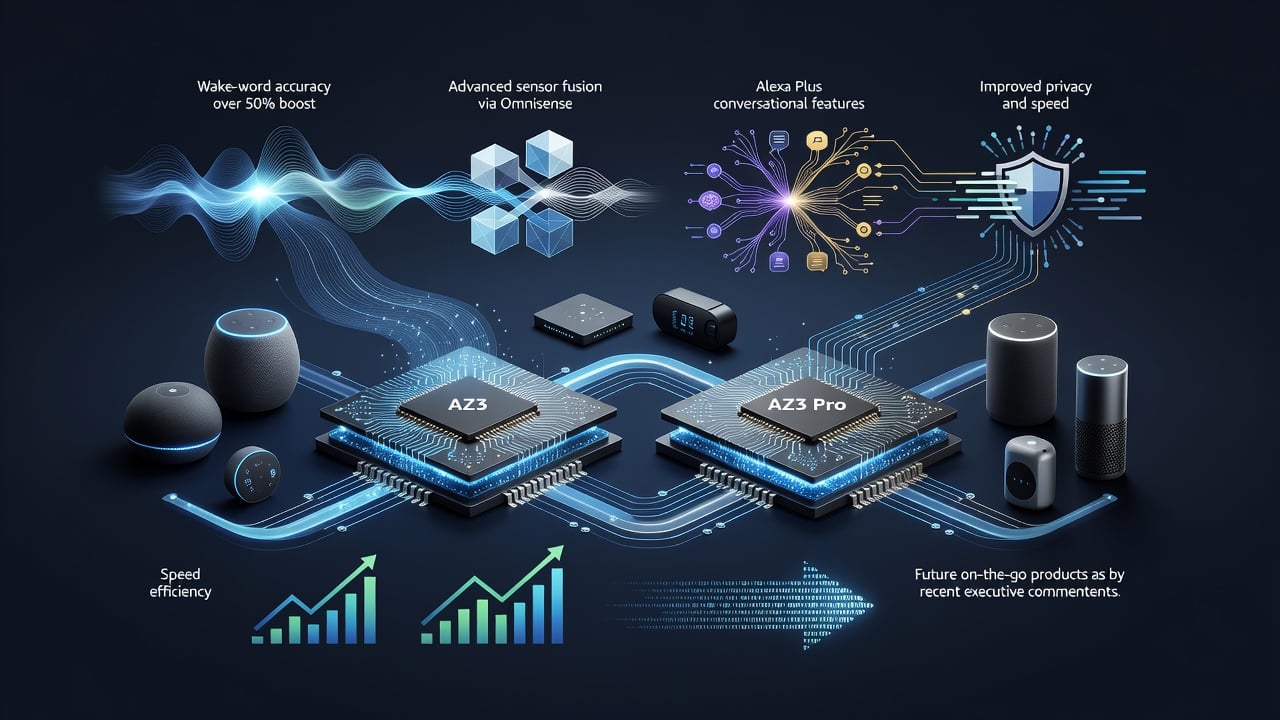
At the center of the latest products sit two custom chips. AZ3 handles the Echo Dot Max. Its more powerful sibling, AZ3 Pro, runs the Echo Studio, Echo Show 8 and Echo Show 11. Both include a dedicated AI accelerator built to run edge models locally. The design choice reduces trips to the cloud. It speeds up answers. It keeps more data on the device itself.
AboutAmazon laid out the technical claims in detail when the devices launched last fall. AZ3 powers the best microphone array yet in an Echo Dot. It filters background noise. It improves wake-word detection by over 50 percent. That single number stands out. Conversation detection becomes reliable enough that users can speak from anywhere in the room. Ambient AI stops feeling like a gimmick.
The AZ3 Pro goes further. It adds support for state-of-the-art language models and vision transformers. Those capabilities matter for the Show displays. A 13-megapixel camera joins audio, ultrasound, Wi-Fi radar, an accelerometer and channel state information. Amazon calls the whole package Omnisense. The fusion platform lets Alexa notice when someone enters a room, suggest a morning routine or warn about an open garage door after 10 p.m. The system acts without constant cloud queries.
But the chips represent only part of a larger story. In early July, Panay told CNBC that Amazon now creates end-to-end silicon for key devices including the Echo Show 8, Echo Show 11 and Fire TV. “If we’re going to go deliver this ambient experience in the home for people in the most secure way, we definitely need to think about how that end-to-end delivery of hardware comes together,” he said. The company still buys Qualcomm parts for other functions. Full vertical integration remains a work in progress.
Security forms a core argument. Local processing limits the amount of voice data sent over the internet. That appeals to customers wary of constant listening. Yet privacy questions persist. Many new AI features process commands by default. Turning off analysis entirely isn’t always an option. The tension between capability and user control has followed Amazon’s hardware efforts for years.
Alexa Plus itself arrived with considerable fanfare. The service offers deeper conversations. It handles more complex tasks. Prime members get basic access. Others pay $20 a month for full features. The new chips make those promises feel more attainable in real rooms. Responses arrive quicker. Context lingers longer. The assistant begins to anticipate needs instead of simply reacting.
And the vision extends past the home. Panay revealed a lab full of experimental hardware. The team has acquired talent and companies to push into wearables and portable gadgets. The 2025 purchase of Bee, a startup focused on wearable AI, fits the pattern. Executives talk about devices people carry that maintain context across locations. A consistent Alexa experience from kitchen to commute suddenly looks realistic.
Recent supply chain reports add another dimension. Analyst Ming-Chi Kuo noted on X that Amazon plans a major shift in its consumer electronics processors starting in 2027. The company will move away from buying finished chips. Instead it will use a customer-owned tooling approach similar to its Trainium AI chips. Taiwanese firm Alchip will handle back-end design and testing. Annual shipments could reach 40 million units. Cost savings on non-AI products would help offset heavy spending on data centers.
That timeline matters. The AZ3 family represents an early step. Future chips could appear in Kindles, more Fire TV models, Ring cameras and Blink devices. Greater control over silicon gives Amazon leverage on pricing at a time when component costs keep climbing. It also reduces dependence on suppliers whose priorities may not match Amazon’s AI timetable.
Competitors face similar pressures. Apple and Google have designed their own AI hardware for years. The difference lies in ambition. Amazon wants Alexa everywhere. It wants the assistant to feel proactive rather than passive. Custom silicon provides the foundation. Without it, latency and privacy concerns would limit how far the company could push.
Sound quality improvements in the new Echo lineup show the chips aren’t just about AI. The Echo Dot Max packs two speakers for the first time. Bass output nearly triples compared with the previous generation. The redesigned Echo Studio shrinks 40 percent yet delivers spatial audio and Dolby Atmos. These aren’t afterthoughts. They demonstrate how the silicon integrates audio processing, neural acceleration and sensor fusion into one package.
Industry watchers see broader implications. Seeking Alpha highlighted the focus on on-device AI for better performance and security. The reports align with what Panay described to CNBC. The hardware chief avoided bold predictions about exact product launches. He emphasized steady progress and a clear direction.
So what comes next? Portable Alexa devices could arrive within a year or two. Wearables that track health data and feed it into routines. In-car systems that continue conversations started at home. The on-the-go roadmap remains deliberately vague. Yet the existence of dedicated testing labs and recent acquisitions suggests prototypes already exist.
Challenges remain. Training advanced models that run efficiently on low-power edge devices demands significant expertise. Balancing cost, battery life and capability will test the silicon team. Regulatory scrutiny over always-listening devices could intensify. Amazon must prove that local processing genuinely protects privacy rather than simply shifting the trust boundary.
Still, the direction looks set. Amazon has invested billions in AI infrastructure. It now turns that expertise inward to its own products. The AZ3 and AZ3 Pro chips are tangible proof. They power devices already on sale. They inform designs still on drawing boards. For an ecosystem long criticized for relying on cloud latency, this represents real progress.
Customers will judge the results in daily use. Faster answers help. Smarter anticipation matters more. If Alexa Plus can manage calendars, order groceries, adjust lights and remember context across rooms and devices, the subscription may feel worth the price. The silicon makes that vision technically feasible. Execution over the next 12 to 24 months will decide whether it succeeds in the market.
One thing seems clear. Amazon no longer views hardware as a side business or simple distribution channel for services. The devices have become the proving ground for its AI strategy. Custom chips sit at the foundation of that effort. Everything else builds from there.


 WebProNews is an iEntry Publication