
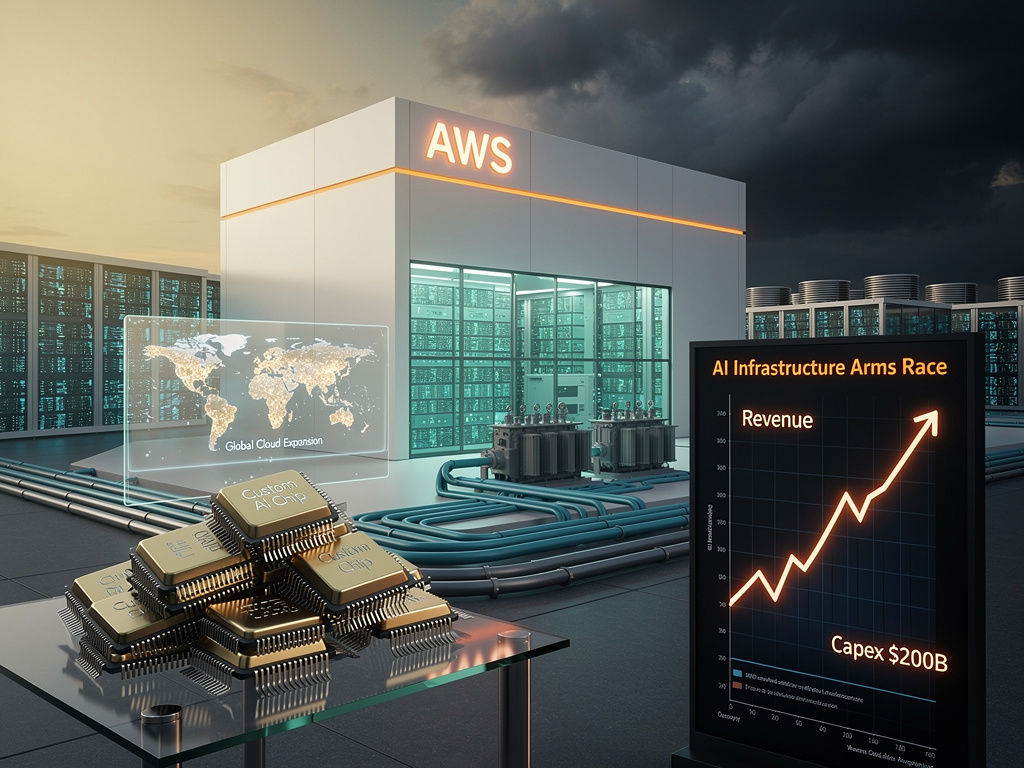
Amazon Web Services has embarked on an unprecedented capital expenditure trajectory that is simultaneously propelling its growth to three-year highs while unnerving Wall Street analysts concerned about the company’s mounting infrastructure investments. The cloud computing giant’s custom chip business has surpassed $10 billion in annual revenue, marking a pivotal moment in the technology sector’s race to control the fundamental building blocks of artificial intelligence computing power.
According to GeekWire, AWS revenue growth accelerated to its fastest pace in three years during the most recent quarter, driven by surging demand for AI infrastructure and cloud services. This expansion comes as Amazon commits to spending approximately $200 billion on capital expenditures through 2025, a figure that has sparked intense debate among investors about the sustainability and ultimate profitability of such aggressive infrastructure buildout.
The company’s strategic pivot toward custom silicon represents more than just vertical integration—it signals a fundamental reshaping of competitive dynamics in cloud computing. AWS’s proprietary Graviton processors and Trainium AI chips have evolved from experimental alternatives to mainstream options that now power critical workloads for major enterprises. The crossing of the $10 billion revenue threshold for custom chips validates Amazon’s multi-year investment in semiconductor design and positions the company as a formidable competitor to traditional chip manufacturers like Intel and AMD.
The Custom Silicon Revolution Transforms Cloud Economics
Amazon’s custom chip strategy addresses two critical imperatives: reducing dependency on external suppliers and offering customers more cost-effective computing options. The Graviton processors, built on ARM architecture, deliver superior price-performance ratios compared to traditional x86 chips, while Trainium chips target the exploding market for AI model training. This dual approach allows AWS to capture value across both general-purpose computing and specialized AI workloads.
The financial implications extend beyond immediate revenue figures. By designing its own chips, AWS gains greater control over its cost structure and can offer more competitive pricing to customers while maintaining or expanding margins. This vertical integration strategy mirrors successful plays by Apple and Tesla, companies that leveraged custom silicon to differentiate their products and improve unit economics. For AWS, custom chips represent both a defensive moat against competitors and an offensive weapon in the battle for AI infrastructure dominance.
Industry analysts note that the $10 billion milestone also reflects broader market acceptance of ARM-based server processors. Major AWS customers, including Netflix, Snap, and Epic Games, have migrated substantial portions of their infrastructure to Graviton instances, demonstrating that custom chips have moved beyond early-adopter status to become enterprise-grade solutions. This adoption curve suggests the custom chip business could expand significantly as more workloads transition to ARM architecture and as AI training demands intensify.
Capital Expenditure Scale Triggers Investor Anxiety
The $200 billion capital expenditure plan represents one of the largest infrastructure investments in corporate history, dwarfing even the massive buildouts undertaken by telecommunications companies during previous technology cycles. This spending encompasses data center construction, networking equipment, servers, and the custom chips that power AWS infrastructure. The sheer magnitude has prompted questions about capital efficiency and whether Amazon is overbuilding capacity in anticipation of AI demand that may not materialize at projected rates.
Wall Street’s concerns center on several key issues: the timing of returns on these investments, the risk of technological obsolescence, and the potential for overcapacity if AI adoption slows. Unlike previous infrastructure cycles where demand patterns were relatively predictable, the AI revolution introduces unprecedented uncertainty. Companies are racing to secure computing capacity, but the ultimate shape of AI workloads, their computational requirements, and their economic viability remain partially unknown.
Amazon’s management has defended the capital intensity by pointing to robust customer demand and the strategic necessity of maintaining infrastructure leadership. The company argues that failing to invest aggressively would cede competitive advantage to rivals like Microsoft Azure and Google Cloud Platform, both of which are pursuing similarly ambitious expansion plans. This creates a prisoner’s dilemma where no major cloud provider can afford to underspend relative to competitors, even if the collective investment exceeds near-term demand.
The AI Infrastructure Arms Race Intensifies
The acceleration in AWS growth to three-year highs validates the company’s thesis that AI represents a generational computing platform shift comparable to the original migration from on-premises infrastructure to cloud services. Enterprise customers are not simply experimenting with AI—they are committing to large-scale deployments that require substantial computing resources. This demand manifests across multiple dimensions: training large language models, running inference workloads, processing vector databases, and supporting traditional cloud applications that increasingly incorporate AI features.
The competitive dynamics have evolved significantly as AI has moved from research labs to production environments. Microsoft’s partnership with OpenAI gave Azure an early advantage in AI infrastructure, forcing AWS to accelerate its own AI service offerings and infrastructure capabilities. Google Cloud leverages its deep AI research heritage and custom TPU chips, while newer entrants like CoreWeave focus exclusively on AI-optimized infrastructure. This intensifying competition drives the capital expenditure arms race, as each provider seeks to offer the most capable and cost-effective AI computing platform.
AWS’s approach differs from competitors in its emphasis on customer choice and flexibility. Rather than betting exclusively on proprietary AI models or forcing customers onto specific chip architectures, AWS offers a portfolio spanning Nvidia GPUs, custom Trainium chips, and Graviton processors. This strategy appeals to enterprises seeking to avoid vendor lock-in while still accessing cutting-edge infrastructure. However, it also requires maintaining broader and potentially more expensive infrastructure than competitors who make more opinionated technology choices.
Custom Chips Reshape Competitive Moats
The success of AWS’s custom chip business fundamentally alters the competitive moats in cloud computing. Historically, cloud providers differentiated primarily through service breadth, global infrastructure footprint, and pricing. Custom silicon adds a new dimension where providers can offer unique price-performance characteristics that cannot be easily replicated. This technical differentiation creates switching costs and strengthens customer retention as workloads become optimized for specific chip architectures.
The $10 billion revenue milestone also represents a significant threat to traditional semiconductor companies. AWS has effectively become a major chip company, albeit one that consumes its own production rather than selling chips in the open market. This vertical integration allows AWS to capture margins that would otherwise flow to Intel, AMD, or Nvidia. As other cloud providers pursue similar strategies—Microsoft with its Azure Maia chips and Google with TPUs—the traditional semiconductor industry faces structural challenges to its cloud data center business.
The custom chip strategy also enables AWS to optimize for specific workload characteristics in ways that general-purpose chip makers cannot. Trainium chips, for example, are designed specifically for the distributed training of large AI models, with architecture choices that prioritize the communication patterns and numerical precision requirements of machine learning. This specialization delivers better performance per dollar for AI workloads, creating technical advantages that are difficult for competitors using off-the-shelf components to match.
Financial Markets Grapple With Valuation Implications
The tension between accelerating revenue growth and escalating capital expenditures creates complex valuation challenges for investors. Traditional cloud computing metrics like revenue growth rates and operating margins must be balanced against the unprecedented capital intensity of the current expansion cycle. Some analysts view the $200 billion investment as prudent positioning for a multi-decade AI revolution, while others see potential for disappointing returns if AI monetization proves more challenging than anticipated.
The market’s reaction reflects this uncertainty, with Amazon’s stock experiencing volatility as investors reassess the risk-reward profile of aggressive infrastructure spending. The company’s ability to maintain revenue growth acceleration while managing capital deployment will be crucial to investor confidence. Key metrics include the pace at which new capacity is absorbed by customer workloads, the utilization rates of existing infrastructure, and the margin profile of AI-related services compared to traditional cloud offerings.
Historical precedents offer limited guidance. The original cloud computing buildout generated substantial returns as enterprises migrated from on-premises infrastructure, but that transition followed relatively predictable patterns. The AI revolution introduces greater uncertainty about workload characteristics, customer willingness to pay, and the ultimate distribution of value between infrastructure providers and AI application companies. These unknowns make it difficult to model returns on the current capital expenditure cycle with confidence.
Strategic Implications Beyond the Cloud Sector
Amazon’s infrastructure investments extend beyond competitive positioning in cloud computing to influence broader technology industry dynamics. The company’s willingness to commit $200 billion signals conviction that AI will drive substantial computing demand for years to come, potentially influencing other companies’ strategic planning. This capital deployment also affects upstream suppliers, from semiconductor equipment manufacturers to construction companies, creating ripple effects throughout the technology supply chain.
The custom chip business has implications for semiconductor industry structure. As cloud providers internalize chip design and consume growing portions of advanced semiconductor production capacity, traditional merchant chip makers face pressure to find new growth avenues. This trend could accelerate consolidation in the semiconductor industry and shift power dynamics between chip designers and foundries like TSMC that manufacture the chips.
For enterprise customers, AWS’s infrastructure expansion and custom chip offerings present both opportunities and strategic considerations. The availability of high-performance, cost-effective computing infrastructure lowers barriers to AI adoption and experimentation. However, customers must also navigate choices between different chip architectures and consider the long-term implications of optimizing workloads for proprietary platforms. These decisions will shape enterprise technology strategies for years to come as AI becomes increasingly central to business operations.
The intersection of accelerating growth, massive capital investment, and custom chip success positions AWS at the center of the AI infrastructure revolution. Whether the $200 billion bet delivers commensurate returns remains uncertain, but the scale of commitment ensures that Amazon will play a defining role in shaping how artificial intelligence computing infrastructure evolves. As the AI arms race intensifies, AWS’s ability to balance growth, profitability, and technological leadership will serve as a crucial test case for capital allocation in the age of artificial intelligence.


 WebProNews is an iEntry Publication