
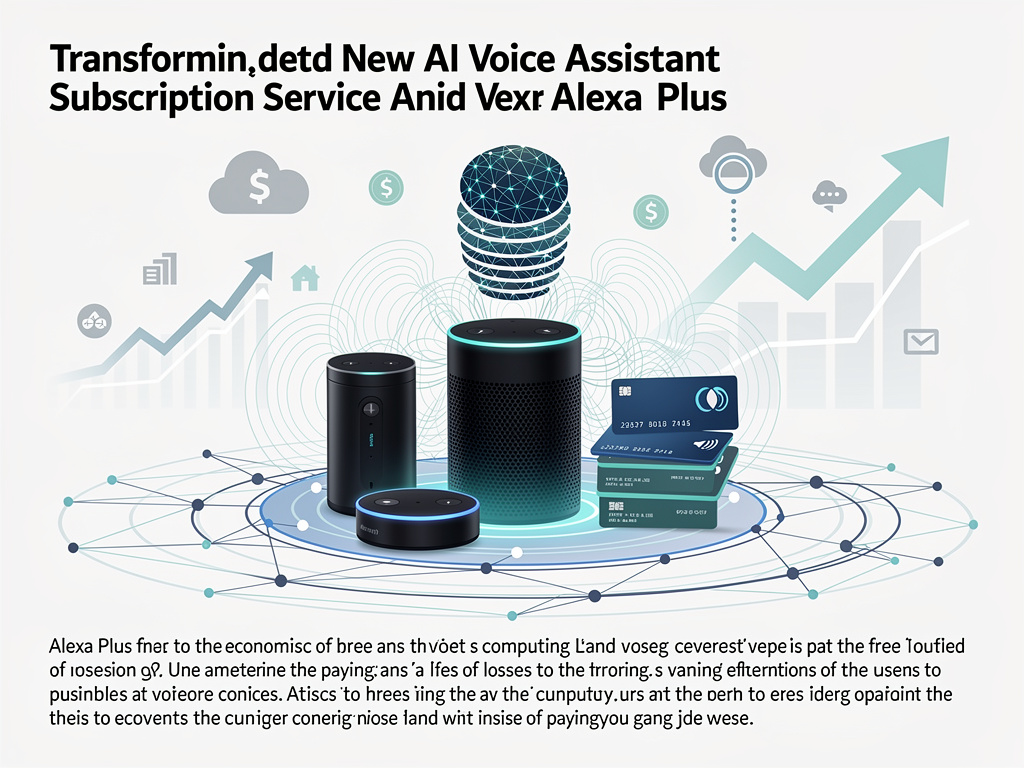
Amazon is preparing to launch its most ambitious transformation of Alexa since the voice assistant’s debut nearly a decade ago, rolling out an AI-powered subscription service that could fundamentally alter the economics of voice computing. The move represents a high-stakes wager that consumers will pay monthly fees for conversational AI capabilities, even as the company’s devices division has reportedly lost tens of billions of dollars since 2017.
According to TechRepublic, Amazon has begun notifying U.S. users about the impending launch of Alexa Plus, a premium tier powered by advanced generative AI models. The service promises more natural conversations, enhanced contextual understanding, and the ability to handle complex, multi-step requests that have long frustrated users of traditional voice assistants. While Amazon has not disclosed exact pricing, industry analysts expect the subscription to cost between $5 and $10 monthly, positioning it competitively against other AI services while generating recurring revenue from Alexa’s estimated 100 million-plus user base.
The timing of this launch reflects both opportunity and urgency. Amazon finds itself at a crossroads where the explosive growth of ChatGPT and other large language models has simultaneously validated the potential of conversational AI while exposing the limitations of Alexa’s original architecture. The company’s devices and services division, which houses Alexa, has faced mounting pressure to demonstrate a path to profitability after years of losses that some estimates place above $25 billion since 2017, according to reporting by Business Insider.
The Technical Transformation Behind Alexa’s Evolution
Amazon’s engineering teams have spent the past two years rebuilding Alexa’s core infrastructure to incorporate large language models similar to those powering ChatGPT and Google’s Bard. This represents a fundamental departure from Alexa’s original design, which relied on predetermined command structures and limited natural language processing. The new system, internally codenamed “Remarkable Alexa,” can engage in extended conversations, remember context across multiple exchanges, and generate responses that feel more human and less scripted.
The technical challenges have been substantial. Unlike text-based AI chatbots, voice assistants must process speech in real-time, interpret various accents and speaking styles, and respond with natural-sounding synthesized speech—all while managing the computational costs of running large AI models. Amazon has leveraged its AWS infrastructure and proprietary AI chips to address these challenges, but the operational expenses remain significantly higher than the original Alexa service. This cost structure makes the subscription model not just desirable but potentially necessary for sustainable operations.
Market Dynamics and Competitive Pressures
The voice assistant market has evolved dramatically since Amazon introduced the Echo speaker in 2014. What began as a race to place smart speakers in homes has transformed into a broader competition for AI dominance. Google Assistant and Apple’s Siri have remained formidable competitors, while newer entrants like OpenAI have demonstrated that consumers will pay for advanced AI capabilities. ChatGPT’s paid tier, ChatGPT Plus, has attracted millions of subscribers at $20 monthly, suggesting significant demand for premium AI experiences.
However, Amazon faces unique challenges in converting free Alexa users to paying subscribers. The company has spent nearly a decade training consumers to expect voice assistance at no additional cost beyond hardware purchases. Market research from Voicebot.ai indicates that while users express frustration with Alexa’s limitations, converting satisfaction into willingness to pay remains uncertain. The success of Alexa Plus may ultimately depend on whether the improvements feel transformative enough to justify ongoing expenses.
The Business Model Recalibration
Amazon’s original Alexa strategy centered on making voice the primary interface for shopping and services within its ecosystem. The company subsidized Echo devices and offered Alexa for free, expecting to recoup investments through increased commerce and service subscriptions. This approach delivered mixed results—while Alexa became ubiquitous in American homes, users primarily employed the assistant for basic tasks like timers, weather checks, and music playback rather than shopping.
The subscription model represents a strategic pivot toward direct monetization. Industry analysts suggest that even modest conversion rates could generate substantial revenue. If 10% of Alexa’s U.S. user base subscribes at $7 monthly, Amazon would generate approximately $840 million annually—a meaningful contribution toward offsetting the division’s losses. More importantly, subscription revenue provides predictable cash flows and changes the economic equation around continued AI development investments.
Privacy Considerations and Data Advantages
The enhanced AI capabilities raise important questions about data privacy and usage. Advanced conversational AI requires processing and potentially storing more detailed interaction data to maintain context and personalize responses. Amazon has stated that Alexa Plus will include enhanced privacy controls, allowing users to review and delete conversation histories more granularly. However, the company’s ability to leverage vast amounts of voice interaction data for model training provides a significant competitive advantage in developing more capable AI systems.
This data advantage extends beyond simple conversation logs. Amazon’s integration of Alexa across its ecosystem—from Fire TV devices to Ring doorbells—creates unique opportunities for contextual AI that understands users’ broader behaviors and preferences. The company’s challenge lies in exploiting these advantages while maintaining user trust, particularly as regulatory scrutiny of AI systems intensifies across global markets.
Developer Ecosystem and Third-Party Integration
Amazon has cultivated an extensive developer community around Alexa Skills, the third-party applications that extend the assistant’s capabilities. The transition to AI-powered Alexa Plus raises questions about how these skills will function within the new architecture. Traditional skills relied on specific invocation phrases and structured interactions, while the new conversational AI may handle many requests natively without requiring separate skills. Amazon has indicated that developers will gain access to new tools for creating AI-enhanced experiences, but the economic model for skill developers remains unclear.
The broader smart home integration ecosystem also faces potential disruption. Alexa’s role as a central hub for controlling connected devices has been a key value proposition, with support for thousands of products from hundreds of manufacturers. The AI-enhanced version promises more intuitive device control through natural language, potentially eliminating the need to remember specific command phrases. However, ensuring reliable performance across this fragmented ecosystem while processing requests through large language models presents significant technical complexity.
The Road Ahead for Voice Computing
Amazon’s Alexa Plus launch occurs amid broader industry uncertainty about the future of voice interfaces. While voice search and commands have become commonplace, they haven’t achieved the transformative impact many predicted. Smartphone-based assistants remain secondary interfaces, and smart speaker usage has plateaued in many markets. The question facing Amazon is whether more sophisticated AI can reignite growth or whether voice computing will remain a supplementary interaction method rather than a primary one.
The success or failure of Alexa Plus will likely influence strategic decisions across the technology industry. If Amazon demonstrates that consumers will pay for premium voice AI, competitors will almost certainly introduce similar offerings. Conversely, if uptake disappoints, it may validate alternative approaches such as embedding advanced AI capabilities into existing subscription services rather than creating standalone voice products. For Amazon, the stakes extend beyond Alexa itself—the initiative represents a test case for how the company can leverage its massive user bases to generate new revenue streams in the AI era.
As Amazon prepares for this pivotal launch, the company faces the challenge of managing expectations while delivering genuine innovation. Early users will compare Alexa Plus not just to the original Alexa but to the rapidly improving capabilities of ChatGPT and other AI systems. The technical bar for success is high, the competitive environment is intense, and the business model remains unproven. Yet Amazon’s scale, infrastructure advantages, and ecosystem integration provide unique assets that competitors cannot easily replicate. The coming months will reveal whether these advantages are sufficient to make voice computing profitable and position Amazon as a leader in the next generation of AI-powered consumer services.


 WebProNews is an iEntry Publication